
Your AI Memory Shouldn’t Belong to Just One Platform
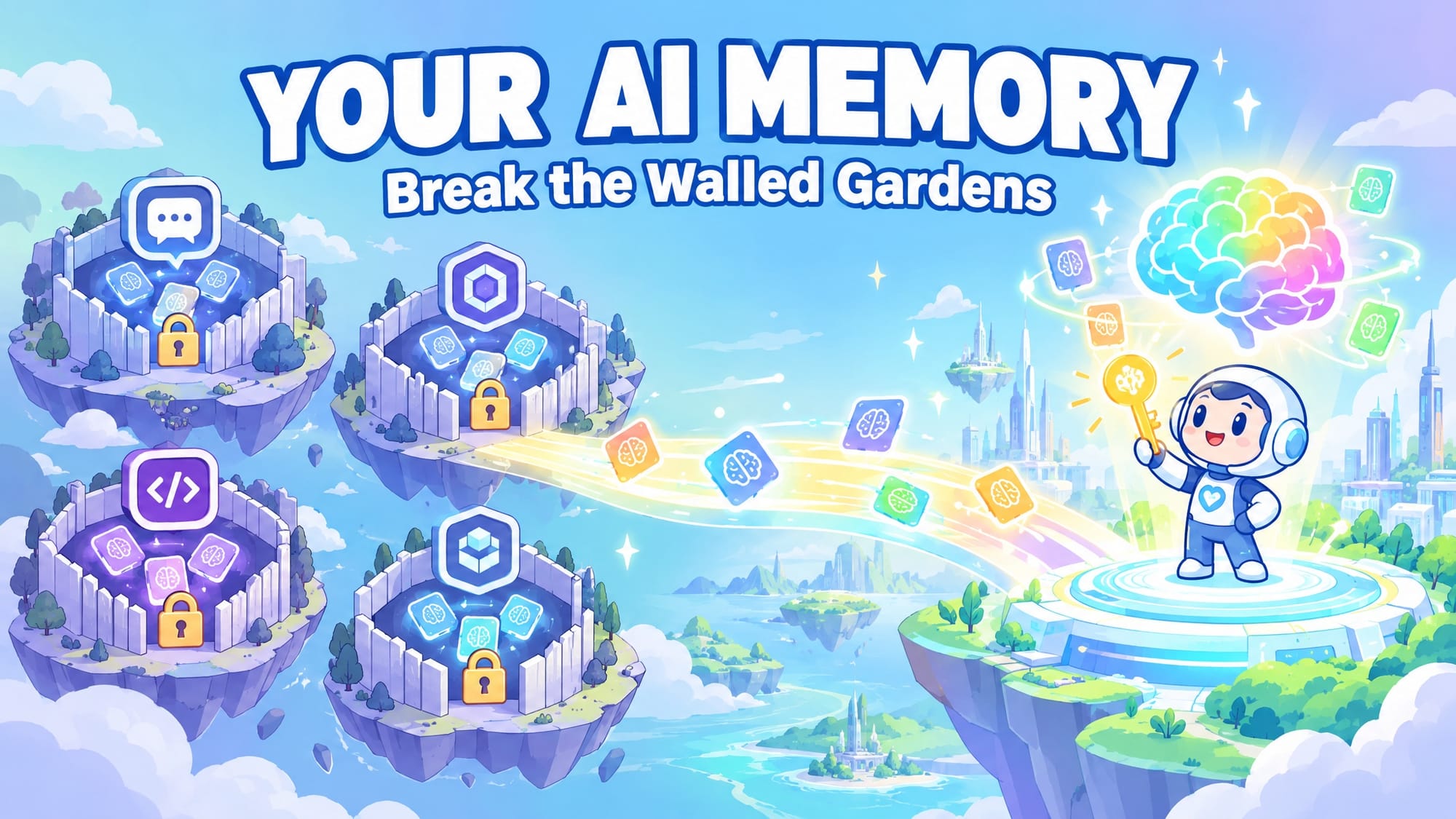
Every AI company is making the memory inside its own platform better and better — but the walls they’re tearing down are all inside their own yard. And nobody’s work runs on a single Agent. Memory should travel with the person, and control should stay in the user’s hands.
An Update Everyone Was Waiting For
On August 25, Anthropic shipped an update: Claude’s memory now works across Chat and Cowork.
The project background, writing preferences, and “where I left off last week” that you told Claude in a chat are already known when you switch to Cowork and put an Agent to work. No need to say it twice.
The feature covers the Free, Pro, and Max plans and is on by default. Users can view, edit, and delete what Claude remembers. Anthropic’s framing is refreshingly plain: what Claude learns in one place, it keeps remembering in another.
Anyone who uses AI heavily knows how much this matters. Re-briefing an AI on your context, over and over, is practically a daily ritual for power users.
Two Months Earlier, ChatGPT Was Doing the Same Thing
On June 4, OpenAI launched a new-generation memory system for ChatGPT called Dreaming. It no longer needs users to say “remember this.” After a conversation ends, it automatically reviews, organizes, and updates its understanding of you.
According to internal OpenAI evaluations cited by the media, the new system reaches 82.8% factual recall, with memory capacity roughly double that of the old one.
Two leading vendors put their effort into the same place in the same summer. That says one thing: beyond model capability, memory is becoming the new battleground for AI products.
But look closely, and you’ll notice that the wall Anthropic tore down is the one inside its own yard. No matter how accurately ChatGPT remembers, it only remembers inside ChatGPT.
The Reality: Nobody Uses Just One Agent
Open the computer of an ordinary knowledge worker, and you’ll probably find a division of labor like this:
- One vendor for drafting proposals and editing articles;
- Another for research and investigation;
- Yet another for writing code and running scripts;
- And for vertical work — say, cross-border e-commerce product selection — a dedicated industry Agent.
This isn’t users fiddling for fun. It’s a rational choice. No model is the strongest at every task, and each vendor’s strengths keep shifting: the best coding tool this month may be a different one next month.
Using multiple Agents is already the norm — and the more Agents there are, the more obvious this problem becomes.
The Smoother It Gets Inside a Platform, the More Expensive It Gets Across Platforms
Here’s the problem: every vendor’s memory only works inside its own house.
The first cost: time. Every time you switch Agents, you have to re-explain: who you are, what project you’re working on, what your preferences and dealbreakers are, how far you got last time. A new Agent needs several rounds of “onboarding training” before it can get into working condition.
The second cost: tokens. All that background has to be stuffed back into context every time. A decent briefing easily runs to several thousand tokens, and feeding it repeatedly across different Agents means paying for it again each time.
The third cost: consistency. On the same matter, one Agent remembers last week’s version while another remembers last month’s. The more scattered the memory, the more the versions contradict each other.
So can’t you just move your memory over? You can — but only once.
Right now, Claude supports importing memory from other AI services, and Gemini launched a feature in March this year for importing memory and chat history from ChatGPT and Claude. But according to Claude’s Help Center, whether importing or exporting, it’s a one-time manual copy-and-paste operation — there’s no continuous sync.
That means the moment the move is complete is the moment the two sides’ memories begin to diverge. What you accumulate on the new platform, the old one doesn’t know; the new preferences you keep developing on the old platform, the new one doesn’t know either.
A one-time import solves “moving house,” not “sharing.”
Platforms Won’t Fix This Bridge on Their Own
Why are vendors so eager about “import,” yet not one has built “continuous sync”?
Because this isn’t a capability problem. It’s a matter of incentives.
Import brings another company’s users over to you; continuous sync lets your own users leave at any moment, memory in hand. The former is customer acquisition; the latter is letting people go.
The same memory is a retention asset to the platform, and to the user it’s their own work experience and personal habits. Same thing, two parties with exactly opposite positions.
What deserves even more vigilance is time. Once memory is on by default, every day and every conversation adds weight to one platform’s memory. The longer you use it, the more complete that memory becomes, and the higher the cost of switching.
Switching costs don’t grow linearly — they compound, like interest. By the time the wall is high enough, it’s too late to talk about sharing.
What a Good Agent Memory Layer Should Satisfy
If memory shouldn’t be monopolized by any single platform, where should it live, and who should manage it? We believe a memory layer built for the multi-Agent era has to meet at least four conditions:
1. Neutral. It belongs to no single model vendor, doesn’t lean toward anyone because of one company’s commercial interests, and doesn’t stop working just because the user switched models.
2. The user holds the keys. Control of memory sits in the user’s hands. Any Agent can read or write only after the user grants authorization — not the platform owning it by default while the user has to apply to view it.
3. Traceable and revocable. Which Agent read or wrote which piece of memory, and when, is on record; and the user can revoke authorization at any time.
4. Portable. Switch to a different Agent, and the memory goes with you — rather than starting from zero every time.
None of these four sounds complicated, but they share one precondition: the memory layer has to stand outside all the platforms.
Phone Numbers Became Portable. Memory Should Too.
This isn’t the first time we’ve been here.
Phone numbers used to be locked in by carriers too: switching carriers meant changing your number, and every contact had to be notified. In the United States, the Federal Communications Commission (FCC) began pushing for wireless number portability as early as 1997. It was originally meant to take effect in 1999, but carriers kept delaying it, and it wasn’t formally implemented until November 24, 2003. Consumer advocates at the time were blunt: carriers were using phone numbers as a bargaining chip to keep users from leaving.
Numbers ultimately became portable not because carriers opened up voluntarily, but because user demand and regulation pushed together.
The data world has walked a similar road. Article 20 of the EU’s General Data Protection Regulation (GDPR), in effect since 2018, states that users have the right to receive the personal data they provided in a “structured, commonly used and machine-readable” format and to transmit it to another party, without hindrance from the original platform. Yet when it comes to AI memory today, all we can do is copy and paste by hand.
AI memory will most likely follow the same path. Today we’re still reintroducing ourselves to every new Agent, but the direction is already clear:
Models can change. Agents can change. Memory should always be yours.
MEMO is building an Agent memory layer, so that memory truly returns to the user’s hands.
FAQ
Q: Can Claude’s new memory link-up be used in ChatGPT or other Agents? No. This update connects memory between two of Claude’s own products — Chat and Cowork — and doesn’t involve any other vendor’s products.
Q: How do people move memory from one AI to another today? The mainstream method today is manual export followed by import, which is a one-time migration. Once the move is complete, the two sides’ memories don’t sync automatically.
Q: Why does cross-platform memory sharing need a neutral memory layer? Because for any single platform, letting users take their memory and leave at any time isn’t in its commercial interest. Cross-platform sharing is better carried by a layer that stands outside all platforms and leaves control in the user’s hands.
Sources
- Claude memory now spans Chat and Cowork: https://techcrunch.com/2026/08/25/claude-cowork-finally-remembers-what-you-told-the-app-in-chat/
- ChatGPT’s Dreaming memory system: https://tech-insider.org/chatgpt-dreaming-v3-memory-update-2026/
- Claude memory import and export documentation: https://support.claude.com/en/articles/12123587-import-and-export-your-memory-from-claude
- Gemini launches memory and chat import from ChatGPT and Claude: https://www.business-standard.com/technology/tech-news/gemini-lets-import-memory-chats-from-chatgpt-claude-how-to-use-126032700463_1.html
- U.S. wireless number portability: https://advocacy.consumerreports.org/press_release/consumers-union-slams-wireless-carriers-for-delaying-cell-phone-number-portability
- EU GDPR Article 20, the right to data portability: https://gdpr-info.eu/art-20-gdpr/