
X Is Starting to Pay Creators — But That’s Just the Tip of the Iceberg
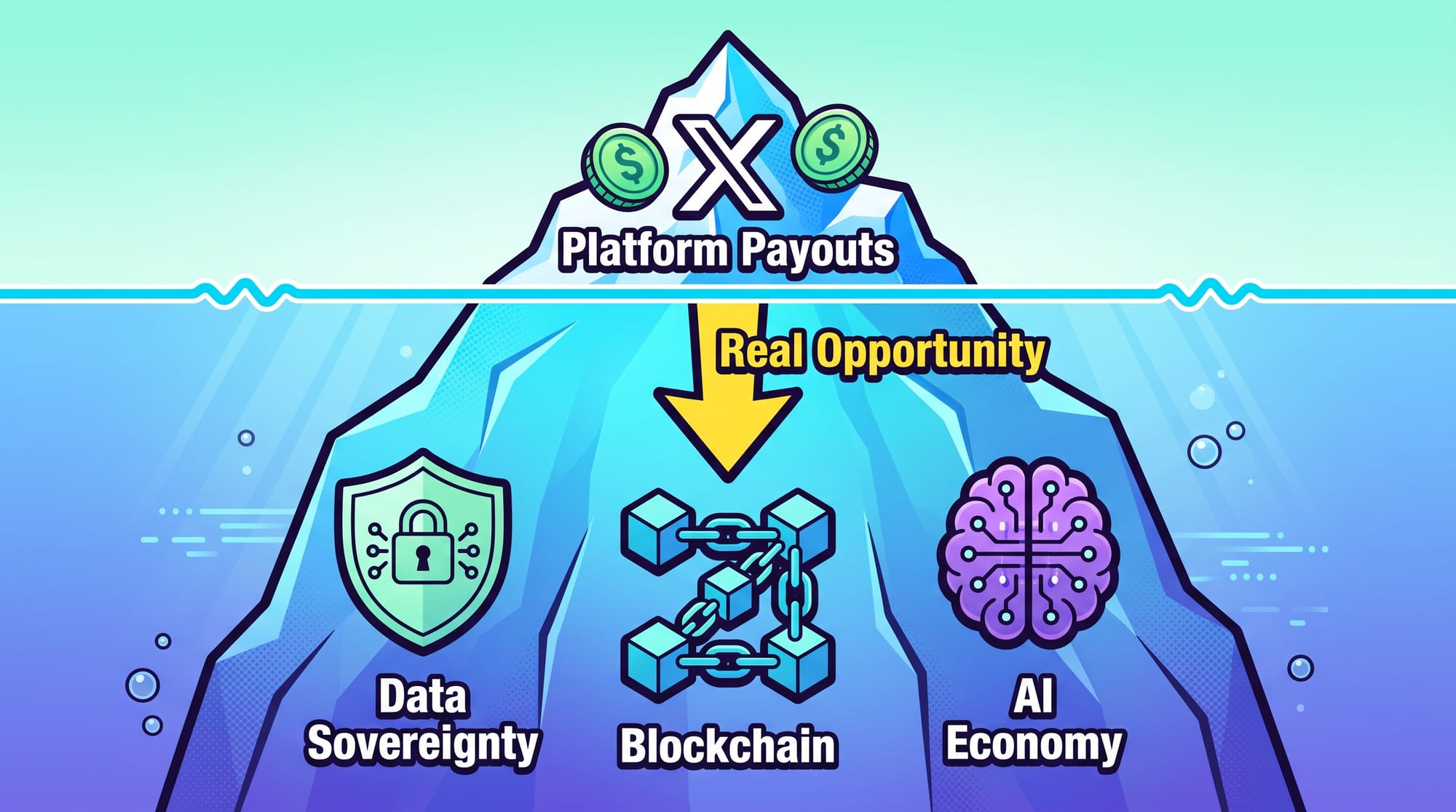
A story has been making the rounds in both crypto and creator circles this week: X is reportedly in talks with Circle about paying content creators royalties and commissions in stablecoins like USDC, replacing its existing ad-revenue-sharing program. According to people familiar with the matter, X’s newly recruited head of design, Benji Taylor, came from Coinbase and brings a deep crypto and DeFi background; Musk’s SpaceX is already settling Starlink’s cross-border billing in stablecoins. The initiative is still in testing, and X hasn’t issued an official statement.
But even as a mere “exploration,” this news is worth taking seriously — because it signals something real: one of the world’s largest social platforms is now seriously considering returning the value data creates to the people who create that data, faster and more directly.
1. This Step Is a Step in the Right Direction
Let’s be clear about one thing first: the direction X is moving in here is correct, and it deserves credit.
In the past, creators produced content on a platform, the platform monetized it through traffic and advertising, and creators only ever received whatever slice the platform chose to hand back — usually after a tedious settlement cycle, bank fees, and exchange-rate erosion. For creators outside dollar-denominated regions especially, waiting for a payout to land could mean losing several percentage points along the way and waiting several extra days on top of that.
Settling in stablecoins is, fundamentally, a real step forward on the question of whether creators can get what they’re owed fairly and quickly. Instant cross-border settlement, bypassing the banking system, no exchange-rate cut — this is a genuine efficiency gain, and a signal that a major platform is starting to acknowledge that on-chain payment suits the creator economy better.
2. But What X Can Give You Is Only the Slice the Platform Chooses to Give
Look a layer deeper into this news, though, and it becomes clear it only solves half the problem.
The data on X — your tweets, your engagement, your traffic — is still, fundamentally, data the platform controls. Control means two things. First, whether that data can be turned into money, how much it’s worth, and when it gets settled are all rules the platform sets unilaterally. Second, your account and your content can lose value or be zeroed out at any moment due to throttling, suspension, or a policy change — entirely independent of what you want.
In other words, stablecoins change how the money gets sent to you. They don’t change the fact that whether you get paid, and how much, is still entirely up to the platform. You’re still the one waiting on the platform’s mood — it’s just that the platform now expresses that mood through on-chain settlement instead of fiat.
3. The Bigger Problem: Most of Your Data Has Never Had a Payment Channel at All
And realistically, what X can cover is only a small slice of the data you generate across the internet.
What about the content you post on other platforms — Xiaohongshu, Bilibili, Reddit, Discord, all the various niche communities? Shouldn’t that carry value that belongs to you too? In all likelihood, no platform is going to follow suit on its own. And even if some do, they’ll each become their own isolated island — your data still scattered across countless account systems you don’t control, unable to flow between them, with no way to prove it all belongs to the same you.
Go a layer further: the behavioral data you leave behind every day just by using the internet — search history, browsing trails, spending preferences, location data — has never had a payment channel at all, from start to finish. It’s quietly collected and quietly monetized by platforms and advertisers, while you, the person who created it, never receive a cent, and often have no idea where it ends up being used.
And that’s just today. Once AI agents start browsing, creating, deciding, and transacting on your behalf, every call they make, every interaction, every task they execute will generate new data. The volume of that data will grow exponentially, far outpacing what humans could ever produce on their own. But right now, there’s almost no mechanism that can answer the most basic question: who actually owns the data your agent generates?
This is the real core of the issue: stablecoins solve a payment-method problem. They don’t solve a data-ownership problem. Even if every platform in the world eventually agrees to pay creators, what you’ll ever receive is still just the small slice the platform chooses to settle — while the far larger, far more valuable data asset you actually own remains uncontrollable, unconfirmed, and untradeable.
4. What DataDID Is Doing: Returning the Decision to Whoever Actually Created the Data
This is exactly the problem DataDID set out to solve — not getting some platform to hand you a slightly bigger cut, but returning the question of who owns data, from the platform’s hands, back to whoever actually created it — including an agent acting on your behalf.
MEMO’s proposed ERC-7829 data asset protocol is built on a core idea: turn the content of the data itself — not a record sitting in some platform’s account system — into an on-chain asset that can be owned, packaged, and traded. It isn’t confined to any single platform. A tweet can be minted. A behavioral record, a knowledge base, and — eventually — the interaction trails an agent produces can, in principle, all be confirmed as ownership in the same way.
Here’s the critical difference: X decides whether to pay you, and how much. DataDID’s logic is that the decision of whether to turn a piece of data into an asset, whether to trade it, who to sell it to, and what it gets used for all sit in the user’s own hands — no platform approval required, and immune to any platform policy change.
MEMO extends this same logic into the agent economy. By integrating the x402 payment protocol and the ERC-8004 identity protocol, an agent gets an on-chain identity and wallet independent of any platform account. The data it produces can be confirmed as an asset, and every time it’s called on, a micropayment triggers automatically, settling revenue in real time to the data’s owner. This isn’t waiting for a platform to hand you a check once a quarter — it’s data that carries its own pricing and settlement capability built in, generating revenue for you around the clock.
Closing
The step X is taking deserves credit — it proves, at minimum, that the idea “the value data creates should flow back to its creator” is now being accepted by mainstream tech giants, not just repeated as a slogan inside Web3 circles.
But what it can actually solve is still just the tip of the iceberg: one platform, one content format, one set of distribution rules written entirely and unilaterally by that platform.
Real data sovereignty shouldn’t mean waiting for a platform’s benevolence. It should mean that ownership defaults to the creator from the moment data is produced — regardless of which platform it was born on, what form it takes, or whether it was generated by a human or by an agent.
This is exactly what DataDID is trying to do: not to get you a slightly bigger cut, but to hand the decision entirely back to you.