
Why Execution Isn’t Enough Understanding x402 and the Economic Runtime of AI Agents
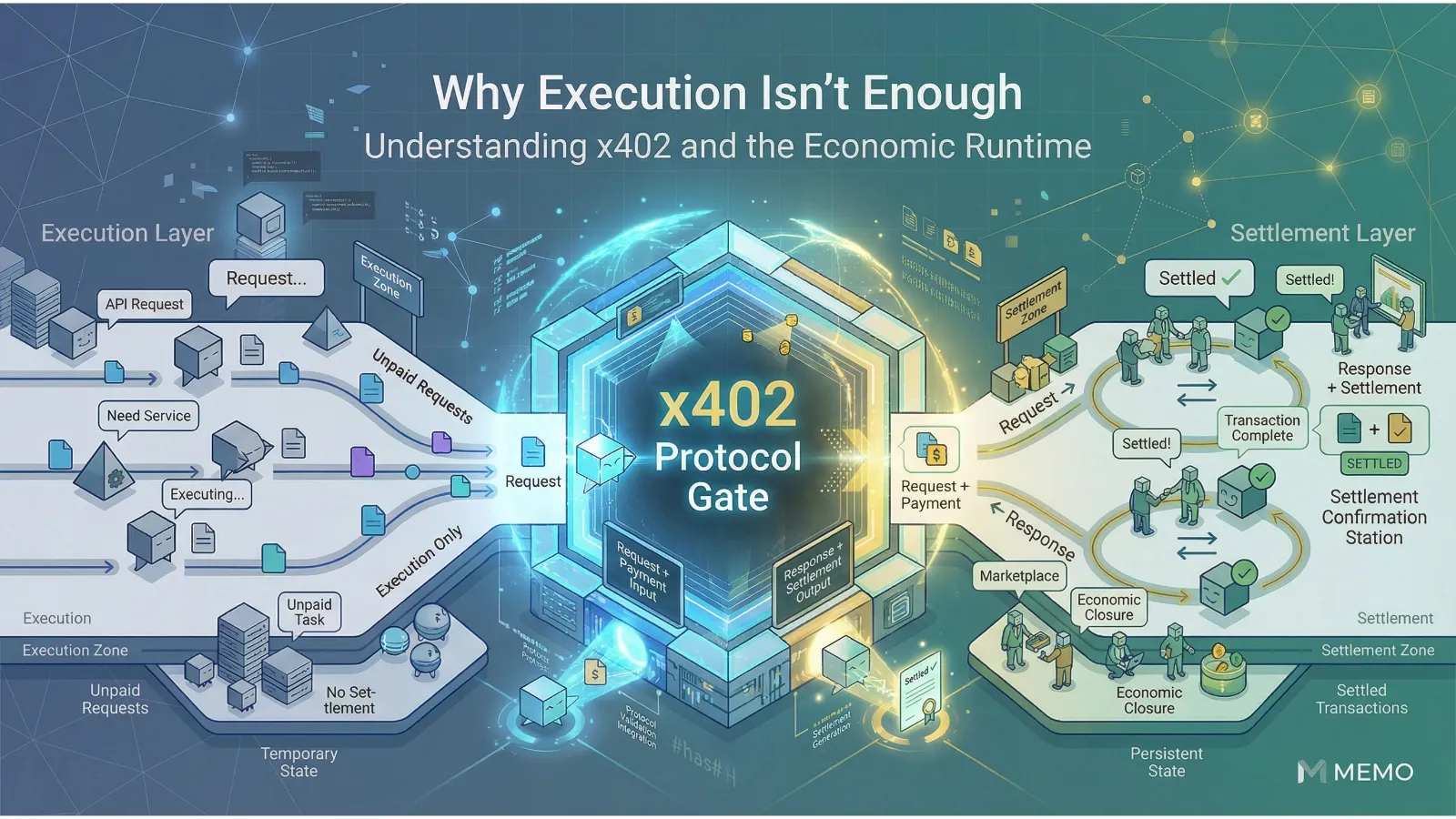
Execution is free and abundant. Developers can spin up a model, call an API, or deploy a service in minutes. But in an agent-first future, the question is no longer whether agents can act — it’s whether they can complete value cycles on their own. An agent that runs but can’t settle, own, or trade the outputs it creates remains a tool; it cannot be an economic actor.
MEMO’s approach is to build the economic runtime that agents need: a tightly coupled system where execution, identity, data ownership, and payment are first-class primitives. A critical piece of that runtime is x402 — a protocol that makes payment a native part of web interactions, enabling accountless, on-demand micropayments suitable for autonomous agents.
From “Do” to “Settle”: Why settlement defines agency
Most production deployments still separate execution from settlement: code runs, logs are produced, invoices are generated, and accounting happens later. That model works for human-driven SaaS, but it breaks when agents must operate autonomously, discover services, delegate work, and pay for resources in real time.
When settlement is external to execution, three problems follow:
- fragile continuity — an agent’s “state of affairs” is never economically closed, so cooperation and delegation require human intervention;
- high friction — onboarding, API keys, and subscriptions block ad hoc, cross-service interactions; and
- opaque accounting — value flows are hidden in off-chain systems and reconciliations.
Turning settlement into part of the execution path eliminates these frictions. That is the practical purpose of x402: embed payments into HTTP so agents can request, pay, and prove fulfillment inline with requests. Payment becomes an action an agent performs, not a separate administrative task.
What x402 brings to an agent ecosystem
x402 revives HTTP’s “payment required” concept as a standardized, programmable signal for requesters and providers. For agents this enables several important capabilities:
- accountless micropayments: agents don’t need pre-provisioned API keys or subscription accounts to consume services;
- instant provable exchange: payment and fulfillment are coupled so economic finality accompanies responses; and
- network-agnostic rails: the pattern supports multiple settlement layers and tokens, making it suitable for cross-chain or hybrid deployments.
These capabilities allow agents to discover and use services on demand with predictable economic outcomes. Payment becomes part of the interaction contract rather than a post facto billing event.
Turning rails into runtime: identity and assetization
Payments answer “how value moves.” Identity and data primitives answer two equally critical questions: “who is transacting?” and “what is being transacted?”
For an agent to transact autonomously it must be identifiable and accountable. Persistent on-chain identities and verifiable credentials allow agents to establish reputation, be discovered by other agents or services, and receive or remit funds with clear attribution. Meanwhile, data assetization converts agent outputs — interaction logs, models, datasets, and derived insights — into well-defined, ownable assets.
When payment rails, identity, and data assets are integrated, agents can both consume and create tradable value. They can pay for a dataset, transform it, and then monetize the result as a verifiable asset. This is the fundamental loop that converts ephemeral execution into lasting economic activity.
Practical architecture: facilitators and efficiency
In real deployments, a pragmatic production role often appears: the facilitator. Facilitators help stitch payments, verification, and cross-chain routing together while minimizing friction for end users and agents. They can perform off-chain aggregation, handle multi-network settlement, and reduce gas or confirmation friction without collapsing traceability or auditability.
MEMO treats facilitators as part of the architecture rather than proprietary middleware. They are engineered as trust-minimizing, interoperable components that accelerate settlement while preserving the on-chain record and the agent’s sovereignty.
Developer ergonomics and business outcomes
For engineers, this stack changes how services are offered and consumed. Providers no longer need to manage complex subscription systems; a protected endpoint can require payment at the protocol level, and agents can satisfy that requirement on demand. For businesses, this unlocks new monetization patterns: data outputs and agent services become priceable assets, revenue flows are auditable by design, and complex collaborations can be automated without manual reconciliation.
For users, it reduces friction: no account setup, no long-term commitments, and predictable, punctual economic interactions. For ecosystems, it enables composable marketplaces where agents are both consumers and suppliers of value.
Execution + Settlement = Agency
Execution answers the question “Can an agent act?” Settlement answers “Can an agent exist?” Without economic finality, agents cannot persist, contributions cannot be priced, and value cannot compound. x402 supplies the low-latency, accountless payment primitive that agents need to interact economically at internet scale; identity and data asset standards supply the trust and asset primitives needed for accountable participation.
At MEMO, settlement is not an add-on — it is infrastructure. By integrating payment rails, identity, and data ownership into the agent lifecycle, MEMO turns one-off executions into durable economic actors. The future of AI is not just smarter agents — it is agents that can organize, transact, and sustain themselves in open economies.
Execution may be cheap.
Economic runtime is everything.
Frequently Asked Questions (FAQs)
Q1:What is a MEMO AI Agent?
A MEMO AI Agent is an autonomous, identity-backed software entity that can access data, call services, pay for work, and be audited—operating with verifiable authority and economic autonomy.
Q2:Why does an agent need a DID?
An Agent DID provides verifiable identity, enables attestations about capabilities, and allows secure, auditable interactions with other services and agents.
Q3:What is x402 and how does it relate to agents?
x402 is MEMO’s payment integration concept modeled on the HTTP 402 pattern: agents discover payment-required endpoints, receive payment instructions, and can programmatically fulfill micropayments to access services.
Q4:Can agents split payments among collaborators?
Yes—payment protocols support multi-party settlement so agents can distribute revenue or costs among team agents deterministically.
Q5:How do agents coordinate complex workflows?
Agents use attestation-based handoffs, verifiable outputs, and on-chain commitments to chain tasks, ensuring integrity across multi-step workflows.