
What the “Are You Dead?” Moment Reveals — and Why MEMO Is Building the Next Generation of DID
In early 2026, a simple question captured the attention of millions in China:
“Are you dead?”
Behind the shocking phrasing was a minimalist app that did almost nothing—except one thing that mattered. It allowed users to confirm they were okay, and if they didn’t, someone else would know.
The app’s explosive popularity was not driven by novelty alone. It surfaced something deeper and far more universal:
a growing anxiety around absence, isolation, and being unseen in a hyper-connected world.
For MEMO, this moment is not about copying a viral idea.
It is about understanding what the world is quietly asking for—and responding with infrastructure, not gimmicks.
A World Where Silence Has Meaning
We live in an era of constant signals. Messages, notifications, transactions, posts. Activity is everywhere.
And yet, paradoxically, more people feel alone than ever.
Remote work, urban migration, solo living, and global mobility have reshaped modern life. In this reality, silence is no longer neutral. Sometimes, silence is a question mark.
Traditional digital systems are not built to understand this. They react only when users act. They assume presence until proven otherwise. And they rarely consider what happens when someone simply disappears from the flow.
The sudden popularity of “Are You Dead?” revealed a truth many platforms have ignored:
People don’t just want to be connected.
They want to be noticed—without being monitored.
Why This Is a Digital Identity Problem
At first glance, personal safety seems unrelated to digital identity. But at a deeper level, they are inseparable.
Identity answers fundamental questions:
- Who am I?
- Am I here?
- Can I be trusted?
- Can someone reach me if it matters?
Most identity systems today—both Web2 and Web3—only answer the first question. They are designed for access, verification, and authorization. Once a task is complete, identity goes dormant.
But real life is continuous.
If identity is to become truly user-centric, it must evolve beyond credentials and permissions. It must be able to represent presence, not just proof.
This is the direction MEMO DID is moving toward.
MEMO’s New Direction: From Identity Ownership to Identity Responsibility
MEMO has always focused on one core principle: users should own their identity and their data.
With the introduction of this new DID capability, MEMO extends that principle further—not by collecting more information, but by redefining what identity can do.
The idea is simple, but powerful:
A decentralized identity should be able to support personal safety—
without becoming invasive, centralized, or controlling.
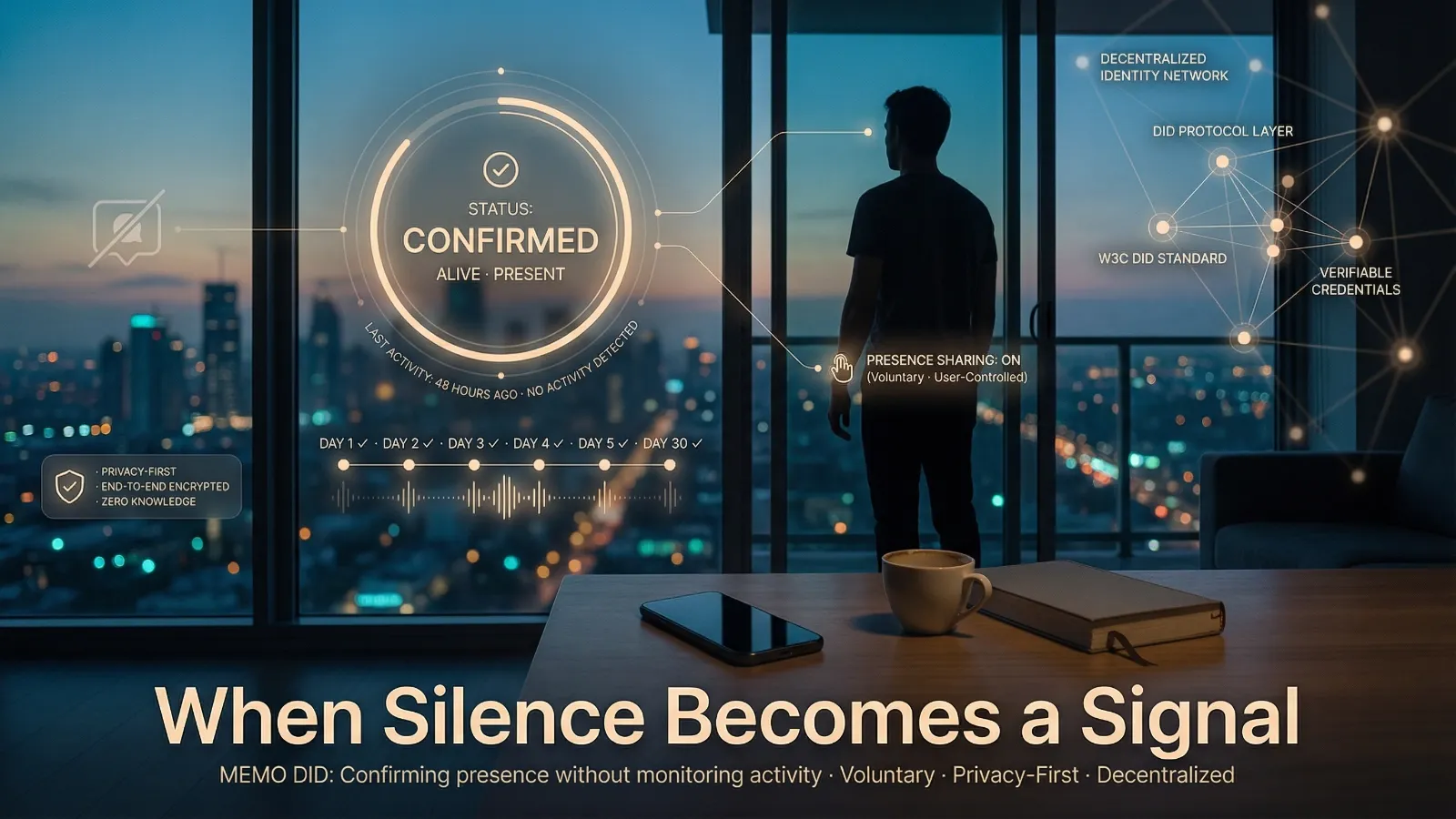
Within the MEMO DID framework, users can voluntarily enable a mechanism that allows their identity to quietly confirm their well-being over time. If that confirmation stops, predefined actions—chosen by the user—can take place.
This is not surveillance.
It is not behavioral analysis.
It is not automation deciding for humans.
It is intent encoded into identity.
Why MEMO Is Uniquely Positioned to Build This
Many apps can create check-in features. Very few platforms can make them trustworthy.
MEMO’s advantage lies in its foundation:
1. Decentralized Identity as the Core Layer
MEMO DID is not an add-on. It is the base. That means safety-related signals are tied to user-owned identifiers, not platform-controlled accounts.
2. Privacy-First Architecture
MEMO does not require continuous tracking, location sharing, or activity profiling. The system is designed to function with minimal disclosure and maximum user control.
3. Composability with the MEMO Ecosystem
This capability is not isolated. It can naturally evolve alongside decentralized storage, data ownership, and future AI agents—without forcing users into a closed ecosystem.
In short, MEMO is not building a “feature.”
It is extending identity into a new domain of human need.
Learning the Right Lesson from Virality
The lesson of the “Are You Dead?” phenomenon is not that shock works.
The real lesson is this:
When a product resonates so deeply, it is often because it touches something infrastructure has failed to provide.
MEMO’s response is deliberately different. Instead of racing for attention, it focuses on durability. Instead of relying on emotional triggers, it builds trust through design.
This approach may not generate instant headlines—but it builds something more valuable: long-term confidence.
Redefining What DID Is For
Decentralized identity has long been discussed in terms of finance, governance, and access control. These remain important.
But the next phase of DID adoption will be driven by human relevance.
- Can identity support care without control?
- Can it signal presence without exposure?
- Can it help people feel safer without feeling watched?
MEMO believes the answer is yes—and that this is where identity truly becomes personal.
The Bigger Picture
This new direction is not the end goal. It is a foundation.
As digital identities begin to interact with autonomous agents, data economies, and persistent online services, the question of “who looks after the user” becomes unavoidable.
By anchoring personal safety in decentralized identity, MEMO is taking an early step toward a future where technology respects silence as much as activity, and autonomy as much as intelligence.
The viral moment reminded the world of a simple truth:
Being connected is not the same as being cared for.
MEMO DID is building for the difference.