
What Makes an AI Agent Real? Inside MEMO’s Infrastructure for Persistent, Economic Agents
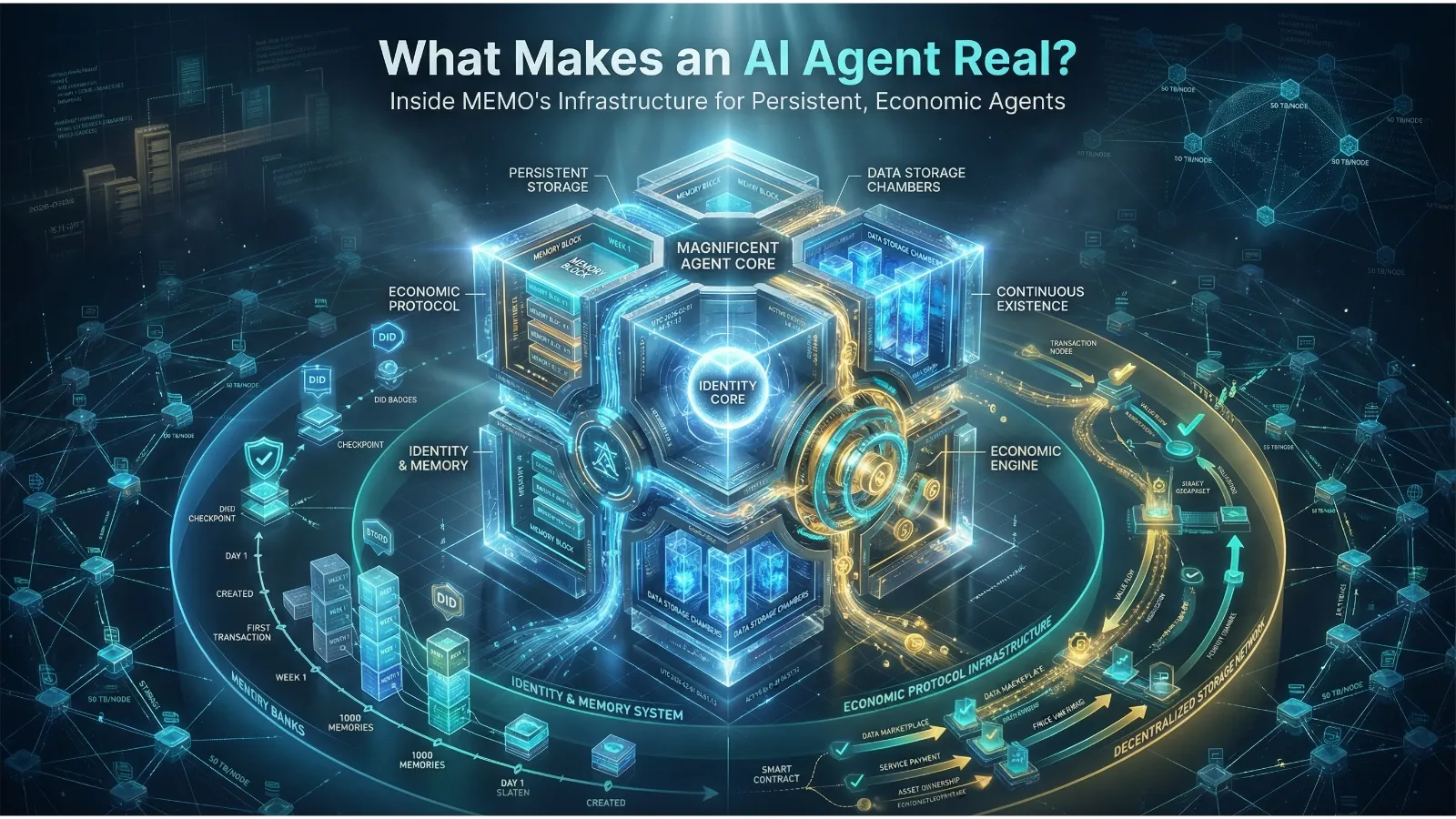
AI Agents are everywhere.
They write code, summarize research, trade assets, answer questions, and automate workflows. From productivity tools to autonomous trading bots, the idea of an “AI Agent” has quickly become one of the most overused terms in the industry.
But beneath the hype lies an uncomfortable truth:
Most AI Agents are not real entities.
They are temporary executions.
They run, respond, and vanish.
So what actually makes an AI Agent real?
At MEMO, we believe an AI Agent becomes real only when it can exist independently, retain memory, own the data it produces, and participate in economic activity—without being bound to a single platform or developer.
This is not a model problem.
It is an infrastructure problem.
The Illusion of Today’s AI Agents
Most AI Agents today are built on centralized platforms and cloud services. Their capabilities may appear impressive, but structurally they suffer from three fundamental limitations:
- No persistence
When the platform shuts down or the service changes, the agent’s memory, context, and learned behavior disappear. - No ownership
The data generated by agents—logs, interactions, insights—belongs to platforms, not to the agent or its creator. - No economic autonomy
Agents execute tasks, but cannot natively settle value, manage assets, or operate as economic participants.
In other words, today’s agents can act, but they cannot exist.
MEMO’s AI Agent infrastructure was designed to solve exactly this gap.
Pillar One: A Data-Native Foundation for Agent Existence
The first requirement for a real AI Agent is data permanence.
Agents rely on memory: historical context, training data, behavioral patterns, and interaction logs. If this data is fragile, the agent itself is fragile.
MEMO provides a data-assetized foundation built on its native decentralized storage and data infrastructure. This foundation gives agents something most systems ignore: a place to live.
Persistent Memory
Agent memory is stored in a decentralized, censorship-resistant environment. Context does not vanish when a platform changes or a service goes offline. Agents retain continuity over time.
Data Ownership and Assetization
Through Data DID and ERC-7829, data generated by agents is no longer passive exhaust. It becomes a defined, ownable, and tradable asset.
This means:
- Agent outputs can be priced
- Contributions can be attributed
- Value can be settled transparently
Data is no longer just used—it is owned.
Pillar Two: From Execution to Economic Life
Execution alone does not make an agent real.
A script can execute.
A cron job can execute.
Even a chatbot can execute.
What separates an agent from automation is economic autonomy.
MEMO integrates x402 and ERC-8004 to provide a full lifecycle runtime environment—covering creation, execution, and settlement.
Autonomous Identity
Each agent operates with an independent on-chain identity. It can authenticate actions, interact with protocols, and make decisions within predefined constraints.
Coupled Execution and Settlement
In MEMO’s framework, execution is inseparable from settlement.
When an agent completes a task:
- Value flows automatically
- Compensation is settled instantly
- No off-chain reconciliation is required
This tight coupling turns agents into self-accounting economic actors, not dependent services.
Execution becomes meaningful because it is economically final.
Pillar Three: Breaking the Agent Island
Even a persistent, economically autonomous agent is limited if it operates alone.
Today’s AI ecosystem is fragmented. Agents are created by different developers, deployed on different stacks, and isolated by incompatible assumptions.
MEMO addresses this with a cross-agent interaction protocol—a shared on-chain language for how agents discover, communicate, and collaborate.
Logical Interoperability
Agents built by different teams can understand each other’s capabilities, intents, and outputs under a common execution and data model.
Service Discovery and Task Delegation
Agents can:
- Discover services provided by other agents
- Delegate tasks dynamically
- Exchange data under verifiable ownership rules
This transforms agents from isolated tools into participants in a cooperative network.
Not a marketplace of bots—but an economy of agents.
When an Agent Becomes Real
So what makes an AI Agent real?
Not intelligence alone.
Not scale.
Not speed.
A real agent must:
- Persist beyond platforms
- Own its memory and data
- Execute with economic finality
- Interact with other agents as a peer
MEMO does not treat agents as features.
It treats them as entities.
By combining decentralized data infrastructure, lifecycle economic runtime, and cross-agent protocols, MEMO provides the missing substrate for agents that are not just useful—but durable, accountable, and economically alive.
The future of AI is not just smarter agents.
It is agents that can exist.
Frequently Asked Questions (FAQs)
Q1:What is a MEMO AI Agent?
A MEMO AI Agent is an autonomous, identity-backed software entity that can access data, call services, pay for work, and be audited—operating with verifiable authority and economic autonomy.
Q2:Why does an agent need a DID?
An Agent DID provides verifiable identity, enables attestations about capabilities, and allows secure, auditable interactions with other services and agents.
Q3:Why does an agent need a DID?
An Agent DID provides verifiable identity, enables attestations about capabilities, and allows secure, auditable interactions with other services and agents.
Q4:What developer tools exist for building agents?
MEMO supplies SDKs, specification documents (EIP-like), sample templates, and integration guides to help developers launch DID-backed agents quickly.
Q5:What real-world use cases are ideal for MEMO agents?
Automated data brokers, privacy-preserving data labeling services, licensed-content assistants, on-chain financial bots, and collaborative multi-agent research workflows.