
What Is MEMO?Understanding the Decentralized Data Infrastructure for the AI Agent Era

MEMO is a decentralized AI data infrastructure network developed by the Memolabs team. Its core mission is to provide decentralized storage, data ownership verification, identity authentication, data assetization, and trading services for the AI economy.
In simple terms, MEMO is building two things:
- A system where users truly own their data
- A secure and trustworthy memory layer for AI Agents
The MEMO project was launched in 2017 and now operates more than 50,000 storage nodes across Southeast Asia, the Americas, and Africa, with millions of registered wallet addresses.
Its investors include HashKey, DHVC, and SNZ, while ecosystem partners include Metis, Harmony, Alibaba Cloud, and AWS.
What Problem Is MEMO Solving?
The core contradiction of traditional cloud storage services — such as AWS or Google Cloud — is simple:
Your data lives on platform-controlled servers, which means users never truly have ownership or control.
At any moment, data can be:
- Deleted by the platform
- Sold to third parties
- Used to train AI models
Meanwhile, the original creators of that data receive nothing in return.
The AI era makes this contradiction even more obvious.
AI Agents require persistent memory. But if that memory is stored on centralized servers, everything can disappear the moment a session ends or an account gets suspended.
MEMO’s solution is to move data storage away from centralized servers and into decentralized networks, while using blockchain technology to establish verifiable ownership from the moment data is created.
In other words:
Every piece of data truly belongs to the user from day one.
MEMO’s Core Technical Architecture
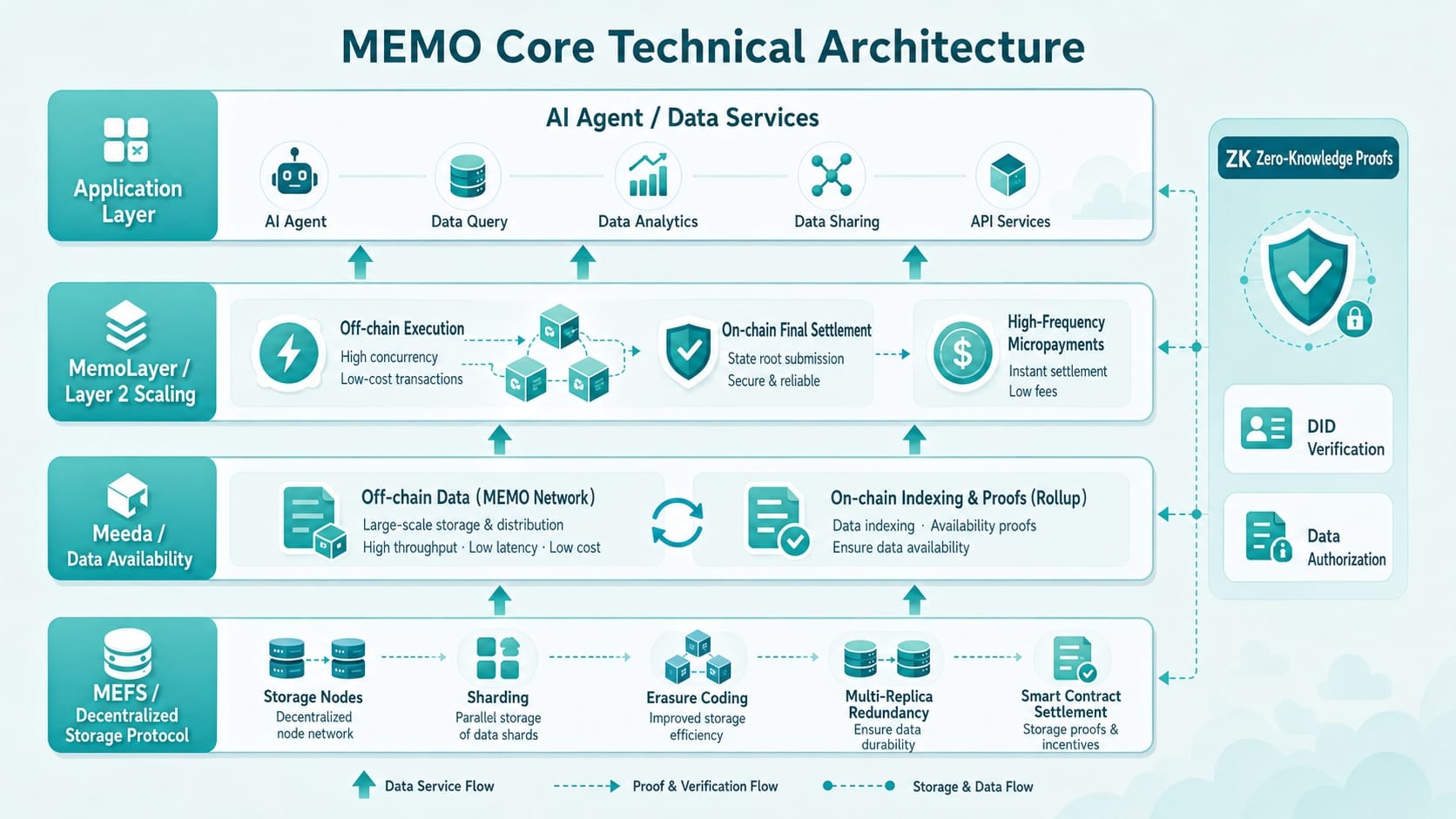
MEMO uses a modular layered architecture, with different layers responsible for different functions throughout the system.
MEFS: The Core Decentralized Storage Protocol
At the foundation of MEMO is MEFS, the project’s self-developed decentralized storage protocol.
MEFS uses:
- Redundant storage
- Data sharding
- Erasure coding
- Multi-replica mechanisms
to ensure data security and resilience.
Even if part of the network goes offline, the data remains available and recoverable.
Storage task matching, fee settlement, and node verification are all managed automatically through smart contracts, without manual intervention.
Meeda: Data Availability for Ethereum Rollups
Meeda is MEMO’s data availability solution designed specifically for Ethereum Rollup scenarios.
It stores actual data off-chain inside the MEMO network, while only keeping indexes and proofs on-chain.
This significantly reduces Rollup transaction costs while still ensuring that data remains verifiable and retrievable at any time.
MemoLayer: Layer 2 Scaling Infrastructure
MemoLayer improves network throughput through an architecture that combines off-chain execution with on-chain final settlement.
It is specifically designed to support high-frequency micropayment scenarios, which are critical for autonomous transactions between AI Agents.
Zero-Knowledge Proofs (ZK)
MEMO also introduces Zero-Knowledge Proof technology at the privacy layer.
This allows users to complete data verification or transactions without exposing the original data itself.
Potential use cases include:
- DID verification
- AI training data authorization
- Privacy-preserving transactions
The MEMO Ecosystem Products
The MEMO ecosystem revolves around one central concept:
Data sovereignty.
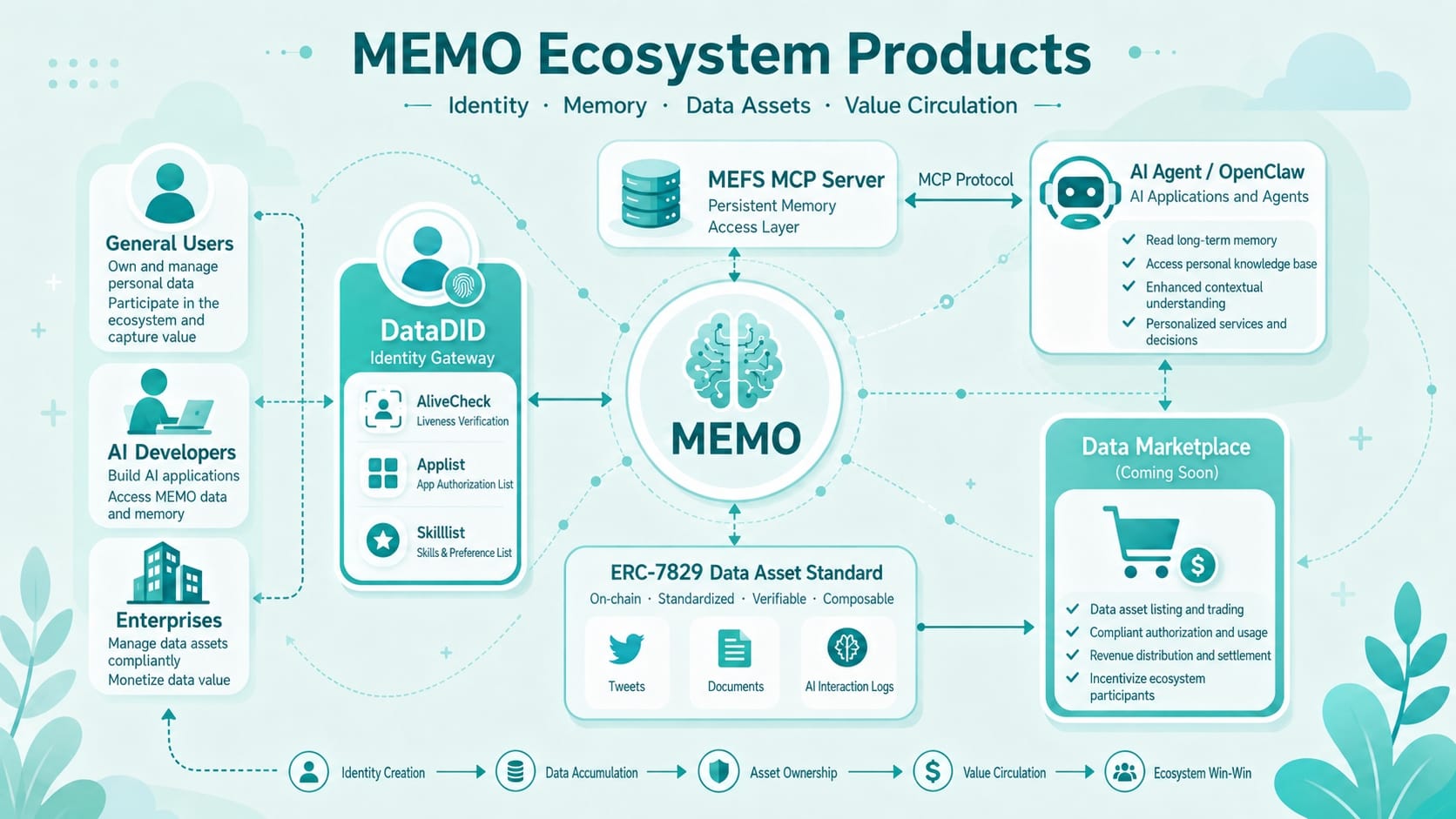
Its products are designed for three major groups:
- Everyday users
- AI developers
- Enterprises
DataDID: The Identity Gateway of the MEMO Ecosystem
DataDID is MEMO’s decentralized data identity system and serves as the main entry point into the ecosystem.
After registration, users receive a dedicated on-chain DID (Decentralized Identifier). All points, data assets, and participation records are tied to this identity.
DataDID includes several built-in modules:
- AliveCheck (digital life protection)
- AppsList (application marketplace)
- SkillsList (AI Skill plugin marketplace)
Access:
👉 datadid.memolabs.net
MEFS MCP Server: Persistent Memory for AI Agents
The MEFS MCP Server is MEMO’s decentralized storage access service built specifically for AI Agents.
Through the MCP protocol, AI Agent clients such as OpenClaw can directly connect to the MEMO network to store:
- Conversation history
- Task outputs
- Knowledge bases
This enables true persistent memory across sessions.
Open-source repository:
👉 github.com/memoio/mefs-mcp-server
ERC-7829: The Data Asset NFT Standard
ERC-7829 is MEMO’s proposed NFT standard for data assets.
It allows content such as:
- Tweets
- Documents
- AI interaction records
to be minted into on-chain data assets.
The standard includes built-in support for:
- Data provenance tracking
- Access control
- Automated revenue distribution
ERC-7829 serves as the technical foundation of MEMO’s data assetization framework.
The Upcoming Data Marketplace
The upcoming data marketplace completes the ecosystem loop.
Once users convert their data into assets, those assets can be traded in the marketplace.
AI companies and other data buyers can purchase data through smart contracts, with revenue automatically settled directly to the original creators.
This creates a fully decentralized data economy where value flows back to those who generated the data in the first place.
How Is MEMO Different from Filecoin and Arweave?
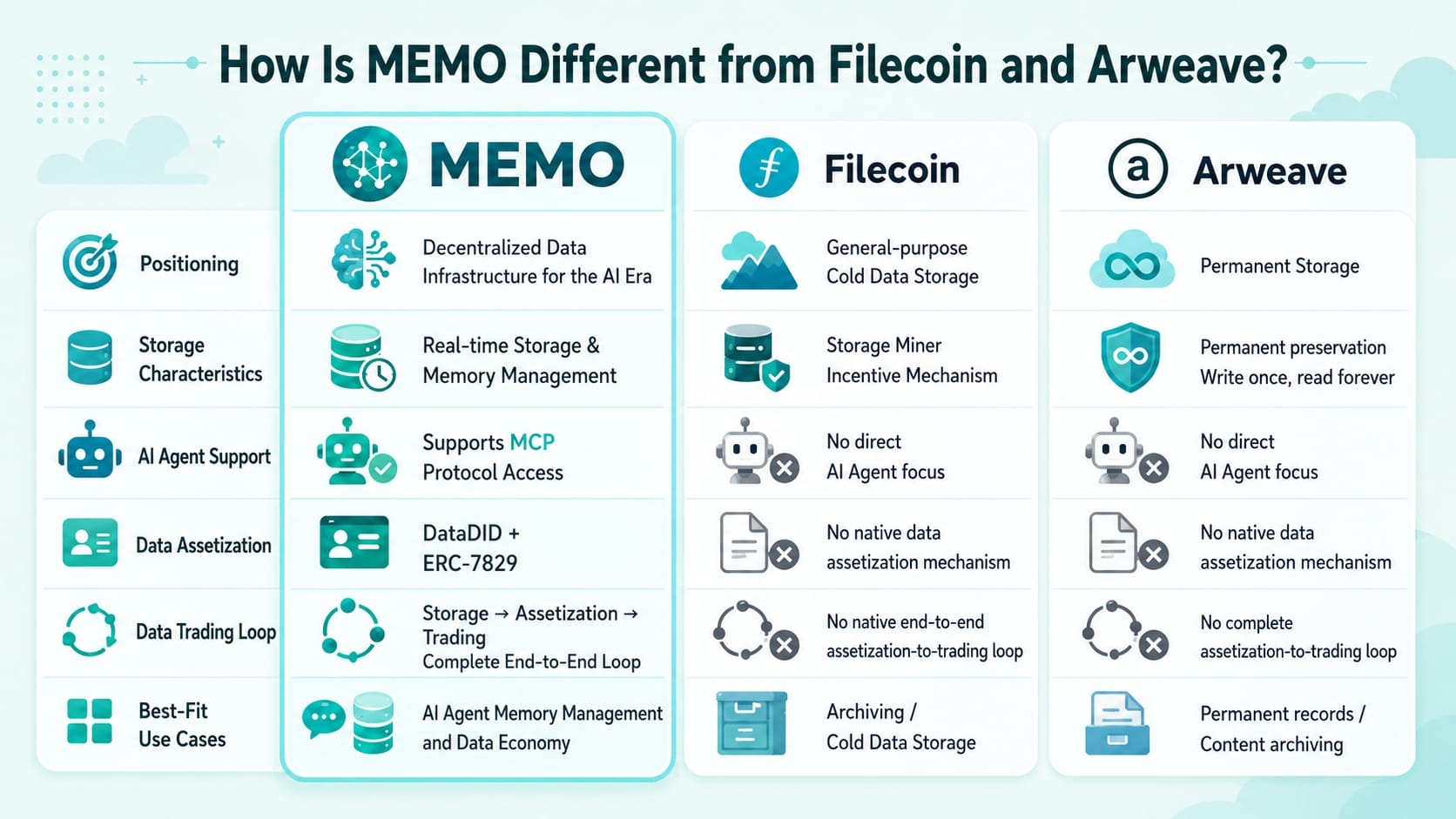
All three projects belong to the decentralized storage sector, but their positioning is fundamentally different.
Filecoin
Filecoin focuses primarily on the general-purpose cold storage market, with miner incentives at the center of its design.
Arweave
Arweave focuses on permanent storage, making it suitable for archival use cases.
MEMO
MEMO differentiates itself in two key ways:
1. AI Agent-Oriented Real-Time Storage and Memory Management
MEMO directly supports MCP protocol integration, enabling AI Agents to use decentralized persistent memory in real time.
2. A Full Data Economy Stack
Through DataDID and ERC-7829, MEMO builds a complete loop from:
- Storage
- To data assetization
- To data trading
MEMO is not just storing data.
It is turning data into economic value.
FAQ
Q: What is the relationship between MEMO and Memolabs?
A: Memolabs is the development team and incubation lab, while MEMO is its core product and network.
Q: How can ordinary users participate in the MEMO ecosystem?
A: The easiest entry point is DataDID:
👉 datadid.memolabs.net
Users can begin by completing daily check-ins to earn points, then install the browser extension to mint tweets into data assets or access applications through AppsList.
Q: Can data stored on MEMO be lost?
A: No.
The MEFS protocol uses redundant storage and data sharding technology, ensuring that data remains available even if some nodes go offline. The system also includes self-repair mechanisms.
Q: How can AI Agents connect to MEMO’s storage capabilities?
A: By deploying the MEFS MCP Server.
Any AI Agent client that supports the MCP protocol can read and write data through the MEMO network, enabling persistent cross-session memory.
Q: What is MEMO’s standard for data assetization?
A: MEMO introduced the ERC-7829 Data Asset NFT Standard, specifically designed for data-based content rather than image NFTs.
It includes built-in access control and automated revenue distribution and is already being used through the DataDID browser extension.
Q: How large is MEMO today?
A: MEMO currently operates more than 50,000 storage nodes across Southeast Asia, the Americas, and Africa, with millions of registered wallet addresses.
It is one of the largest decentralized storage networks in terms of both node scale and user coverage.
Official Channels
- Official Website: memolabs.org
- Twitter: @MemoLabsOrg
- Telegram: t.me/memolabsio
- DataDID Portal: datadid.memolabs.net
- MEFS MCP Server: github.com/memoio/mefs-mcp-server