
What If Your Digital Identity Could Look After You? Rethinking Safety, Trust, and Care in the Age of MEMO DID
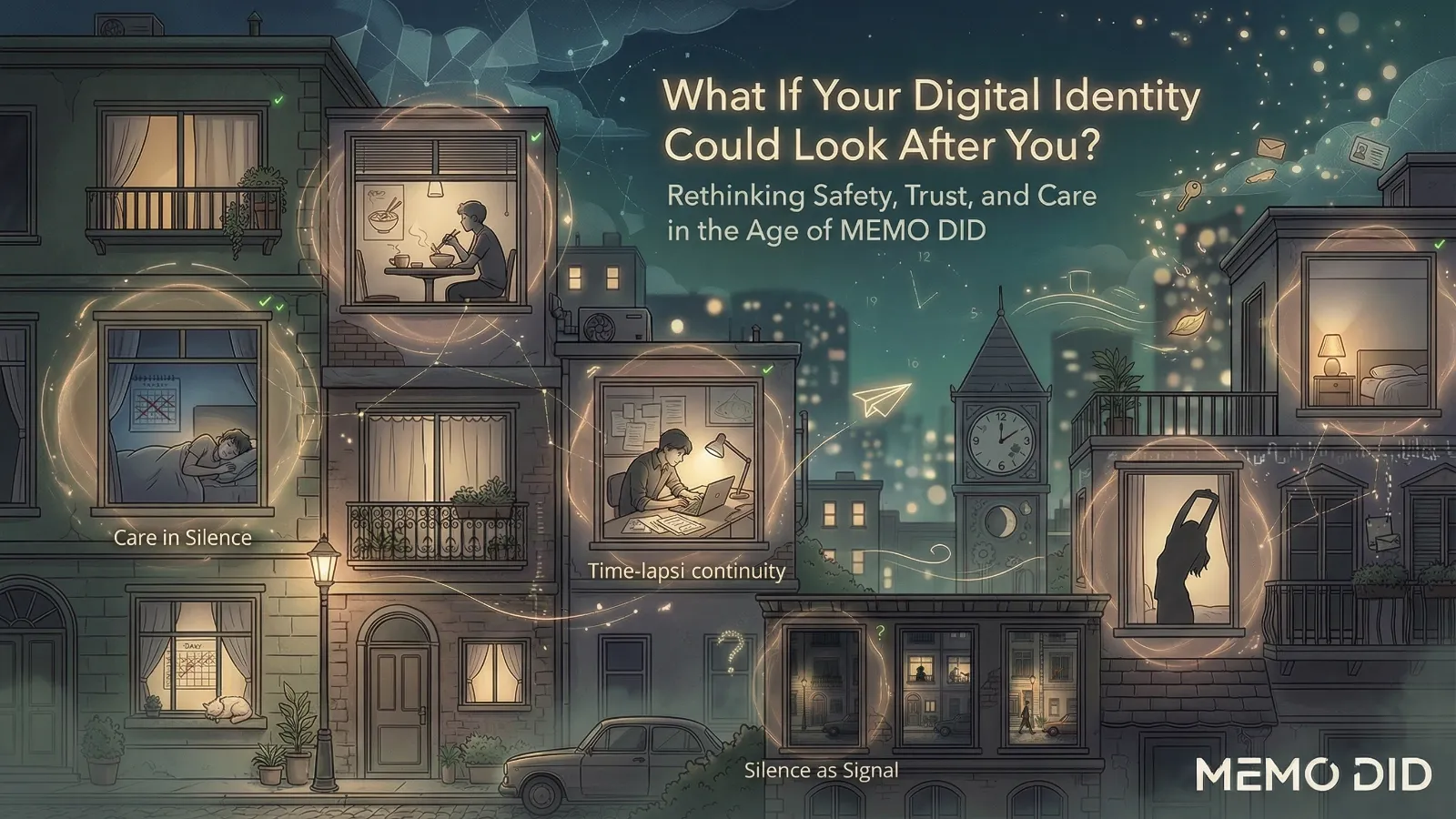
What if your digital identity could do more than prove who you are?
What if it could quietly look after you—without watching you, tracking you, or turning your life into data?
For most of the internet’s history, digital identity has been reactive. You use it when you log in, when you sign a transaction, or when you authorize access. Once the task is complete, identity disappears into the background.
But human life doesn’t work in transactions.
Safety, trust, and care are continuous.
At MEMO, we believe decentralized identity is ready for a deeper role—one that reflects how people actually live.
When Identity Stops Being Just Technical
Today’s digital identity systems are optimized for platforms, not people. They focus on credentials, permissions, and compliance. Even in Web3, DID is often treated as infrastructure rather than experience.
Yet as more of life moves online—and more people live independently, remotely, or globally—the question shifts:
Who notices when something is wrong?
In the physical world, communities, routines, and relationships provide subtle safety nets. In the digital world, those nets are often missing. Silence goes unnoticed. Absence has no signal.
This is the gap MEMO DID is beginning to address.
A New Direction: Identity as a Layer of Care
MEMO DID is evolving beyond identification and data ownership toward something more human: personal safety through user-controlled signals.
Rather than asking users to share more data, MEMO explores a simpler idea:
What if identity itself could help confirm that someone is okay?
This new capability—designed within the MEMO DID framework—introduces a concept of voluntary presence confirmation, sometimes referred to as an “alive check.” It allows users to decide how and when their identity quietly affirms their well-being.
No constant monitoring.
No invasive tracking.
No centralized authority.
Just a respectful, opt-in mechanism rooted in decentralized identity.
Why Silence Matters More Than Data
Most digital systems react to activity. MEMO’s approach recognizes that inactivity can be meaningful too.
In certain real-world situations—living alone, traveling long-term, working in isolation—silence can become a signal worth acknowledging. MEMO DID enables users to define what that signal means, and what should happen if it occurs.
Crucially, the user remains in full control:
- Who is notified
- Under what conditions
- With what level of information
The system does not attempt to “understand” the user. It simply respects the rules the user sets.
Privacy Is Not a Feature—It’s the Foundation
Any system touching personal safety must treat privacy as non-negotiable. MEMO DID does this by design.
All safety-related interactions are built on decentralized identifiers and user-owned data principles. There is no requirement to share location, behavior patterns, or sensitive personal information.
The goal is not to observe life—but to support autonomy.
This distinction matters. MEMO’s approach avoids turning safety into surveillance, and care into control. Instead, it offers users a tool that exists quietly, activating only when they choose.
What This Means for the Future of Web3 Identity
Web3 often speaks about sovereignty, but sovereignty is incomplete without protection. A truly user-centric identity system should not only empower transactions—it should support continuity of life.
By extending DID into personal safety, MEMO is redefining what digital identity can represent:
- A presence, not just a credential
- A safeguard, not just an access key
- A long-term companion, not a one-time tool
This direction opens possibilities far beyond a single feature. It creates a foundation for identity systems that can coexist with AI agents, data economies, and autonomous services—while staying grounded in human needs.
MEMO’s Vision: Technology That Knows When to Stay Quiet
MEMO is building infrastructure for a future where users truly own their data, identity, and digital agency. The evolution of MEMO DID reflects this philosophy.
Sometimes the most powerful technology is the one that does not demand attention.
A digital identity that looks after you should not be loud.
It should not be intrusive.
It should simply be there—when it matters.
This is the direction MEMO DID is moving toward.
And it is only the beginning.