
What Happens When AI Starts Paying for Your Data?
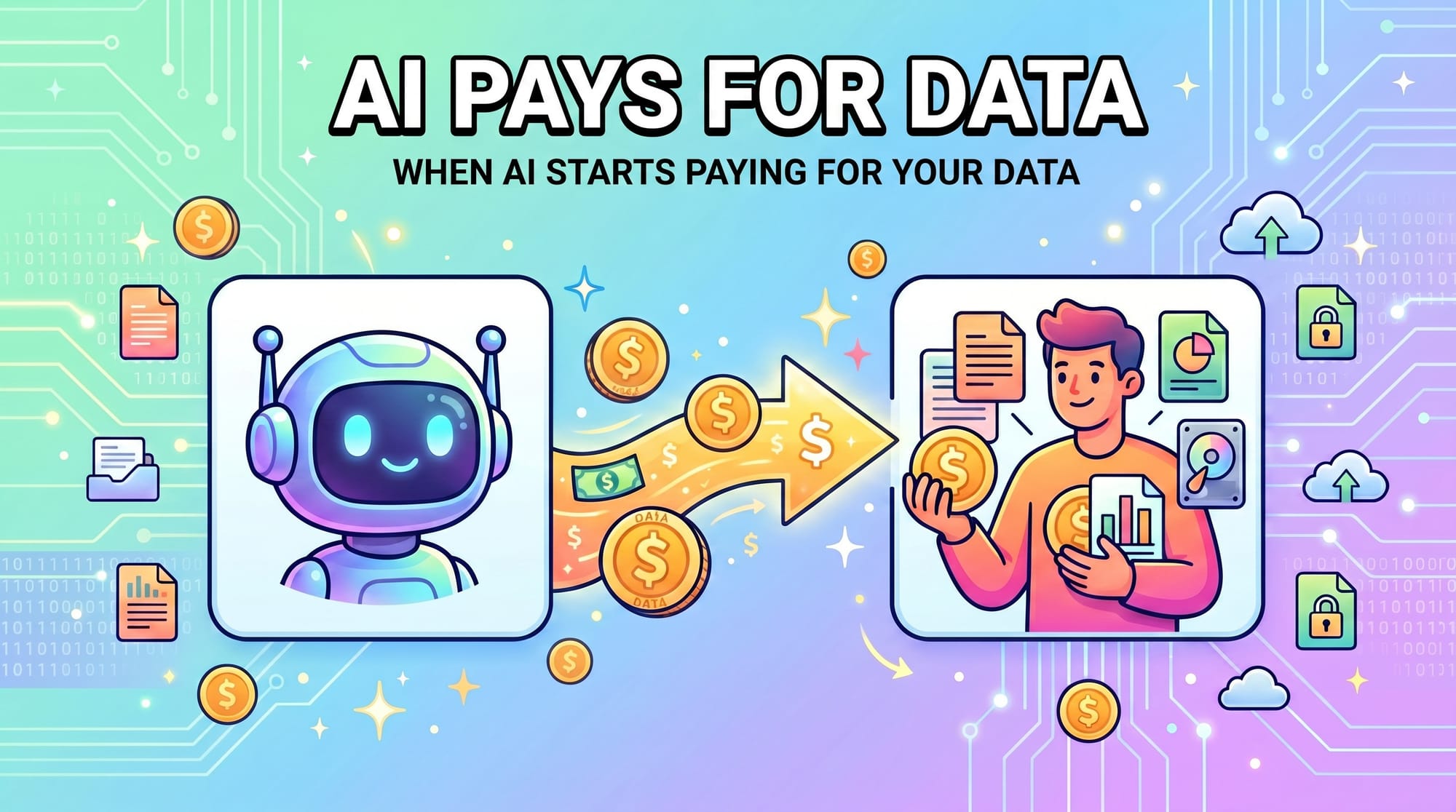
Imagine an ordinary morning in 2030.
You pick up your phone, scroll through social media for twenty minutes, post a tweet about breakfast, chat with a friend about a movie you recently watched, and casually answer a question from an AI assistant.
In the top-right corner of your screen, a tiny number keeps ticking upward.
It’s your daily data earnings notification — an AI company’s training system has accessed your content three times today, and the licensing fees have already been automatically settled into your account. Not a huge amount, but real.
You put your phone down and continue eating breakfast, barely thinking about it. Just like how today you use Alipay to pay or WeChat to message people without finding it remarkable.
Right now, this scenario sounds like science fiction.
But what if I told you that every piece of technology required to make it happen already exists today?
1. An Overlooked Reality
Before talking about “the future,” let’s first talk about something happening right now.
Over the past few years, the speed of AI development has shocked everyone. From ChatGPT to large language models, from text generation to image and video creation, the boundaries of AI capability are expanding at a visible pace.
But very few people seriously ask one question:
What exactly are these AI systems trained on?
The answer is simple:
Human data.
Every post you make on social media, every keyword you type into a search engine, every digital trace you leave across platforms — all of it forms the foundation of today’s most powerful AI models.
Without this data, modern AI would not exist.
And where does that data come from?
From you.
From billions of ordinary internet users just like you.
So here’s the real question:
When AI companies use this data to build models worth hundreds of billions of dollars — and then use those models to build commercial empires — what do ordinary users get in return?
The answer is:
Almost nothing.
You provided the raw materials for free. Someone else used those materials to build the factory. The factory generated enormous wealth, but that wealth had nothing to do with you.
This isn’t a conspiracy theory.
It’s simply how the current digital economy works.
2. Why Has This Happened?
To understand why ordinary users have been excluded from AI’s value distribution system, we first need to understand a deeper issue:
Data ownership has never been taken seriously.
The content you post on social platforms may legally belong to you, but the platform typically has extremely broad rights to use it.
The same applies to tweets on Twitter/X.
As for behavioral data generated inside apps, platforms often claim ownership so completely that users cannot even access the data themselves.
This system was created during the early internet era, when the value of data was not fully understood.
Platforms offered free services. Users contributed data. An unspoken transaction took place between both sides.
The problem is that over time, this trade has become increasingly unfavorable for users.
AI has made the issue impossible to ignore.
When data becomes the core production resource of AI training — and the AI industry grows into a trillion-dollar market — the question of “Who owns the data?” stops being merely a legal or technical issue.
It becomes a fundamental question about wealth distribution.
3. The Technology Is Already Ready
The good news is that the technology needed to solve this problem already exists today.
Layer One: Data Ownership Verification
Blockchain technology can create immutable on-chain ownership records for data.
Who created the data, when it was created, and how it has circulated can all be permanently anchored on-chain and transparently verified.
This solves the foundational problem:
Who actually owns the data?
Layer Two: Self-Sovereign Identity
Decentralized Identity (DID) systems allow users to own digital identities that do not depend on any platform.
This identity is generated and controlled by you.
No platform can unilaterally take it away.
Your data assets, authorization records, and behavioral history are tied to your identity — not to a company’s servers.
Layer Three: Automated Licensing and Settlement
Smart contracts can automate the entire authorization process through code.
If an AI company wants to use your data, it triggers a licensing contract, pays the required fee, and the earnings are instantly settled into your account.
No lawyers.
No intermediaries.
No manual operations.
Everything happens automatically.
Together, these three layers form a complete infrastructure for a new data economy:
- Data ownership verification
- Self-sovereign identity
- Automated revenue distribution
This is not just a concept.
It’s not a vision trapped inside a whitepaper.
It is a technological path that can already be built and used today.
4. Ordinary People Can Finally Participate in AI Development
Once this infrastructure becomes reality, one thing changes fundamentally:
For the first time, ordinary people become suppliers to AI — not just raw materials.
Today, you are an AI user.
You use AI tools to improve productivity and save time.
At the same time, you are also unknowingly an AI trainer.
Your data is already being used, even though you are not informed and receive no compensation.
But in the future, you can become an active data supplier to AI systems.
You can choose to verify ownership of your data, turn it into an asset, license it to AI companies, and receive real economic rewards in return.
This is not a small difference.
It is a fundamental shift in identity.
From passive raw material
to active participant.
From the edge of the value chain
to one of its core nodes.
And importantly, this is also beneficial for the AI ecosystem itself.
One of the biggest challenges facing AI companies today is the shortage of high-quality training data.
Freely scraped internet data may be massive in quantity, but its quality is inconsistent, and copyright risks are becoming increasingly severe. Lawsuits from organizations like The New York Times have already demonstrated how serious this issue has become.
When data can be verified, legally licensed, and market-priced, AI companies gain access to higher-quality and more trustworthy training data.
Meanwhile:
- Data suppliers (ordinary users) receive fair compensation
- AI companies gain compliant data sources
- The entire ecosystem operates under transparent and equitable rules
This is what the AI economy should look like.
5. What’s Missing Is Not Technology — It’s Awareness
Now let’s return to that ordinary morning in 2030.
For that future to become reality, we need more than mature technology.
We need a shift in awareness.
Enough people need to recognize that the data they generate every day is a valuable asset — not free raw material for platforms to harvest indefinitely.
And that shift in awareness is already happening.
AI’s rapid rise is accelerating it.
Once the enormous value of the AI industry became visible to everyone, the question of “Who owns the data?” could no longer be avoided.
Every person who begins thinking about data sovereignty today is helping push this transformation forward.
Every person who chooses to take control of their digital identity today is casting a vote for a fairer AI economy.
Data sovereignty is not some distant Web3 ideal.
It is a real transformation already underway.
And you can choose to become part of it starting today.