
The UN Just Warned That AI Will Consume 9.3 Trillion Liters of Water by 2030
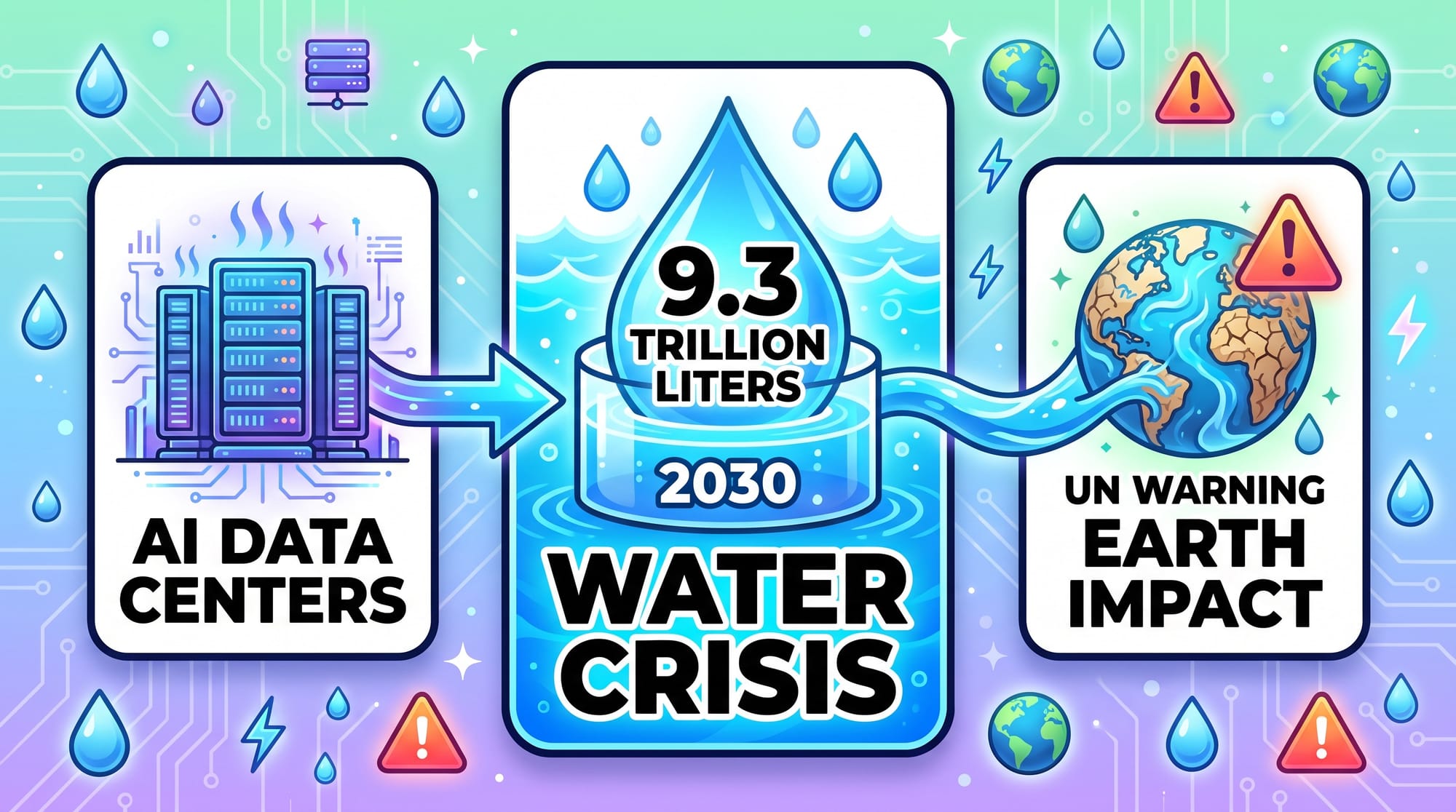
The United Nations University Institute for Water, Environment and Health released a report a few days ago. The numbers are blunt enough to make you stop and sit in silence for a moment: by 2030, global AI data center electricity consumption will double from 448 terawatt-hours to 945 terawatt-hours per year — and water consumption will jump from 4.5 trillion liters to 9.3 trillion liters.
What Does 9.3 Trillion Liters Actually Mean?
Here’s one way to grasp it. Today, more than 600 million people in sub-Saharan Africa lack access to basic water for daily living. By 2030, that number climbs to 1.3 billion. The water that AI data centers will consume in a single year is enough to supply all 1.3 billion of those people for an entire year.
Kaveh Madani, Director of the UNU Institute for Water, Environment and Health and the report’s lead author, put it plainly: “The industry’s relentless race for growth is overriding the most fundamental principles of sustainability.”
That stings. But after reading through the primary data ourselves, it’s hard to argue with him.
Let’s Break Down the Report
In 2025, data centers worldwide consumed 448 terawatt-hours of electricity. AI accounted for roughly one-fifth of that. By 2030, AI’s share is projected to climb to 40%.
Why? Because models keep getting larger, inference sequences keep getting longer, and multimodal capabilities send per-call energy costs through the roof. A single inference request at the GPT-5.5 tier consumes more than ten times the energy of a GPT-4 call from two years ago.
And it’s not just training that burns resources. The agentic era has arrived. A single task now orchestrates dozens of sub-agents and spawns hundreds of tool calls, with token counts exploding at every step. Every additional token means additional energy — and another scoop of cooling water.
TSMC recently noted that AI demand is so intense that capacity can only “support so much.” NVIDIA’s newly released Nemotron 3 Ultra is explicitly designed for “long-running agents” — translation: the old paradigm of run-and-exit is over. Today’s AI is supposed to stay on, keep thinking, and keep calling tools indefinitely. Like an intern who never goes home.
Behind all of this: denser server rooms, taller cooling towers, and river evaporation rates creeping up year after year.
A Question Worth Sitting With
Where does AI end up, ultimately?
Bigger models? Stronger reasoning? More servers, more electricity, more water?
Here’s a counterintuitive fact: the global energy consumption curve for data centers tracks almost perfectly with the AI capability curve. Every ChatGPT conversation, every Cursor autocomplete, every NotebookLM summary translates into real electricity bills and real cooling water charges somewhere in the world.
And that bill is spiraling out of control.
Cloudflare Radar recently published a striking data point: over the past week, 57.5% of global HTML web requests came from bots. Only 42.5% came from humans. The internet is no longer primarily a place where people browse — it’s a place where machines talk to machines, scrape data from each other, and train each other.
Every one of those machine-to-machine communications burns energy.
The internet is transforming from something built for humans into something built for machines. And machines have a much bigger appetite.
So What Do We Do?
Efficiency improvements are real and ongoing — better chips, more optimized inference frameworks, more aggressive quantization. These help. NVIDIA’s Nemotron 3 Ultra alone delivers meaningful cuts to inference costs.
But efficiency gains are symptom relief. The underlying condition is the architecture itself.
Look at the structural logic of today’s AI data infrastructure. It’s built to funnel the world’s compute and storage into a handful of hyperscalers. AWS, Google Cloud, and Microsoft Azure collectively control over 60% of global cloud compute. Data centers grow larger. Cooling towers grow taller. Power demands grow faster.
That centralized model has a structural flaw: the larger the scale, the lower the marginal efficiency.
Pack ten thousand servers into one campus, and heat dissipation becomes a physical nightmare. Liquid cooling, immersion cooling — whatever you try, the conversion efficiency from electricity to useful compute always hits the same ceiling imposed by centralized physics.
And there’s another layer most people overlook: most of the data stored in these facilities is duplicated.
The same model weights stored across a hundred nodes. The same dataset downloaded separately by dozens of teams. The same video shuttled back and forth across CDN nodes on three continents. The energy wasted on storage redundancy is larger than most people imagine.
This Is Where MEMO’s Thinking Comes In
MEMO’s core premise is simple: don’t put all the world’s eggs in one basket — and don’t pour all the world’s cooling water into one pool.
MEMO uses a decentralized storage network (MEFS) to distribute storage tasks across idle nodes scattered around the globe. You don’t need to build a million-square-foot hyperscale data center. You just activate storage resources that already exist, already distributed, already sitting mostly unused.
The benefits go beyond data sovereignty and privacy.
Take cooling. Centralized data centers dedicate specialized cooling infrastructure that accounts for 30–40% of total power consumption. Decentralized nodes operate in ambient environments — they don’t require centralized cooling, and that entire chunk of energy overhead simply disappears.
Academic research backs this up. A 2025 study published in Energy and Buildings compared centralized and distributed cloud architectures directly. The conclusion was unambiguous: distributed architecture delivers 19–28% energy savings.
That’s not a projection or a thought experiment. It was measured.
There’s another hidden cost in centralized storage worth naming: data transit. A model inference call from Beijing might route through a data center in Virginia — crossing Pacific undersea cables, bouncing through more than a dozen routing nodes, burning transmission energy at every hop.
MEMO’s decentralized network stores data close to where it’s needed and retrieves it locally. Routing hops drop by more than half. In the agentic AI era — where agents read and write data continuously at high frequency — the transaction cost isn’t just gas fees. It’s real, physical electricity.
A Candid Note
Decentralized storage isn’t a cure-all. It doesn’t solve every AI energy problem. It doesn’t replace solar or wind. Its value is in offering a different possibility: AI infrastructure doesn’t have to follow the centralized playbook.
You don’t have to concentrate the world’s compute in three companies’ server rooms. You don’t have to let a single data center drain a city’s water allocation. You don’t have to keep fighting the laws of physics with “bigger, denser, hotter.”
There’s another way to look at it.
Activate idle hard drive space. Connect distributed nodes into a coherent network. Let data live where it belongs, instead of routing everything into a single massive warehouse.
Simple in concept, hard in execution — it requires the protocol layer, the incentive layer, and the consensus layer to work together. MEMO has spent over three years building this infrastructure: the x402 protocol connecting AI with on-chain payments, ERC-8004 defining decentralized data interaction standards, and the DataDID plugin giving users full control over their own data.
These look like Web3 vocabulary. At ground level, they address one problem: infrastructure efficiency isn’t a one-way street of hardware optimization. Architectural rethinking is a far larger lever.
Back to That UN Report
9.3 trillion liters of water. 945 terawatt-hours of electricity. 399 million tons of carbon emissions.
These numbers describe an industry sprinting toward something unsustainable.
Kaveh Madani’s statement had a second half: “With nations and corporations rushing to build new compute infrastructure, overall water and energy demand will in all likelihood continue to rise.”
In other words: efficiency alone isn’t enough. Switching to more power-efficient chips alone isn’t enough. The industry needs a genuinely different architectural choice.
The MEMO team holds one belief that’s been constant throughout this work.
The future of AI shouldn’t be built inside a handful of giant data centers. It should grow across the hard drives of countless individuals and nodes distributed around the world.
Not centralized — distributed.
Not monopolized — collectively built.
Not “bigger, denser, hotter” — but more dispersed, more efficient, more sustainable.
The road ahead is long. MEMO has been on it for three years.
2030 isn’t far away.
9.3 trillion liters isn’t science fiction. It’s a number the United Nations ran through models and calculated seriously.
When we look back at today from that vantage point, someone will ask: at that inflection point, some people chose to build more servers. Others chose a different path. Which one were you?