
The Second Data Revolution: From Production Input to Ownable Assets
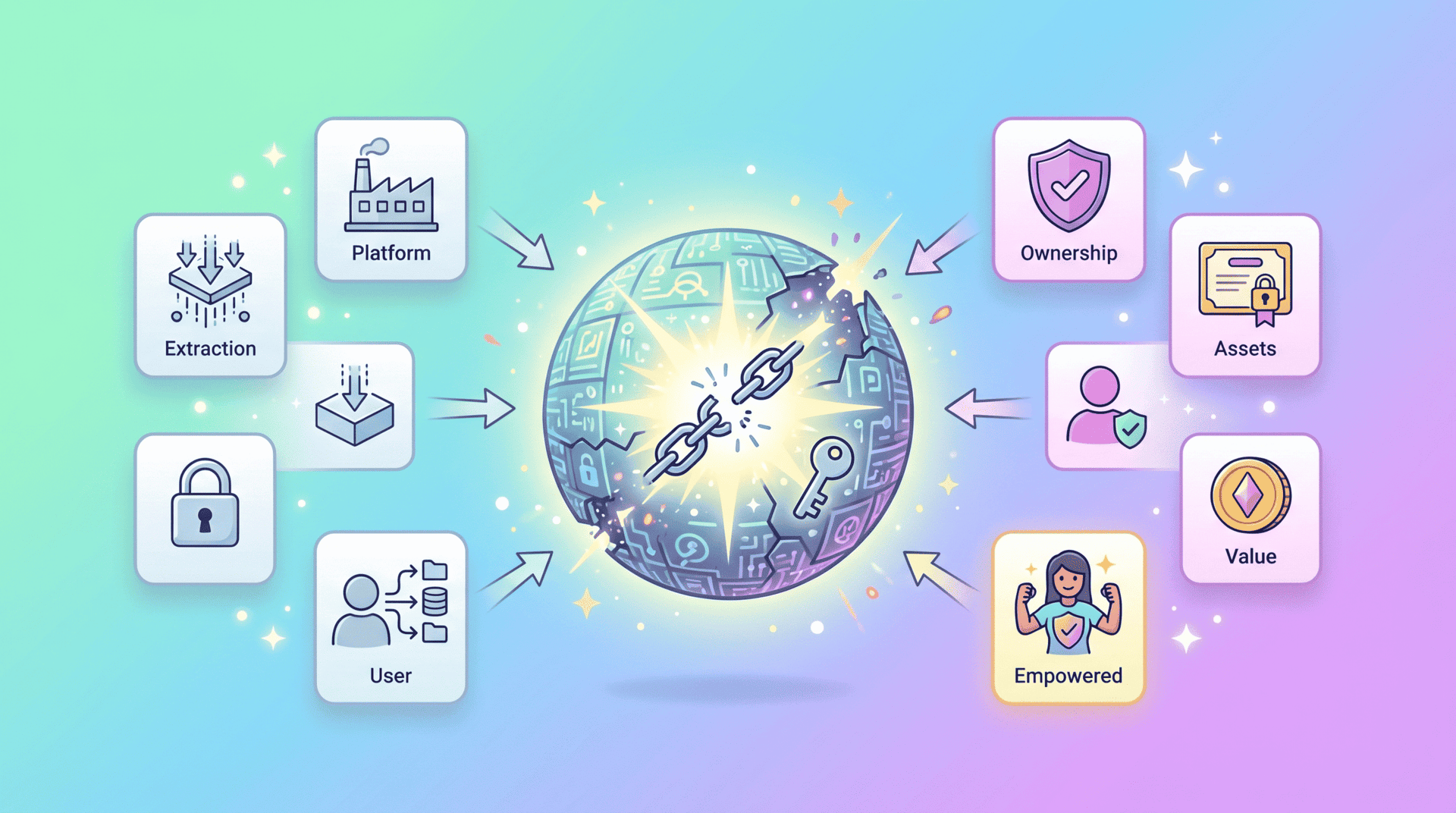
There is a question that, after 30 years of the internet, is finally being taken seriously:
Who does data actually belong to?
This question has been set aside for so long not because there is no answer, but because the answer is inconvenient for too many parties. Platforms need data to sustain their business models, advertisers need data for precise targeting, and AI companies need data to train models. Across this entire value chain, the original creators of data — ordinary users — have always been at the very end, contributing the most while receiving the least.
But now, technological evolution is fundamentally changing this dynamic.
1. The 30-Year Data Paradox
The first era of the internet solved the problem of information distribution. Anyone could publish content and make it visible to the world. This was an unprecedented form of empowerment.
The second era of the internet solved the problem of connection. Social networks, e-commerce platforms, and search engines connected billions of people into a single network. Traffic became the most important resource, and attention became the scarcest commodity.
But in the process, something quietly happened: user data became systematically concentrated in the hands of a few platforms.
What you searched for, what you expressed on social media, what you purchased on e-commerce platforms — this data has been collected, analyzed, sold, used to train models, used to predict behavior, and used to influence decisions. And all of this usually happened without your knowledge, and without asking for your consent.
The deeper paradox is this: the value of data comes from its accumulation and circulation, yet in the current system, the benefits generated from that accumulation and circulation flow almost entirely to intermediary platforms, rather than to the original source of the data — the individual.
This is a systemic unfairness that has persisted for 30 years.
2. The AI Era Makes This Issue More Urgent
If over the past 30 years the data issue was background noise, the arrival of the AI era has made it a central issue that must be addressed head-on.
The reason is simple: AI’s demand for data is unprecedented.
The capabilities of large language models depend, to a large extent, on the quality and scale of their training data. Every article, every conversation, every accumulation of knowledge can become part of a model’s capabilities. This means that every digital trace left by humanity over decades now carries greater economic value than ever before.
At the same time, a structural contradiction has become more pronounced: data creates enormous value for AI, yet that value is captured by a small number of AI companies, with no mechanism for the original contributors of the data to share in that value.
Furthermore, as AI agents begin to act on behalf of humans — automatically completing tasks, executing transactions, and generating content — the questions of data origin, quality, and ownership become critically important. If the data used by an AI agent has unclear provenance or ownership, then its actions lack a trustworthy foundation.
The issue of data sovereignty has never been so closely tied to everyone’s real interests.
3. Three New Shifts Are Quietly Emerging
Over the past two years, discussions around data assetization have begun shifting from conceptual debates to infrastructure development. Three notable changes are emerging:
First, data is being viewed as an asset, not just a raw input.
In the past, data was defined as a production input — a raw material that drives economic activity. But the defining feature of raw materials is that once they are used, the value transfers to the user, and the original owner no longer benefits.
Now, with the maturation of blockchain technology, data is being redefined as an asset that can be owned, priced, and circulated repeatedly. The fundamental difference between an asset and a raw input is that ownership of an asset is persistent, and the value it generates can continuously flow back to its owner.
This shift in understanding is giving rise to entirely new models of the data economy.
Second, verifiability is becoming a core component of data value.
In an era flooded with AI-generated content, the value of a piece of data increasingly depends on whether it can be verified: where it comes from, whether it has been tampered with during circulation, and whether its usage history is clearly traceable.
Data without verifiability carries a high trust cost in high-value scenarios. Blockchain’s immutable records and timestamps naturally provide this verifiability, enabling a complete lifecycle record for each piece of data — from creation to circulation, with every step traceable.
Third, data ownership is shifting from platforms to individuals.
This trend is still in its early stages, but the signals are clear. Users are becoming aware of the value of their data, regulators are paying closer attention to data ownership, and technological tools are beginning to offer better support.
Real change will not come from platforms voluntarily giving up control — that is unrealistic. It will come from a redesign at the architectural level. When data storage, ownership, and circulation occur within on-chain protocols directly controlled by users, platforms lose the ability to unilaterally determine the fate of data.
4. Four Key Dimensions of Data Assetization
For data to truly become an asset rather than remain a concept, capabilities must be established across four dimensions:
Ownership: Data must have clear attribution.
The prerequisite for any asset is clear property rights. The first step in data assetization is to establish on-chain ownership records for each piece of data — who created it, when it was created, and what modifications it has undergone. This information must be permanently anchored in immutable infrastructure.
Only once ownership is established does everything else become meaningful. Data with unclear ownership cannot circulate in markets or generate returns for its original creator.
Circulation: Data needs a trusted marketplace.
After ownership is established, data must be able to circulate freely. This requires a transparent and efficient marketplace where buyers and sellers can discover each other, complete transactions, and settle through smart contracts.
However, there is a subtle balance: data circulation must occur while protecting privacy. Buyers need to verify the quality and provenance of data, but they do not necessarily need access to all raw information. This “usable but not visible” requirement is driving innovation in data trading models.
Revenue: The value generated by data should return to its creators.
This is the core proposition of data assetization. When your data is used — whether for AI training, research, or enterprise decision-making — you should receive corresponding returns.
This requires the automated execution capabilities of smart contracts. Each use of data can trigger a payment to the original creator, making the process automatic, transparent, and free of intermediaries.
Protection: Data assets require reliable security mechanisms.
Like any other type of asset, data assets need protection. This includes not only preventing hacking but also avoiding permanent loss due to unforeseen circumstances.
In this regard, decentralized storage offers greater reliability than centralized servers. Data is distributed across multiple nodes, eliminating single points of failure. At the same time, account recovery mechanisms are an essential part of the data asset security system.
5. The Historic Convergence of Two Technology Curves
The reason this moment represents a critical window for data assetization is that two technological trajectories — long evolving independently — are now converging in unprecedented ways.
One is the AI curve. AI is evolving from a tool into an agent, from answering questions to acting on behalf of humans. In this process, the demand for high-quality, traceable, and clearly owned data is growing exponentially.
The other is the blockchain curve. Blockchain is evolving from a carrier of speculative assets into infrastructure for identity, payments, permissions, and auditing. Its capabilities — immutable records, automated contracts, and decentralized trust — are exactly what data assetization requires.
The convergence of these two curves creates a new possibility: data can become a true asset, rather than just a passive production input.
6. The Evolution Path Over the Next Three Years
If this direction holds, the evolution path over the next three years is relatively clear:
Short term (1–2 years): ownership infrastructure matures first.
The first step in data assetization is to establish clear on-chain ownership records. Relevant standards, tools, and platforms will mature first, allowing users to easily turn their data into assets. This is the direction closest to real demand and with the least technical friction.
Medium term (2–3 years): data marketplaces become active.
As ownership infrastructure matures, data marketplaces will begin to see real activity. AI companies, research institutions, and enterprises will become the primary sources of demand, while individuals and organizations become the main suppliers. Pricing mechanisms will gradually emerge through market interaction.
Long term (3+ years): the data economy becomes a core part of the internet.
Once data ownership and trading become foundational capabilities, a complete data economy will gradually take shape. Users will no longer be just consumers of internet content, but participants in — and beneficiaries of — the data economy.
7. Conclusion: The Second Data Revolution
The first revolution of the internet solved the problem of information distribution. It allowed content to flow freely and gave everyone a voice.
The second data revolution will solve the problem of value ownership. Data will no longer exist merely as numbers on platform balance sheets, but will return to each real creator as an asset that can be owned, protected, traded, and monetized.
This revolution will not happen dramatically. It is quietly reshaping the logic of data ownership through the establishment of technical standards, the creation of data marketplaces, and the adoption of ownership tools.
When all of this becomes reality, one truth will be self-evident:
The data you create should work for you.