
The Enclosure Movement, Reenacted: This Time, What’s Being Fenced In Is Your Data
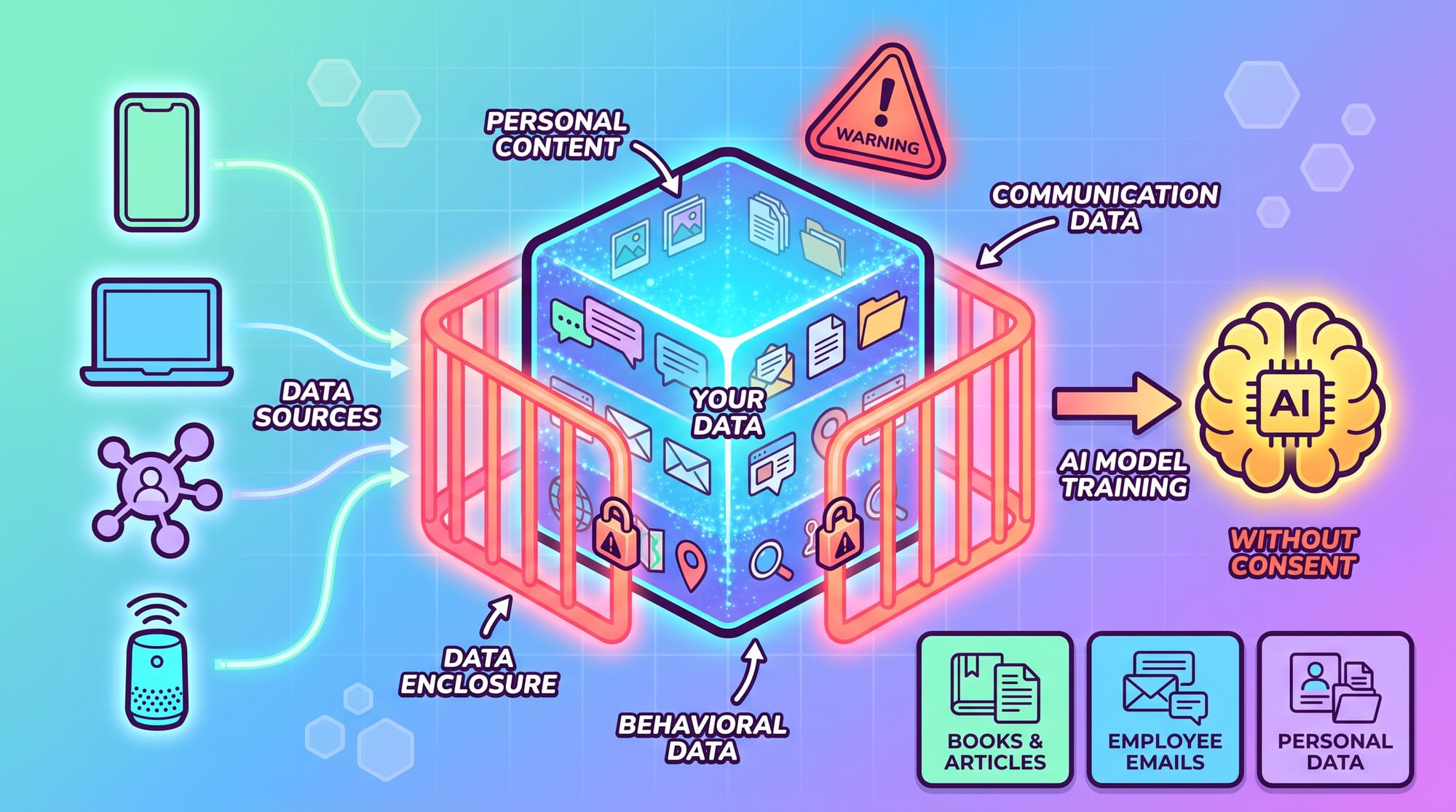
Every elegant act of plunder needs a righteous opening line.
In the late fifteenth century, when European fleets first set foot on the shores of the Americas, they brought more than muskets and crosses. They brought a Latin phrase that would later be written into international law textbooks: terra nullius — nobody’s land. The phrase meant that if a piece of land carried no ownership marker recognized by the “civilized world” — no fence, no deed, no church — then in the eyes of the law, it was empty. Whoever planted a flag first, owned it.
This was never a trivial legal formality. For the past five hundred years, it has served as the underlying license for nearly every act of colonial expansion, land seizure, and resource extraction. Land that Indigenous peoples in the Americas had lived on, farmed, and moved across for generations was declared nobody’s land simply because it didn’t match the European definition of “ownership.” Aboriginal Australians had lived on their continent for tens of thousands of years, yet it wasn’t until 1992 — barely three decades ago — that Australia’s High Court, in the landmark Mabo v Queensland decision, formally overturned the terra nullius doctrine that had stood for two hundred years, acknowledging that Aboriginal land rights had never actually disappeared. They had simply never been recognized by the “civilized world.”
Two hundred years, for one belated acknowledgment. And in those two hundred years, there was more than enough time to redistribute an entire continent’s resources, wealth, and fate.
This Latin phrase is worth resurrecting in 2026 because it never actually vanished. It just changed clothes and put them on your data.
Book-Breaking and Auctions: Two “Flag-Planting Ceremonies” That Happened This Month
In August, two news stories made headlines in the tech press within days of each other. At first glance, they looked like unrelated business transactions. Look closer, and they’re the same logic performed twice.
The first took place in a warehouse in Nevada. Investigators from the tech outlet 404 Media hid an AirTag inside a shipment of rare books and tracked it to Amazon’s LAS8 warehouse in Las Vegas. There, a team code-named VGT3 received the paper books, sliced their spines open, and fed them into high-speed scanners. The original books were destroyed immediately afterward. Most of these books were published before 2022 and had never been digitized — not a single word inside them was written by AI. They were scanned into Amazon’s own Nova model as training material, and the books themselves — along with the paper, ink, and binding, along with what their authors may have spent half a lifetime writing — were shredded, recycled, and permanently erased. Anthropic reportedly did something similar, under the code name “Project Panama”: buy books, disassemble them, scan them, destroy them.
The second took place in a Delaware bankruptcy court. Spirit Airlines, grounded and declared bankrupt, had its internal corporate data auctioned off as part of its asset liquidation. Google won the bid for $10 million: roughly 100 million emails, 500 million Teams messages, 516 code repositories, nearly 30 million lines of code, and decades of operational records. The industry has a precise and chilling name for this category of data: “corporate exhaust.” The competing bidder, another AI data company called Mercor, offered $7.5 million and lost.
Nobody asked the employees who wrote those hundred million emails whether they consented. Nobody asked the authors of those books whether they were willing to have their work disassembled and destroyed. The logic of terra nullius never required “asking.” It only required confirming that no one else’s flag was already planted on the land.
To an AI company, an undigitized book looks no different from an unfenced prairie — both are “unclaimed” ground, and whoever plants a flag first owns it. The internal communications a bankrupt company leaves behind look no different from territory abandoned by the defeated — both can be priced and auctioned publicly once the gavel falls, while the people who actually invested their time, effort, and privacy into that data don’t even get a seat in the auction gallery.
Enclosure: The European Version of the Same Logic
If terra nullius was the overseas colonial version of this logic, the Enclosure Movement was its domestic European practice.
In Britain, from the sixteenth through the nineteenth centuries, common land that generations of farmers had shared for grazing, farming, and gathering firewood was fenced off, parcel by parcel, into private property by landlords and capital. Farmers’ right to use that land was a fact upheld by centuries of customary law, but it had never been written onto any deed. When capital decided to enclose it, that very absence of formal title — “possession in fact, without formal confirmation” — became the perfect opening. The fact that you’ve used something for generations doesn’t mean you own it. If you can’t produce a piece of paper proving ownership, your right doesn’t exist.
That sentence was a brutal reality for eighteenth-century English farmers. Today, it applies almost word for word to every ordinary internet user. Every tweet you write, every browsing record you leave in your browser, the content assets you’ve accumulated over years on social platforms — you use them, you create them, you depend on them, yet you’ve never held a “digital deed” proving any of it belongs to you. And that is exactly the blank space capital is best at exploiting.
“Fair Use”: A Defense That Sounds Uncomfortably Familiar
Back to the book-shredding itself. The current court ruling holds that this kind of destroy-as-you-scan process qualifies as “fair use.” The reasoning: the original book is destroyed, so there’s no “copy and resell” scenario, and therefore no copyright infringement in the traditional sense.
Read purely as legal reasoning, this is internally consistent. But put your ear closer to history, and you’ll hear a tone that’s uncomfortably, chillingly familiar.
Colonizers never said “we are robbing this place.” They said they were “developing” land that was “underutilized.” They said they were turning “backwardness” into “civilization.” They said Indigenous farming methods were inefficient, and that capital and technology would finally let the land be “put to its fullest use.” Every act of plunder needs a language of efficiency that sounds beyond reproach to wrap itself in — back then it was “development,” today it’s “fair use”; back then it was “the civilizing mission,” today it’s “technological progress.”
The question the court’s ruling answers is: “Was this book illegally copied and resold?” That’s a question defined last century, designed specifically to guard against pirates. But the question that actually deserves to be asked in 2026 was never that one. It’s this: does an author have the right to decide whether the words they poured their life into get sliced apart, scanned, and destroyed to feed a commercial model they never authorized and may never have even heard of? Current copyright law was never designed to answer that question, because it has always been about who holds the right to copy — not whether a creator’s control over their own work is being respected.
This isn’t a legal loophole. It’s an entire hierarchy of values — efficiency over consent, scale over the individual, fait accompli over prior authorization. Five hundred years ago, that hierarchy was applied to land. Today, it’s being applied, unchanged, to data.
An Employee’s Late-Night Email Is Now Google’s Training Material
The Spirit Airlines case exposes this hierarchy even more completely, and even more ironically.
Somewhere in those hundred million emails, there’s almost certainly a customer service agent patiently answering an angry passenger’s complaint at eleven at night. Somewhere in those five hundred million Teams messages, there’s almost certainly an engineer trading dozens of messages with a colleague in the middle of the night, chasing down a system outage. Wrapped inside that text is the specific effort and emotion of specific people, given up during specific late nights. But under bankruptcy law, those messages are treated exactly like servers, office furniture, and a corporate logo — line items in an asset liquidation, bundled with the company, and sent to auction.
At no point in that entire process did anyone ask the people who wrote those messages: are you willing?
Because bankruptcy law has only ever cared about whether creditors get paid first — not whether the original creators of that data have any say. This isn’t one company being unusually cold-blooded. It’s that the entire system was never designed, from the outset, to include “what the data’s creator wants” as a factor worth considering. And that’s precisely what should alarm us most — not that any one person did something wrong, but that the whole system runs so smoothly that nobody even notices something is off. After de-identification, the names and identities inside those messages were stripped out. But what can’t be stripped out is this: they were, in the first place, the specific trace left behind by a specific person on a specific late night — and now they’ve been enclosed into a $10 million asset package.
A Two-Hundred-Year-Late Confirmation, and the One We Can Still Get Right
It took two hundred years for Mabo to overturn terra nullius. Britain’s actual land registration system was likewise built slowly, piece by piece, over the long years following the Enclosure Movement. History has proven, again and again, that formal confirmation of rights always lags behind possession — and every year of that lag is another year for vested interests to cement their gains. By the time the law finally, belatedly, acknowledges that “this land already had an owner,” the original owner has usually long since been displaced, and actual control of the land has long since changed hands in practice.
This is exactly why the data domain cannot afford to repeat this script. A court ruling typically takes years to land. The speed at which tech giants scrape, disassemble, and auction data is measured in weeks. If we keep waiting for legislators and judges to slowly restore justice the way they did two hundred years ago, by the time the “data version of Mabo” finally gets decided, there may not be a single inch of unclaimed data soil left in the world.
This time, confirmation of rights has to happen before possession — not after.
This is also why, over the past two years, a wave of on-chain protocols focused on “data rights confirmation” has begun to emerge. What they’re fundamentally trying to do is dismantle the very precondition that makes enclosure possible in the first place — the fact that data has no clear, verifiable owner. Concretely, this means binding a verifiable creator identity to every piece of data from the moment it’s created — effectively issuing an immutable proof of ownership the instant the data is born, instead of waiting for some giant to plant a flag first and hoping a court ruling catches up decades later.
Take ERC-7829, a standard purpose-built for data assets, as an example. Its core innovation is treating the content of the data itself — not an image, not an avatar — as the asset that can be owned and traced: storage proofs make the content tamper-evident; access control lets the creator define, on their own terms, who can use it and how; and revenue distribution executes automatically through smart contracts, requiring neither a giant’s goodwill nor a court ruling that arrives two centuries too late.
What it’s doing is, at its core, the same thing as those land rights that took two hundred years to be recognized — except this time, the goal is to move “confirmation of rights” to the moment just before possession happens, instead of making creators wait through an appeal process nearly as long as a lifetime.
History Doesn’t Repeat Itself, But It Rhymes
Someone once said history doesn’t repeat itself, but it often rhymes.
Enclosure, terra nullius — these names have long been nailed to history’s pillar of shame. No one today would publicly defend colonial plunder. But when we point the camera at the data domain, we find the ghost of that same logic striding back onto the stage, dressed in thoroughly modern, thoroughly neutral, seemingly harmless new language: “fair use,” “efficiency first,” “asset optimization.” And this time, almost no one notices what’s being replayed.
A broken spine doesn’t speak. A liquidated inbox doesn’t protest. This is precisely what makes this logic so insidious — it always chooses targets that, for the moment, have no ability to speak up for themselves. Two hundred years ago, it was Indigenous peoples without Western-style land deeds. Today, it’s ordinary creators without on-chain proof of ownership. A place once marked “unexplored” on a map was never actually empty. No one simply bothered to ask: was someone already living here?
This same drama has played out too many times before, and every time, the final act has only been written into the history books decades or centuries later, appended with a belated apology. This time, it’s our turn to decide: do we keep watching from the sidelines, waiting for the next belated confirmation of rights, or do we write “data is born with an owner” into this era’s ledger, right now.
The real question was never “is this legal.” History has already proven that legality can always be granted after the fact — the victors always have time to rewrite their own actions into a righteous chapter. The real question is this: when the next batch of books gets disassembled, when the next bankrupt company’s servers go up for auction, do we choose, once again, to pretend this is unclaimed land — or do we, this time, finally remember that behind every inch of data stands a person who should have been asked, “are you willing?”
Unclaimed land was never truly unclaimed. It’s just that its owner’s voice hadn’t yet been heard by this world’s rules.