
The Complete Ecosystem Map of Data Mining Points

Since Data Mining launched, a lot of users have been asking the same question: what can points actually do?
Underneath that question is a real uncertainty about what points are anchored to. In traditional points systems, points are often just a number that looks valuable but can never actually be spent on anything. DataDID doesn’t want to be that kind of system.
This map lays out, in one place, every way to earn Data Mining points across the MEMO ecosystem and every way to use them.
1. Where Points Come From
Before getting into what points are worth, it helps to understand where they come from. The Data Mining points system runs on two parallel tracks.
Online points. Having the plugin active signals that your node is available. Points are issued hourly. The base rate is 6 points per hour, with a streak multiplier that grows the longer you stay consistently online — roughly 1.35× by day 7, maxing out at 1.5× by day 10. Daily online points cap at 108. This track rewards steady, consistent participation: the more regular your online time, the faster your points accumulate.
Data contribution points. Measured by the number of effective unique domains you visit, weighted by two multipliers — diversity and quality. Three dimensions influence your final score: the number of unique domains visited that day, the breadth of content category coverage (using the IAB content taxonomy), and effective time spent per page. Anti-gaming mechanisms are built in — a single domain with less than 5 seconds of dwell time doesn’t count as an effective visit, and sub-pages under the same second-level domain are consolidated. This track rewards genuine, diverse browsing behavior, not sheer data volume.
A typical example: on your 7th consecutive day online, with 8 hours of activity and 20 unique domains visited across multiple categories, you can expect around 101 points that day.
Beyond the Data Mining module itself, there are other ways to earn points across the ecosystem. Daily check-ins earn a points reward. Installing the datadid-checkin Skill through OpenClaw fully automates check-ins, with points landing automatically. Participating in the platform’s periodic campaigns provides additional points rewards. Inviting friends to register earns starter points for both parties.
2. Spending Points Directly in the Ecosystem
The first category of use is direct in-ecosystem spending.
Tweet Minting is the most direct spending channel for points. Through the DataDID browser extension, users can mint their own tweets from X (formerly Twitter) as on-chain data assets, built on the ERC-7829 standard. The minting process consumes points. Once minted, a tweet is no longer just a line of text on Twitter’s servers — it becomes an on-chain asset with integrity verification anchoring, programmable access control, and automatic revenue distribution rules built in. Points function here as the fuel for data asset formation.
The other major spending category lives in AppsList, DataDID’s built-in application marketplace. AppsList brings together various functional Web3 applications that users can log into directly with their DataDID identity, several of which accept points for participation.
AliveCheck is the flagship application in AppsList, and MEMO’s on-chain life monitoring module. Users can subscribe to AliveCheck using points. Once subscribed, checking in daily on AliveCheck signals you’re okay; if you miss two consecutive days, the system automatically notifies your pre-set emergency contacts. Users can also set up a message capsule — essentially an on-chain will — which the system automatically delivers to designated contacts if you go offline. What points purchase here is a safeguard for your digital legacy.
Beyond that, the platform’s periodic campaigns also accept points for participation. During the Summer Appreciation Season, for example, installing the plugin and connecting a wallet — or an existing user simply logging in — earns an immediate points reward. Points can also be used to participate in various platform tasks for additional earning opportunities.
3. The Relationship Between Points and Ecosystem Identity
Points aren’t just a spending credential. They’re also a quantified record of a user’s ecosystem identity.
In the DataDID ecosystem, every contribution a user makes accumulates as points tied to their DID identity. Total points reflect the depth of a user’s participation in the ecosystem — the deeper the engagement, the more points accumulate, and the more complete a user’s on-chain identity profile becomes. That profile isn’t just a number. It’s a component of a user’s reputation within the MEMO ecosystem.
The value of that reputation shows up across several scenarios. In the data marketplace, a data provider’s reputation influences both the pricing of their data assets and buyer trust decisions. In future ecosystem governance, participation and contribution levels may serve as an important reference for earning governance rights. In cross-ecosystem collaboration, a verifiable on-chain contribution record is, in itself, the most powerful credibility endorsement available.
Points play the role here of a quantified scale for identity reputation — recording, measuring, and accumulating every small contribution a user makes.
4. Where Points’ Future Value Is Anchored
The most closely watched value scenario for points is their connection to MEMO’s future economic model.
The DataDID points system was designed from the outset with deep ties to MEMO’s economic model. Accumulated points can be converted into eligibility for future MEMO ecosystem benefits — this is the core anchor for the future value of points. Specific conversion ratios and trigger rules will be announced later, but points themselves aren’t directly equivalent to a token. They’re a quantified credential recording a user’s contribution and participation in the ecosystem, and an important basis for future benefit distribution.
The other future value scenario is the data marketplace. Data Mining processes and de-identifies behavioral data locally through ZK Proofs, generating verifiable proofs of behavioral diversity. Once the data marketplace officially launches, the behavioral signals behind these proofs can be packaged as standardized data assets, with smart contracts handling the full transaction pipeline — listing, matching, payment settlement, and access permission grants. When AI training data buyers purchase de-identified behavioral datasets through the marketplace, points gain a genuine external demand anchor. The data marketplace provides points with a channel from “in-ecosystem benefit” to “external economic value.”
These two scenarios form the two layers anchoring points’ value. Benefit eligibility anchors the in-ecosystem distribution logic. The data marketplace anchors the economic support of external demand. Together, these two layers form the complete medium-to-long-term value framework for points.
The Complete Points Ecosystem Map
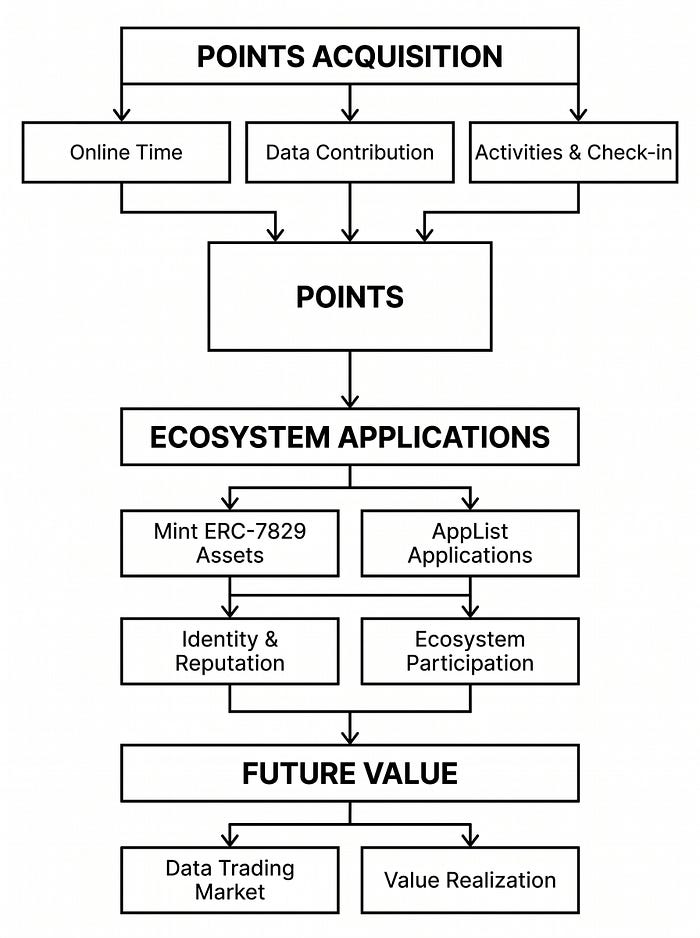
Putting all four layers together, here’s the complete ecosystem map for Data Mining points within MEMO.
Points are earned along two tracks. Online time produces online points; behavioral diversity produces data contribution points. Check-ins, Skill automation, campaign tasks, and referral rewards serve as supplementary entry points.
Points can be spent immediately. Spend points to mint tweets as on-chain assets, subscribe to AliveCheck’s on-chain life monitoring service, and participate in platform campaigns for additional earning opportunities.
Points accumulate into identity. Every contribution is recorded against a user’s DID identity, building their reputation within the ecosystem and influencing future credibility judgments in the data marketplace, governance, and cross-ecosystem collaboration.
Points anchor to the future. Accumulated points convert into eligibility for MEMO ecosystem benefits, and gain economic backing from external demand once the data marketplace launches.
These four layers interlock. The source layer guarantees a sustainable supply of points. The spending layer guarantees their immediate value. The identity layer guarantees their long-term accumulated meaning. The future layer guarantees their upside. Points aren’t an isolated product feature — they’re a component of MEMO’s entire ecosystem economic model, converting every ordinary act of use into accumulated benefit within the ecosystem.
This is also the most fundamental difference between DataDID’s points system and most “check in for points” products. In those products, points are a marketing tool that gets used up and forgotten. In DataDID’s ecosystem, points are a quantified credential of a user’s participation in the data economy — one that keeps appreciating as the ecosystem grows.
Every normal moment spent online, every tweet minted, every check-in, every campaign joined — each one adds a new coordinate to this map.
Your points are becoming your position in the data economy.