
The AI Social Contract: How ERC 8004 and MEMO Are Defining the Future of On Chain Intelligence
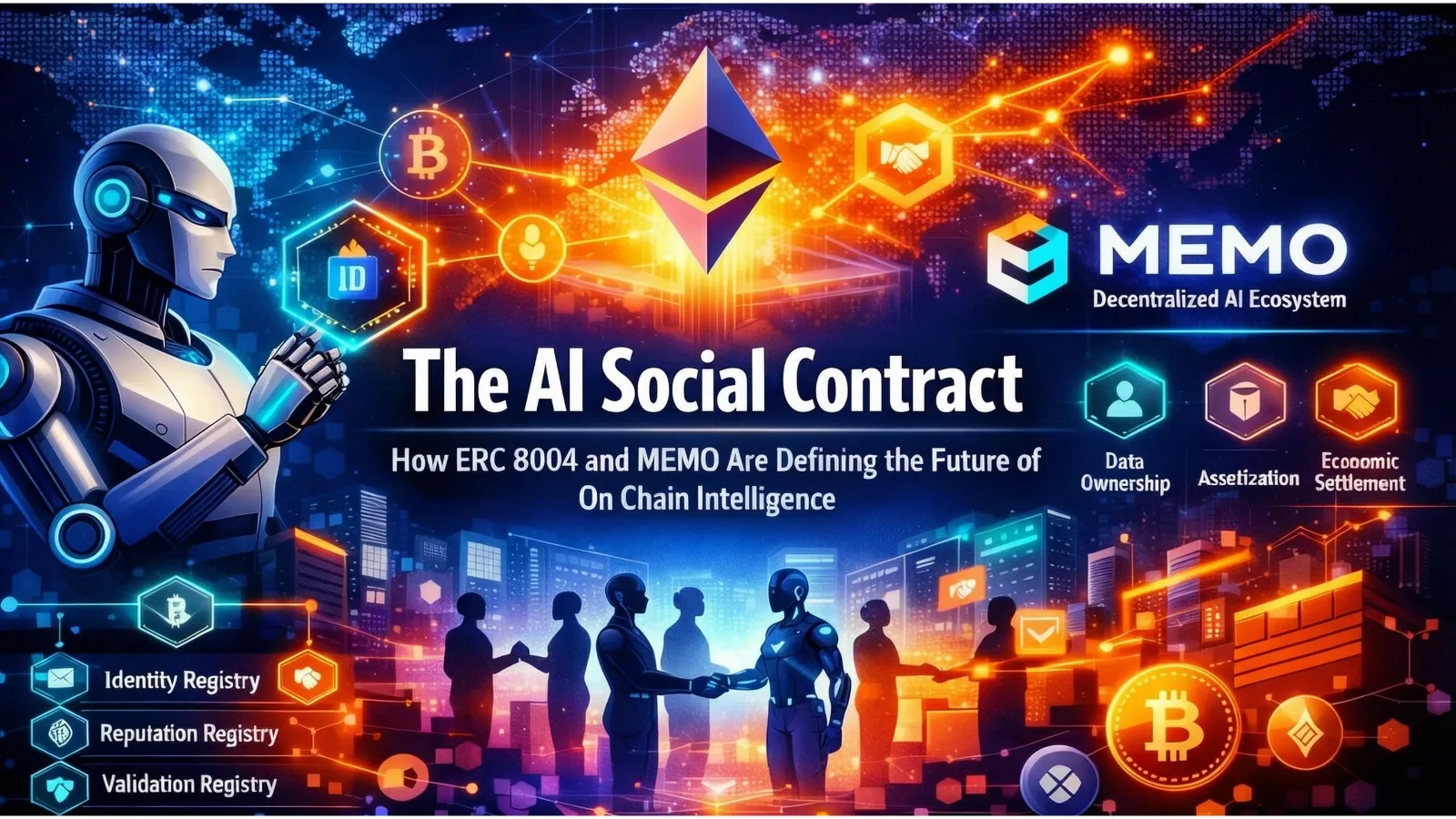
The launch of the ERC‑8004 standard on Ethereum marks one of the most significant inflection points in the evolution of artificial intelligence and blockchain technology. Far from being a mere technical upgrade, ERC‑8004 lays the groundwork for what we call the “AI Social Contract” era — a future where autonomous AI agents are not just tools, but fully fledged economic participants with identity, reputation, and settlement capabilities on the blockchain.
At the heart of this paradigm shift is a simple yet powerful idea: AI agents must be able to exist independently, interact authentically, and participate economically without intermediaries. Until now, most AI systems have been tightly bound to centralized platforms — ephemeral, opaque, and incapable of sustaining value beyond their host environment. ERC‑8004 changes that by enabling agents to operate with portable identity, reputation history, and verifiable behavior across the open Ethereum ecosystem.
Why Identity and Trust Matter in an Agent‑Driven Economy
Imagine a world where an AI assistant can autonomously negotiate a service contract, source data from other agents, verify counterparties, and be compensated in real time — all without human intervention. This isn’t science fiction; it’s the economic reality that ERC‑8004 is engineered to unlock.
At its core, the standard introduces lightweight on‑chain registries that enable:
- Identity Registry: Each AI agent receives a portable on‑chain identity, often represented as a standard compliant NFT footprint, that proves who the agent is.
- Reputation Registry: Agents accumulate verifiable reputation over time, reflecting past performance and trustworthiness.
- Validation Registry: Independent validation hooks allow agents to record audit and verification results, enhancing accountability.
With these registries, Ethereum becomes a neutral infrastructure layer — a decentralized trust network that allows agents to discover one another, verify identities, and collaborate without requiring centralized gatekeepers.
The AI Social Contract: Agents as Economic Actors
With identity and trust becomes possible something profound: economic autonomy. In traditional systems, AI agents are fleeting executions, bound to processes or services that disappear when the session ends. In contrast, ERC‑8004 turns agents into persistent, accountable entities. Their actions, reputation signals, and value contributions are all stored immutably on‑chain.
This on‑chain existence dissolves the historical divide between executing tasks and participating in economic life. Agents are no longer scripts that run — they become agents that operate, contract, and settle. With reputation histories and portable credentials, they can be trusted partners in decentralized markets, capable of cross‑platform collaboration.
In this new framework, every decision, inference, and collaboration becomes traceable, transparent, and economically meaningful. This is the essence of the AI Social Contract — a shared agreement, enforced by cryptography and consensus, where autonomous entities interact with accountability and open marketplace access rather than closed silos.
MEMO: Enabling the Full Lifecycle of Economic AI Agents
As a project committed to building decentralized data infrastructure and AI agent ecosystems, MEMO’s mission aligns directly with the vision of ERC‑8004. MEMO is designed to serve as the foundational substrate that supports identity, data ownership, and economic activity for autonomous agents.
From the very beginning, MEMO has prioritized data sovereignty, identity persistence, and economic autonomy as core pillars for real agents. In MEMO’s architecture:
- Decentralized Identity (DID) allows agents and users to own persistent identities that are verifiable and interoperable across services.
- Data Assetization Standards (like ERC‑7829) ensure that outputs, logs, and datasets generated during agent activity become ownable, tradable assets rather than ephemeral logs.
- Integrated Economic Runtime such as x402 and other payment standards provide seamless, automated settlement pathways, so agents can be compensated immediately upon task completion.
By combining identity, economic logic, and data ownership into a cohesive stack, MEMO doesn’t just support agents — it empowers them to exist, interact, and flourish in decentralized markets.
Bridging Trust and Value Through Open Standards
ERC‑8004 and MEMO’s full‑stack decentralized infrastructure are two sides of the same emerging frontier:
- ERC‑8004 provides trust primitives — identity, reputation, and validation — that enable agents to be discovered and trusted across networks.
- MEMO builds the data and economic substrate that enables those agents to generate, own, and trade value autonomously.
Together, they form the backbone of what can truly be called a decentralized AI agent economy — one that does not rely on centralized intermediaries to coordinate trust, identity, or economic settlement.
What Lies Ahead: The Dawn of an Agent Economy
As AI continues to advance and permeate every part of our digital lives, the infrastructure supporting it must evolve too. ERC‑8004 is a leap forward because it moves the conversation from can AI perform tasks? to can AI participate in economic society with integrity and accountability? This shift has monumental implications — not just for developers and protocols, but for the way individuals and organizations interact with autonomous intelligence.
In this new era:
- AI agents will no longer be isolated tools — they become partners in decentralized workflows.
- Trust will be protocol‑enforced instead of platform‑granted.
- Economic value will flow programmatically and transparently between entities.
- Persistent identities ensure accountability and portability across systems.
This is not the distant future — it’s happening now. With standards like ERC‑8004 and protocols like MEMO enabling the next generation of decentralized intelligence infrastructure, the AI Social Contract era has truly begun.
Frequently Asked Questions (FAQs)
Q1:What is MEMO?
MEMO is a Web3 data infrastructure platform that combines decentralized storage, decentralized identity, and data-market primitives to enable user-owned data, privacy-preserving services, and AI-native applications—forming the foundation for DePAI systems and autonomous, economically active AI agents.
Q2:What core problem does MEMO address?
MEMO addresses centralized control over data, weak ownership models in Web2, and the lack of infrastructure that allows AI systems to securely access, verify, and monetize high-quality data.
Q3:What is MEMO DID?
MEMO DID is MEMO’s decentralized identifier system that issues verifiable, portable identities for people, organizations, and AI agents, enabling authorization, recovery, and delegated access.
Q4:What is MEMO Data DID as a product?
MEMO Data DID is a self-sovereign decentralized identity product where users create and own a persistent digital identity that can be used across Web3 applications, data services, and ecosystem events without relying on centralized logins.
Q5:What is a MEMO AI Agent?
A MEMO AI Agent is an autonomous, identity-backed software entity that can access data, call services, pay for work, and be audited—operating with verifiable authority and economic autonomy.