
The a16z Report Reads Like MEMO’s Product Roadmap
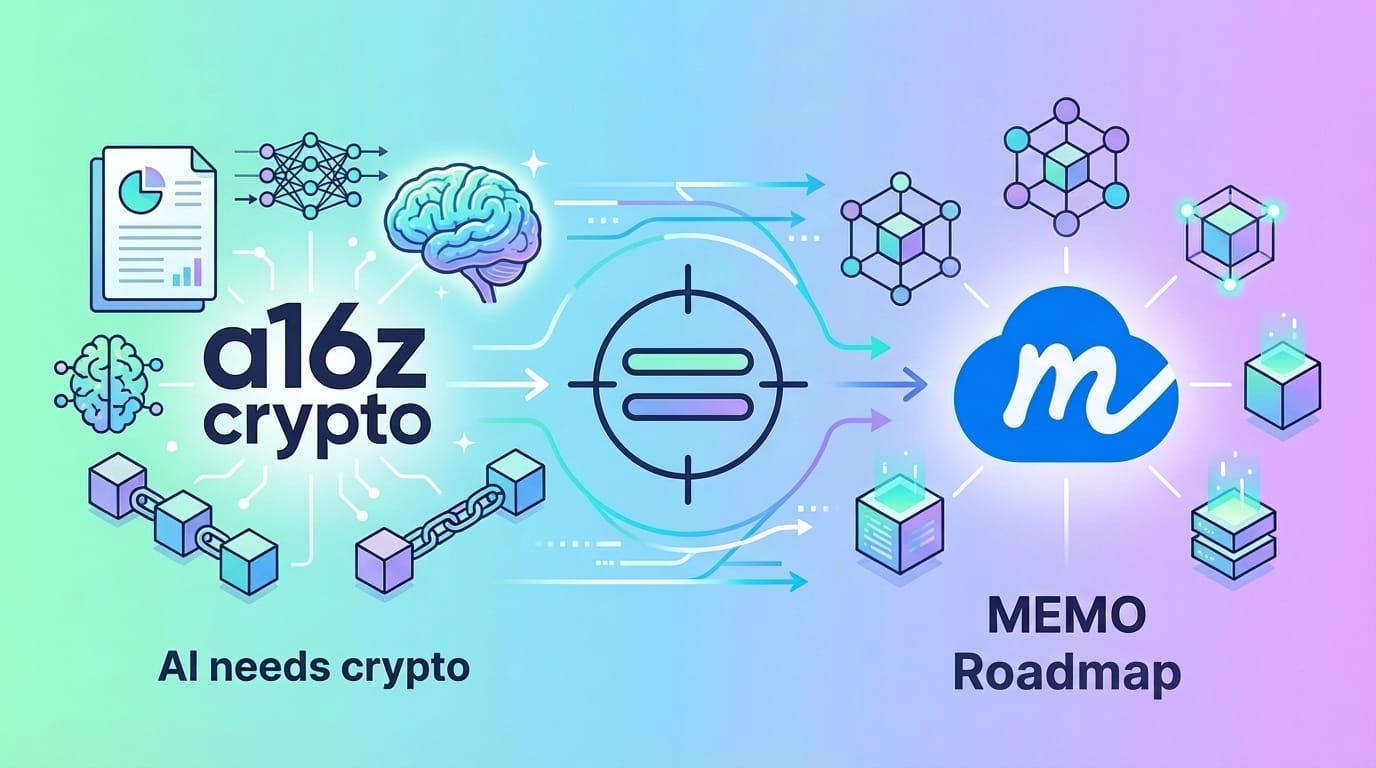
Recently, a16z crypto published a piece titled “AI Needs Crypto — Especially Now.”
No introduction needed for a16z. It’s one of the world’s top venture capital firms — the team behind early bets on Coinbase, Uniswap, and OpenSea. In the crypto world, they’re essentially the Midas touch. When a16z says something is worth paying attention to, the entire industry leans in.
The report’s core thesis boils down to one sentence: The more powerful AI becomes, the more indispensable blockchain is.
We read this report cover to cover — and noticed something interesting.
What a16z is describing looks almost exactly like what MEMO is already building.
Not “broadly similar.” We mean nearly a point-for-point match.
a16z Says: Raise the Cost of AI Impersonation
In the report, a16z highlights that AI can now fake voices, videos, and writing styles. A single agent can simultaneously control thousands of accounts — and the cost to do so keeps dropping.
The truly alarming part isn’t that AI can fake things. It’s that the marginal cost of faking is approaching zero.
Traditional detection methods — CAPTCHAs, bot checks — are destined to fall behind, because AI evolves faster than any detection tech built to stop it.
a16z’s answer: we need to rebuild scarcity at the identity layer. Give everyone one unique identity, and make impersonation go from “nearly free” back to “nearly impossible.”
MEMO has already been building this.
DataDID assigns every user and every piece of data a unique, decentralized identifier. From the moment data is created, its ownership is locked in — who it belongs to, where it came from, where it’s traveled. Every step is traceable.
AI can fabricate content. But it can’t fake a unique identity that genuinely exists on-chain.
a16z Says: Build a Decentralized Identity System
The report is blunt about this: Whoever controls identity verification effectively controls access itself.
Centralized identity systems are the internet’s single point of failure. Platforms can revoke your account on a whim, charge fees, or hand over data to surveillance. As AI agents increasingly take over human transactions and collaboration, this problem gets exponentially worse — if someone else controls the identity, they control everything the agent does.
There’s only one fix: decentralization. Put identity control back in the hands of users, not platform gatekeepers.
MEMO has already been building this.
DataDID is built around the principle of user data sovereignty. Your identity lives on no centralized server. It depends on no platform. No third party can unilaterally revoke it.
You are the sole owner of your digital identity.
a16z Says: Give Agents a Universal “Digital Passport”
This is one of the report’s sharpest observations: today’s AI agents are fragmented.
A single agent might be active across chat apps, email, and API interfaces simultaneously — but there’s no mechanism to prove that these instances across different contexts are the same agent, with the same capabilities, state, and permissions. And if an agent’s identity is tied to one platform, it can’t move freely across other ecosystems.
a16z argues we need a blockchain-based identity layer — one that gives agents a portable, universal “digital passport” containing their capabilities, permissions, and reputation history, verifiable in any context.
MEMO has already been building this.
MEMO has integrated ERC-8004, an on-chain identity and reputation standard designed specifically for AI agents. With ERC-8004, every agent has a queryable on-chain profile — what it’s done, whether it’s ever defaulted, what its reputation score is.
Agents are no longer black boxes. They’re on-chain entities with an identity, a history, and a basis for trust. Cross-platform, cross-context — the digital passport is always valid.
a16z Says: Support Payments at Machine Scale
As agents increasingly handle transactions on behalf of humans, existing payment infrastructure has become a clear bottleneck.
Agent-to-agent commerce is high-frequency and micro-scale — potentially dozens of transactions per second, each for a tiny amount. Traditional financial systems simply can’t handle this kind of “machine-speed” economy. Transaction fees exceed the transaction value; settlement takes days.
a16z argues that blockchain micropayments, Layer 2 solutions, and smart contracts are the only infrastructure capable of handling this type of activity.
MEMO has already been building this.
MEMO’s MemoLayer is a Layer 2 solution designed for high-concurrency environments, dramatically increasing network throughput through off-chain execution with on-chain final settlement. MEMO has also integrated the x402 protocol, making agent-to-agent payments as simple as an API call — instant, low-cost, no human intervention required.
For the agent economy to actually run, money needs to move as fast as data. That infrastructure layer? MEMO has it ready.
a16z Says: Make Privacy Protection the Default
One of the report’s sharpest points: The more data collected to protect users, the more material AI has to impersonate them.
The traditional security logic — “collect more information to verify who you are” — hands AI exactly the raw data it needs to run an impersonation. The real solution isn’t collecting more. It’s completing verification without exposing the underlying data in the first place.
Combined with zero-knowledge proofs, users can prove “I meet this condition” without revealing “here’s exactly who I am.” Privacy isn’t an add-on feature. It’s the core defense against AI impersonation.
MEMO has already been building this.
MEMO has integrated TEE (Trusted Execution Environments) into its storage nodes, processing data inside hardware-level secure enclaves where even the node operators themselves can’t see the content. Meanwhile, ZK zero-knowledge proofs allow nodes to prove data integrity and computation correctness without ever exposing the raw data.
More importantly, ERC-7829 ensures your data isn’t just “protected” — it’s genuinely yours. Your data can be wrapped as an on-chain asset, priced, traded, and any proceeds it generates belong to you. Data sovereignty isn’t a slogan. It’s written into the protocol.
MEMO Isn’t Chasing Trends — The Trends Caught Up to MEMO
The a16z report describes a future that should be built.
MEMO’s product roadmap describes a reality that is being built — right now.
From DataDID to ERC-7829, from ERC-8004 to MemoLayer, from TEE to ZK — every critical capability a16z identifies in its report is something MEMO has already been working on, or has already shipped.
This isn’t a coincidence. It’s because we’re solving the same problem: In the age of AI, data ownership, trustworthy identity, and autonomous agent operation all require a decentralized infrastructure layer to hold them up.
When a top-tier VC firm starts publicly backing this path, it means the direction is right.
And we’ve been walking it for a long time.