
MEMO’s Evolution: From Decentralized Storage to AI Agent Infrastructure
Summary:
From an early-stage decentralized storage project to a full AI Agent infrastructure protocol stack in 2026, MEMO has completed two critical identity upgrades over the span of a few years. This piece works through four layers — storage foundation, identity and asset formation, payments, and application ecosystem — to explain how MEMO uses protocols like MEFS, DataDID, ERC-7829, ERC-8004, and x402, together with products like Data Mining, Data Wallet, SkillsList, and AppList, to build a data infrastructure system capable of supporting autonomous AI Agent operation.
The explosion of AI agents is reshaping the blockchain industry’s center of gravity.
In the first half of 2026, the five major North American cloud providers’ combined AI-related capital expenditure surpassed $800 billion, yet the marginal returns on compute investment are declining faster than ever — the bottlenecks at three foundational layers, training data, trustworthy identity, and asset rights confirmation, are becoming the key obstacles constraining AI agents at scale. At the same time, MEMO, which began as a decentralized storage project, is completing a cross-stage architectural upgrade. MEMO’s full protocol stack has already outgrown the category of “storage project” and is forming a complete infrastructure system spanning storage, identity, asset formation, and agent collaboration.
This piece traces MEMO’s evolution path from storage to AI agent infrastructure from a technical architecture standpoint, and the logic connecting each layer.
I. The Storage Layer: A Distributed Data Foundation
Decentralized storage is not the final form of data infrastructure — it’s the physical starting point of the AI Agent trust chain.
MEMO’s original foothold in the market was decentralized storage. MEFS (MEMO File System) is its core distributed file system protocol, deployed across more than 50,000 storage nodes in 50+ regions worldwide, delivering EB-scale expandable data storage capacity. MEFS’s sharding, redundancy, and efficient access mechanisms enable large-scale data to persist reliably without any centralized trust assumption.
Built on top of this is the Meeda DA (Data Availability) layer, providing low-cost, high-availability off-chain data storage and verification for Layer 2s and AI agents. In AI training scenarios, managing intermediate model checkpoints, inference logs, and training datasets demands extremely high reliability and cost efficiency from storage. The combination of MEFS and Meeda DA delivers a data storage foundation with no dependency on any centralized cloud provider.
The core capability MEMO has built at this layer is distributed physical resource orchestration. A network of 50,000+ nodes is not a lab-environment testnet — it’s a production network running continuously across the globe. This scale provides a genuinely reliable storage foundation for the protocol layers above it, and lays the physical-layer groundwork for the AI computation and data orchestration that follow.
II. Identity, Data Asset Formation, and Payment Layer: Making Data a Circulating Asset
For the AI Agent economy to operate at scale, data must first have the tripartite circulation capability of identity, asset formation, and payment working as one.
The storage layer solves “where does the data live.” Storage itself does not solve “who does the data belong to.” Under an industry trend of increasingly tightening compliance requirements around AI training data — the EU AI Act’s retroactive requirements on training data copyright compliance, GDPR’s cumulative fines exceeding €4.5 billion, national data protection regulations restricting personal data use — every step from data collection to trading now requires explicit confirmation of rights.
MEMO has built three interlocking protocol components at this layer — identity, asset formation, and payment — which together support the complete circulation of data on-chain.
Identity: DataDID + ERC-8004
DataDID is MEMO’s decentralized identity system, assigning a unique on-chain identifier to every user and data asset. DataDID’s registered users have already reached the million-level mark. Every action a user takes in the system — check-ins, points, data contributions, asset holdings — is bound to their DID identity. The identity itself does not depend on any centralized platform’s control; private keys are held by users themselves, and there is no possibility of a platform unilaterally revoking an identity.
MEMO is also actively aligning with protocols that are gaining consensus at the industry level. ERC-8004 is an on-chain identity and reputation standard for AI Agents jointly proposed by institutions including MetaMask, the Ethereum Foundation, Google, and Coinbase, and MEMO is one of the early adopters of this standard. Under this standard, every agent holds a non-transferable on-chain record containing behavioral history, a reputation score, and proof of capability, enabling agents to achieve cross-platform mutual recognition and collaboration in a zero-trust environment. As the agent economy moves from standalone applications toward multi-agent collaboration, trustworthy agent identity and reputation accumulation mechanisms will be a core infrastructure-layer requirement — MEMO’s choice to follow an industry standard rather than build an isolated system of its own also lowers the future cost of cross-ecosystem interoperability.
DataDID answers “who is the person,” while ERC-8004 answers “who is the agent.” The two are complementary within the same identity framework: humans verify identity through DataDID, agents verify capability and reputation through ERC-8004, and collaboration and value transfer between humans and agents rest on the same underlying on-chain identity protocol.
Asset Formation: ERC-7829
ERC-7829 is the data asset NFT standard proposed by MEMO. Its fundamental difference from traditional NFT standards is that ERC-7829 directly embeds a content integrity verification anchor in each token’s on-chain storage, letting anyone verify whether an asset has been tampered with by comparing the on-chain hash value against a data copy; the token natively supports programmable access control, letting data holders set read conditions at mint time — who can access it, what conditions are required, whether payment is needed; and revenue distribution rules are directly encoded in the contract’s royalties field, with splits executed automatically on every transaction.
ERC-7829 has already launched first in DataDID’s social data Mint feature, and has been adopted by more than 20 projects. For the MEMO ecosystem, ERC-7829 upgrades “data that can be stored” at the storage layer into “assets that can be held” — the critical bridge connecting the storage layer to the economic layer.
Payment: x402
Autonomous AI agent operation cannot happen without payment capability. If an agent needs to call an external API to obtain data, use compute resources, or purchase a service, it needs a payment channel that completes automatically without human manual operation.
x402 is an open payment protocol jointly launched by Coinbase and Cloudflare in 2025 — a decentralized implementation of the HTTP 402 Payment Required status code, enabling AI agents to initiate and receive cryptocurrency micropayments through API calls, with payment granularity as precise as a single data request or a single compute call. This allows agents to autonomously complete the full transaction loop of “request service → pay fee → obtain result → settle account” without human intervention. MEMO has implemented and integrated the x402 payment protocol.
When an agent calls data from MEMO’s storage network, it can pay storage and retrieval fees in real time via x402, with no need for manual top-ups or prepaid account management. With identity, asset formation, and payment coupled together, MEMO’s storage network transforms from a “manually managed resource pool” into a “service marketplace agents can consume autonomously.”
III. Application Ecosystem Layer: The Complete Loop from Tools to Marketplace
The value of the protocol layer is ultimately realized through productized applications.
MEMO’s current application-layer footprint covers the complete chain from data collection to asset trading.
SkillsList is a Skill plugin marketplace built for agents, providing AI agents with a channel for capability expansion. The MEFS MCP service gives agents decentralized persistent storage capability, the datadid-checkin Skill achieves check-in automation, and more third-party Skills are covering scenarios such as content generation, data processing, and automated tasks.
AppList is MEMO’s application aggregation layer, presenting the full range of applications built on the MEMO protocol stack in one place. From data collection to asset formation, from identity management to agent collaboration, AppList has become the unified entry point for understanding the full picture of the MEMO ecosystem. Developers can publish their own applications on AppList, and users can experience the complete Agent toolchain in a single click.
Data Wallet is the product-layer realization of ERC-7829. With the wallet as the entry point, Data Wallet lets users directly manage their own data assets: minting their own data asset NFTs, viewing on-chain integrity proofs, setting access permissions and revenue distribution rules, and completing peer-to-peer data transactions via x402. Data Wallet isn’t an abstract protocol concept — it’s a tool users can operate directly in a browser or on mobile, translating ERC-7829’s on-chain asset representation into an asset management experience users can actually perceive.
Data Mining is the data incentive module within the DataDID browser plugin, and also MEMO’s direct-to-end-user functional entry point in the ecosystem. As users browse normally, the system locally structures and de-identifies browsing behavior signals via ZK Proof, generating a verifiable mathematical proof that is uploaded on-chain. Points are calculated in parallel along two lines, online duration and behavioral diversity, with anti-gaming mechanisms ensuring fairness through multi-dimensional cross-validation. Data Mining solves the trusted-collection problem on the data supply side — letting users contribute behavioral diversity signals at zero operational cost and zero privacy cost.
The data marketplace is the last critical piece of the puzzle in the MEMO ecosystem. ZK-anonymized behavioral datasets are packaged as standardized data assets, with smart contracts completing the full transaction chain from listing, matching, payment settlement, to access permission grants. The marketplace’s launch will give points an external demand anchor, forming the closed loop of “data collection → asset formation → circulation.”
IV. Full Protocol Stack and Competitive Positioning
MEMO’s differentiation isn’t technical leadership in any single component — it’s the synergy of a complete stack running from storage all the way up to the agent layer.
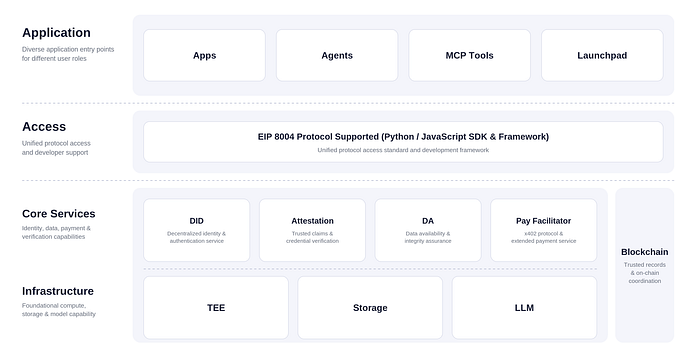
The design logic of the four-layer architecture is:
The bottom layer is the storage layer, composed of the MEFS decentralized file system and the Meeda DA data availability solution, providing EB-scale data storage and verification capability.
The identity and asset formation layer and the payment layer build the DataDID decentralized identity system and the ERC-7829 data asset standard on top of storage, giving data ownership and control logic. The x402 protocol provides a micropayment channel for the Agent economy, enabling service consumption to be completed automatically.
The topmost application ecosystem, through SkillsList, AppList, and the data marketplace, converts protocol capability into products and experiences that end users can perceive.
Each layer supports the capability of the layer above it, ultimately giving AI Agents trustworthy identity, verifiable behavior, autonomous payment, and callable services.
Placing MEMO alongside Filecoin makes the difference in positioning much clearer. MEMO’s differentiated path isn’t found in the technical metrics of the storage layer itself, but in the complete protocol stack built on top of storage — identity, data asset formation, Agent payments, application ecosystem. This path of extending upward from storage means MEMO is not a single storage project, but a comprehensive protocol system with storage as its foundation and data asset formation plus Agent collaboration as its core objective.
Filecoin is the best reference point for this judgment. As a pioneer in decentralized storage, Filecoin has accumulated deep experience in protocol design and market promotion at the storage layer, but its capability boundary is concentrated mainly in the storage layer itself. MEMO’s path is entirely different from Filecoin’s — storage is only MEMO’s starting point; extending upward is its core focus. From DataDID’s identity system, to ERC-7829’s data asset formation, to x402’s payment capability, to a complete application ecosystem, MEMO has already built a complete protocol stack running from storage to agent collaboration.
For the AI Agent economy, infrastructure needs to satisfy four dimensions simultaneously: data must be able to be trustworthily stored and verified, agents must have tamper-proof on-chain identities, service calls must have an automated micropayment channel, and agents must be able to achieve mutual recognition and collaboration through unified identity and protocols. Based on the technical architecture publicly available today, solutions that simultaneously cover all four of these dimensions are not common in the market. Through the node network MEMO has accumulated via years of continuous storage-layer buildout, combined with upper-layer extensions through protocols like DataDID, ERC-8004, ERC-7829, and x402, it has already shipped concrete products across every one of these dimensions.
V. Direction of Evolution and Industry Significance
Every upgrade MEMO makes is an advance positioning for the next stage of ecosystem demand.
Between 2024 and 2026, MEMO completed two identity upgrades, from “decentralized storage” to “AI Agent infrastructure.” The first upgrade expanded from storage into identity and data asset formation; the second expanded from identity into payments and Agent collaboration protocols. Neither upgrade replaced prior capability — each layered on top of what came before: the storage layer provides the data foundation for the identity layer, the identity layer provides the reputation foundation for the payment layer, the payment layer provides the economic loop for the application layer, and the application layer in turn validates the feasibility of the protocol layer.
Viewed on a longer timeline, MEMO’s evolution can be divided into three phases.
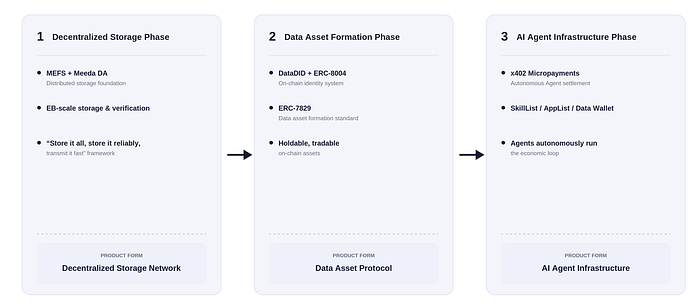
Phase One: The Decentralized Storage Phase
The core objective of this phase was building a decentralized storage foundation. Through MEFS and Meeda DA, MEMO solved the problem of data being able to be “stored at scale, stored reliably, and transmitted quickly.” Global node deployment gave MEMO cross-regional, cross-redundancy-tier physical resource orchestration capability, and established “decentralized storage network” as its initial product form, primarily responsible for data persistence and availability services.
Phase Two: The Data Asset Formation Phase
In this phase, the core question shifted from “where does the data live” to “who does the data belong to, and how can it be used.” DataDID provided on-chain identity for both people and data, ERC-7829 packaged data into on-chain assets that could be held, traded, and verified, and ERC-8004 further extended that same identity logic to AI Agents themselves. This phase completed the MEMO protocol stack’s leap from “storage” to “data assets,” letting data circulate freely on-chain as an independent asset for the first time.
More forward-looking still, this phase paved the way for the AI Agent economy of the next phase. The establishment of on-chain identity (DataDID + ERC-8004) and data assets (ERC-7829) solved precisely the two thorniest problems in autonomous AI Agent operation — “who do I represent” and “what can I use.” Once an agent has a tamper-proof on-chain identity and can call on trustworthy data assets, the payment and collaboration of the third phase have a genuinely executable foundation.
Phase Three: The AI Agent Infrastructure Phase
Only after data asset formation was complete did AI Agents’ autonomous operation have a real economic foundation. x402 gave agents the ability to call external services and settle automatically. SkillsList and AppList let an agent’s capabilities be extended in modular fashion. Data Wallet gave users and agents a unified entry point for managing data assets. The product form of this phase is “AI Agent infrastructure” — MEMO is no longer just a storage project, but a complete protocol stack supporting the operation of the agent economy.
A tight progressive relationship runs through the three phases. Phase one is the decentralized storage network. Phase two is asset representation at the protocol layer. Phase three is agent collaboration at the application layer. Each layer depends on the capability accumulated in the layer before it — the on-chain identity and data assets established in phase two are precisely the prerequisite for phase three’s AI Agents to autonomously execute tasks and settle fees. What comes together in the end is an infrastructure that supports the operation of the AI Agent economy.
The scale of the AI Agent economy is moving from the proof-of-concept stage into early commercial deployment. When hundreds of thousands of agents autonomously collaborate on the same network, the completeness of capability across the four foundational layers — storage, identity, asset formation, and payments — will directly determine whether the entire ecosystem can operate normally. MEMO’s direction of evolution is an advance positioning for this future need: starting from storage, and building upward all the way to a data infrastructure layer on which agents can operate autonomously.