
MEMO: The Boundaries of the Agent Data Layer Go Beyond Storage
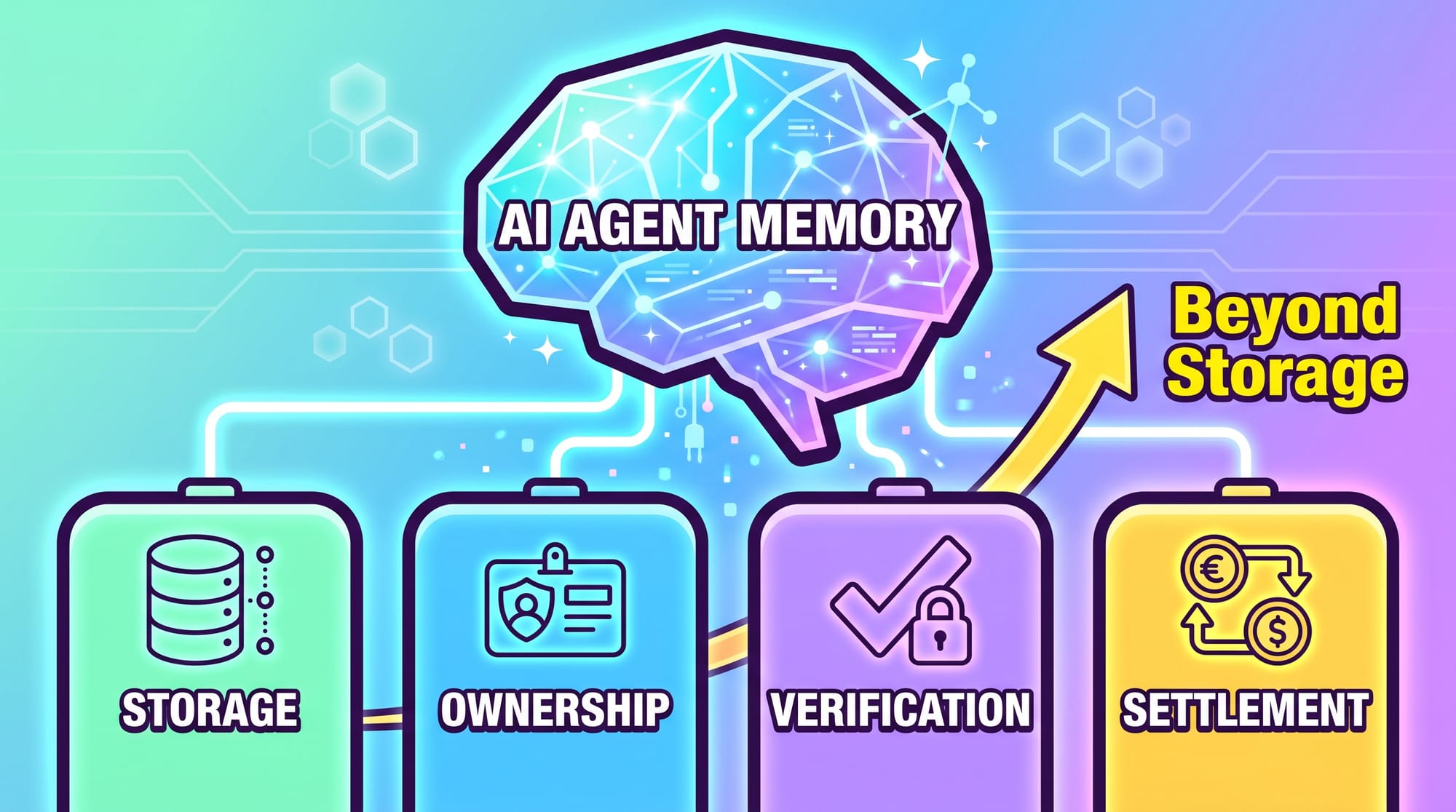
Any conversation about data infrastructure for the agent era tends to slide toward the same spot: can the data actually be stored, and is storing it affordable. That question obviously can’t be avoided, but it’s just the bottom rung of what a data layer is actually responsible for.
McKinsey projects that by 2030, commercial activity conducted autonomously by agents will reach $3 trillion to $5 trillion. Once the initiator, executor, and settler of a transaction are all machines — and none of those machines know each other — the questions the data layer has to answer stop being just “can this be stored.” They expand to: who does this data belong to, is it actually genuine, and can the value it generates be calculated and distributed cleanly. This piece is about how far the data layer’s responsibility should actually extend in the agent economy.
1. Storage First Answers Whether Data Survives
Whether data can be preserved long-term and withstand a single point of failure is the most basic requirement of any data layer.
This layer answers a yes-or-no question: does the data still exist, without vanishing entirely just because one server went down or one company folded. MEMO handles this layer with MEFS, using a combination of erasure coding and multiple replicas, paired with its own risk-aware failure confirmation mechanism, RAFI — even if some nodes go offline, the data can still be fully recovered. For Layer 2s and rollups built on chains like Ethereum, MEMO also built a data availability solution called Meeda, keeping large volumes of data off-chain while putting only the index and commitment proofs on-chain, balancing cost against verifiability.
But being storable is only the passing grade. A piece of data with unclear ownership, unverifiable authenticity, and no way to generate revenue is, in the end, just a file — not an asset. If the data layer stops here, it’s no different from a cheaper hard drive.
2. To Become an Asset, Ownership Has to Be Clear First
If it’s unclear from the moment data is created who it belongs to, where it came from, and whether it’s been altered, none of the subsequent conversation about circulation or revenue can even begin.
This problem gets thornier once agents deploy at scale. Industry observation shows that at most enterprises, the number of APIs, service accounts, and AI agents already runs 20 to 50 times the number of human accounts. Once non-human identities outnumber human ones, continuing to rely on a one-person-one-account identity system clearly can’t hold up — what’s needed is an identity framework purpose-built for machine scale.
A Keyfactor survey of 450 cybersecurity professionals from early 2026 found that 86% of respondents believe AI agents cannot be fully trusted without a unique, dynamic digital identity — yet only half of enterprises have actually built the governance framework to match.
At this layer, MEMO built DataDID, assigning a unique decentralized identity marker to every user and every piece of data, so that its creation, circulation, and use can all be traced. For agents themselves, MEMO has integrated ERC-8004, an on-chain identity and reputation standard designed for autonomously operating AI agents. Every agent has a queryable on-chain record — what it’s done, whether it’s defaulted on anything, what its reputation score is — no longer an unauditable black box.
3. Only What Can Be Verified Can Be Used With Confidence
Rights confirmation answers who owns the data. Verification answers whether the data can be trusted.
These two are often talked about as one thing, but they’re actually separate. Even if a piece of data has crystal-clear ownership, if there’s no way to prove its content is genuine and unaltered, whoever uses it is still taking on risk.
IBM’s 2025 data breach cost report gives a concrete number: organizations using unapproved shadow AI tools pay an average of $670,000 more per breach, and among organizations that experienced an AI-related security incident, 97% lacked matching access controls. The faster AI gets adopted, the more verification lags behind — and the cost of that gap only grows.
MEMO introduces trusted execution environments (TEE) into its storage nodes, processing data inside a hardware-level isolated environment where even the node provider itself cannot see the data’s content. Paired with zero-knowledge proofs, a data user can verify the integrity of the data and the correctness of a computation without ever exposing the raw data itself. This usable-but-invisible design means verification no longer depends on trusting some platform — it depends on math and hardware themselves.
4. Only What Can Settle Lets Value Actually Move
Rights confirmation and verification solve trust. Settlement solves whether value actually flows back to where it should.
If a piece of data gets called on repeatedly without ever generating corresponding revenue, data sovereignty is just a slogan sitting on paper. The agent economy is naturally made up of high-frequency, small-value transactions — a single call might be worth only a few cents, but the frequency of those calls is extremely high. x402, a payment protocol designed for agents, has already processed roughly 165 million machine-to-machine transactions in its early stage — proof that this isn’t a hypothetical need, but a scale problem already happening in real time.
At this layer, MEMO has integrated the x402 protocol, letting payments between agents be as simple and instant as a single API call. Paired with the ERC-7829 data asset standard, any form of data can be packaged into a unified on-chain asset carrying its own access control and revenue distribution rules — every time it’s called on, revenue automatically flows to the data’s owner.
5. Stack All Four Layers, and You Get the Complete Boundary
Storage governs whether data can be stored. Rights confirmation governs whether ownership is clear. Verification governs whether data can be trusted. Settlement governs whether value can actually move.
None of these four things is novel on its own. What’s hard is building them on the same underlying architecture, instead of stitching together four unrelated standalone modules. Plenty of solutions on the market only build out one or two of these layers well — some focus on storage cost and capacity, some focus on identity and reputation — very few design all four layers together from the start.
Behind MEMO’s four layers sits the same ledger and the same identity system. From creation, to storage, to verification, to settlement, data moves through one continuous chain — not four services that need to be bolted together afterward.
6. The Next Step: Moving Toward Memory Capability
Once the foundation is solid, MEMO’s plan for agent memory capability won’t stop at just storing data. Two categories of projects exist right now.
One category focuses purely on memory capability — teaching an agent to extract key information from conversation, retrieve it on demand, overwrite old facts with new ones, and judge when information has expired. But these projects often lack a solid decentralized data foundation underneath.
The other category focuses purely on data capability — building out storage, rights confirmation, verification, and settlement thoroughly, without adding the semantic layer on top that turns data into usable memory. These two capabilities rarely show up together in the same architecture.
What MEMO plans to dig into next is, first, core semantic capability: extracting structured facts from raw data, retrieving relevant memories on demand, overwriting old facts with new ones and resolving conflicts, and judging when each piece of memory is true and when it expires. This is the threshold a system has to clear before it can even be called “memory” — without this layer, what’s stored is just a raw record, not usable memory.
On top of semantic capability, an engineering layer is also needed: managing memory in tiers — short-term, working, and long-term — compressing memory content to reduce retrieval cost, and building forgetting and fading mechanisms to prevent memory drift and hallucinated recall.
This layer matters more directly to MEMO than it does to centralized memory products, because every memory call MEMO makes has to pass through its node network and on-chain settlement. How well compression and tiering are handled doesn’t just affect model token costs — it affects real network storage and settlement costs.
This also means forgetting can’t be a blunt, simple deletion, and compression can’t be lossy discarding. Forgetting should gradually lower the retrieval priority of outdated information rather than destroying it outright. Compression should produce a recoverable summary rather than a truncation. Otherwise, the raw evidence the semantic layer relies on to judge whether a piece of information still holds true might get stripped away prematurely by the engineering layer.
Building solid semantic and engineering capability is a goal most efforts in the memory-layer space are already pursuing. What makes MEMO different is a third layer built on top of those two: verifiability and data sovereignty for the memory itself.
When a memory is downgraded or fades out, it should be provable that this happened through natural, rule-based decay — not through a platform or third party quietly altering or deleting it. And a memory system shouldn’t disappear entirely just because one company shuts down or one product gets discontinued. Centralized memory products struggle architecturally to deliver on either of these points — yet they’re capabilities MEMO’s existing foundation of storage, rights confirmation, verification, and settlement already naturally provides.
Put semantic capability, engineering capability, and verifiability plus sovereignty guarantees together, and what emerges is a complete data layer with both strong agent memory capability and strong data capability — one where memory capability is built, from the very start, on a foundation of trust and sovereignty that’s difficult for others to replicate, rather than covering just one half of the equation the way most projects do.
Closing
What MEMO is doing right now is building these four foundational layers solidly. That foundation already delivers a real capability: once connected to an agent platform through the MEFS MCP, the conversation logs, task results, and knowledge base content an agent generates during operation can be permanently stored and retrieved at any time — not wiped clean the moment a session ends.
This is the first prototype of the data layer extending upward, and the starting point memory capability will grow from. Get the survival, ownership, trust, and circulation of data solid first, then extend toward memory capability — that’s how MEMO views the relationship between the data layer and the memory layer.
Sources:
- McKinsey’s $3–5 trillion 2030 agentic commerce projection
- Non-human identities at 20–50x human accounts: industry observation composite report (2026)
- Keyfactor January 2026 survey report
- IBM, 2025 Cost of a Data Breach Report