
In the AI Agent Economy, Automation Meets Decentralized Ownership
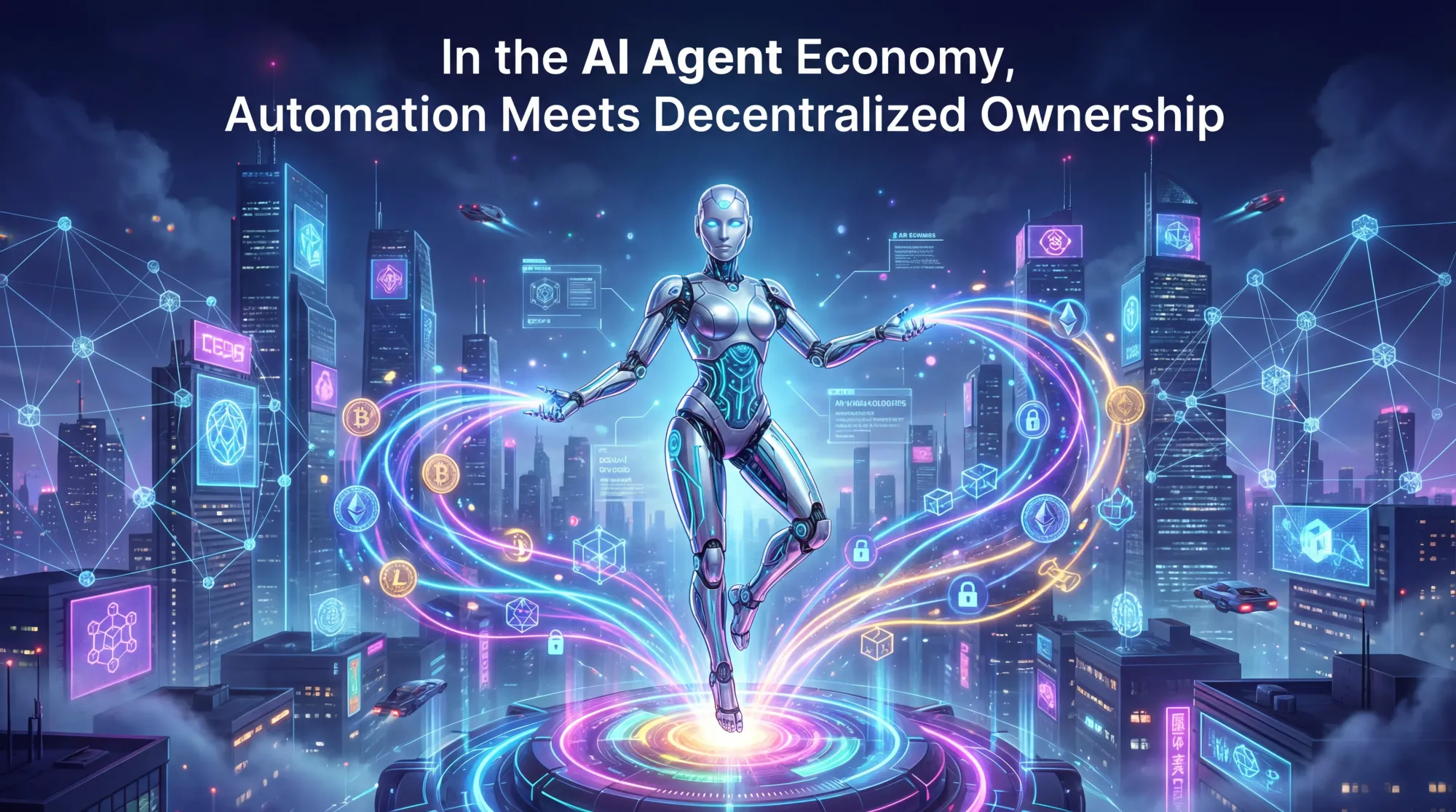
In the AI Agent Economy, Automation Meets Decentralized Ownership is no longer a theoretical idea—it is a practical requirement. As AI agents begin to operate autonomously across data, applications, and blockchains, the old model of centralized control quietly breaks down. Automation without ownership creates efficiency, but not fairness. Ownership without automation creates rights, but not scale. The AI Agent Economy only works when both exist together, and this is exactly the gap MEMO is designed to fill.
I. AI Agents Are Becoming Economic Participants
AI agents are rapidly evolving beyond task-based automation. They search, negotiate, coordinate, and execute actions continuously. In doing so, they consume data, generate new datasets, and produce economic value.
In an AI Agent Economy, agents behave less like software tools and more like economic participants. They interact with other agents, access services, and exchange value autonomously. This shift exposes a critical problem: most AI systems still rely on centralized platforms to define identity, permissions, and value distribution.
MEMO approaches this problem from the infrastructure level, treating AI agents as first-class participants in a decentralized economic system rather than extensions of closed platforms.
II. Why Automation Alone Is Not Enough
Automation increases efficiency, but without ownership, it concentrates power. When AI agents operate inside centralized systems, platforms retain full control over agent identities, data flows, and revenue capture.
This model limits scalability and trust. As agents become more autonomous, it becomes harder to justify a single entity controlling all outcomes.
The AI Agent Economy requires a new foundation—one where ownership is verifiable, permissions are programmable, and automation operates without relying on centralized trust. MEMO provides this foundation by combining decentralized identity, data ownership, and automated value exchange into a unified system.
III. Decentralized Identity for AI Agents
For AI agents to operate independently, they need identity. Not temporary credentials or API keys, but persistent, verifiable identities that can exist across networks.
MEMO enables AI agents to operate with decentralized identifiers (DIDs), allowing each agent to:
- Prove identity without centralized registration
- Sign actions and transactions autonomously
- Build reputation over time
- Interact with other agents under enforceable rules
This identity layer is critical in the AI Agent Economy. It ensures that automation does not erase accountability, and that every action can be traced to a verifiable entity.
IV. Ownership Turns Data into Assets
AI agents continuously generate data: execution traces, interaction logs, model feedback, and behavioral signals. In most systems, this data is extracted and monetized by platforms, leaving creators and users without control.
MEMO treats data as an ownable asset from the start. By leveraging blockchain-based data ownership standards, AI-generated and AI-consumed data can be:
- Clearly owned
- Programmatically authorized
- Monetized without intermediaries
- Reused without losing control
In the AI Agent Economy, data becomes capital—not exhaust. Ownership ensures that value flows to the rightful participants.
V. Native Payments for Autonomous Agents
Autonomous agents cannot rely on manual billing or off-chain payment systems. True autonomy requires native, programmable value exchange.
MEMO integrates automated payment mechanisms that allow AI agents to:
- Pay for data, APIs, and services in real time
- Receive compensation automatically for completed tasks
- Enforce usage-based pricing without human intervention
- Execute payments as part of agent workflows
This closes the loop between automation and ownership. Agents can operate, transact, and settle value independently, forming the economic backbone of the AI Agent Economy.
VI. Trustless Collaboration at Scale
One of the most powerful outcomes of MEMO’s design is trustless collaboration. AI agents do not need prior relationships or centralized coordination.
With decentralized identity, ownership, and payments in place, agents can:
- Collaborate across organizations
- Exchange data under enforceable rules
- Coordinate complex workflows securely
- Scale globally without platform lock-in
This enables an open AI Agent Economy where innovation is composable and permissionless.
VII. What This Means for Builders and Businesses
For builders, MEMO lowers the barrier to launching autonomous AI agents that can operate independently and capture value directly. Agents are no longer confined to single platforms or ecosystems.
For businesses, MEMO reduces dependency on centralized AI providers. Automation becomes portable, ownership becomes transparent, and economic participation becomes programmable.
The result is an AI Agent Economy that is open, sustainable, and aligned with long-term value creation.
VIII. The Path Forward
The future of AI is autonomous—but autonomy without ownership leads to silent centralization. The AI Agent Economy only works when automation is paired with decentralized ownership at the infrastructure level.
In the AI Agent Economy, Automation Meets Decentralized Ownership, and MEMO provides the tools to make this convergence real. By redefining identity, data ownership, and value exchange for AI agents, MEMO is helping build an economy where intelligence can operate freely—and fairly—at global scale.