
Give Your Agent a Memory Vault: When Models Become Consumables, Only Sovereign Memory Can Carry a “Digital Personality” Forward
Key Takeaways
A paradigm shift: Large language models (LLMs) are becoming interchangeable “inference engines,” while the memory that accumulates over time is what truly defines an Agent’s personality and capability.
The industry’s dilemma: Whether it’s the “ecosystem fences” of closed-source giants or the “cloud custody” of third-party memory middleware, neither solves the real question of who sovereignly owns the memory.
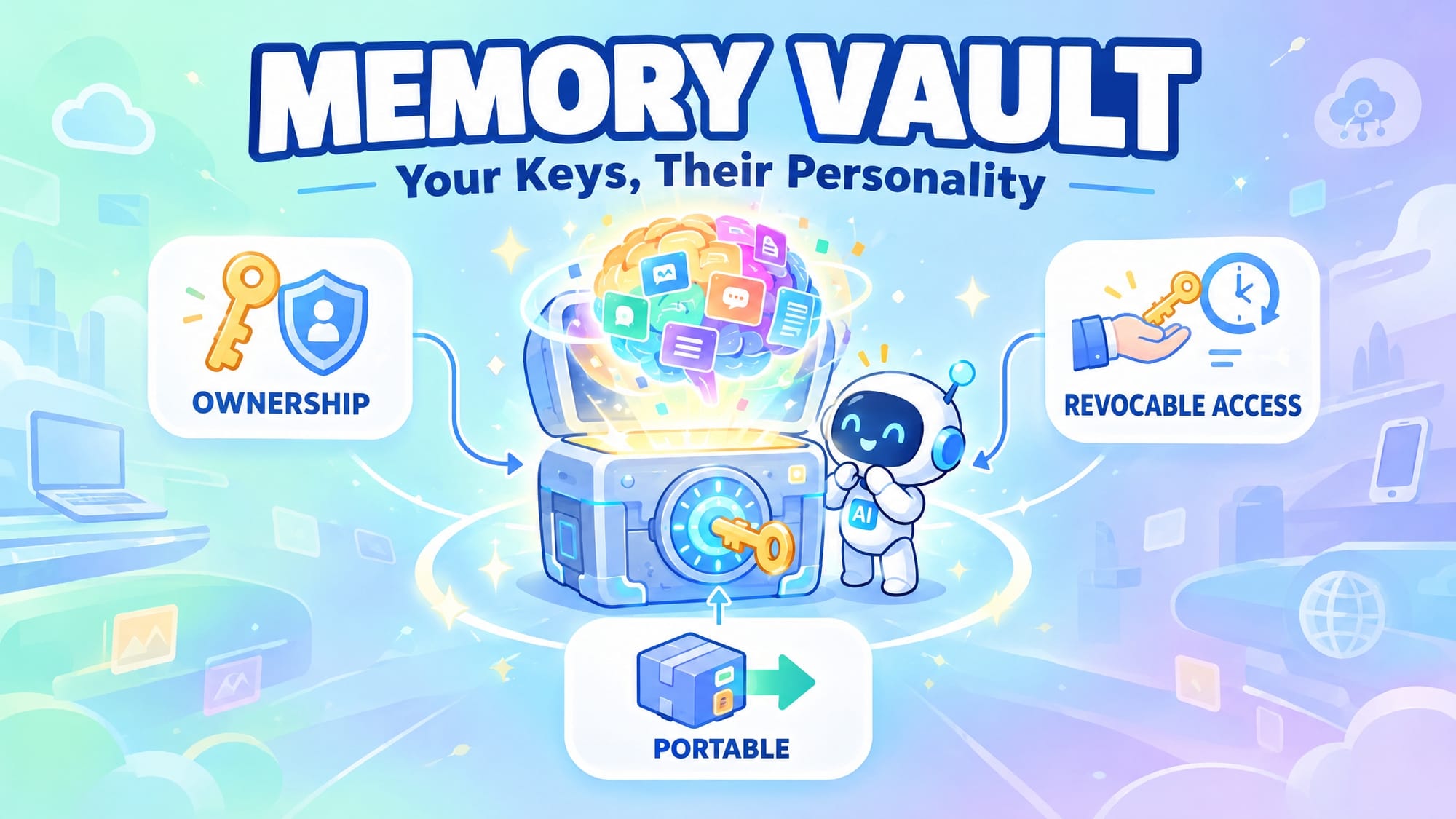
Three pillars of a memory vault: private-key-level, end-to-end ownership; fine-grained, protocol- and contract-based authorization; and lossless cross-model portability with incremental evolution.
MEMO’s path forward: Build a decentralized memory foundation with MEFS + DataDID + MCP Server, and hand the keys to memory back to users and Agents themselves.
In 2026, the focus of competition in the AI industry is shifting from a “race for model parameters” to a full-blown “race for long-term memory.”
On June 4, OpenAI launched a new-generation memory system for ChatGPT, Dreaming V3, which according to internal evaluations lifted long-horizon factual recall to 82.8%. On August 25, Anthropic officially connected Claude’s global memory across Chat and the Cowork collaboration space, turning it on by default across Free, Pro, and Max. Meanwhile, the major model vendors have rolled out “memory import and export” tools, trying to show users that switching to a different AI assistant no longer means introducing yourself from scratch.
On the surface, AI is getting better and better at “knowing you.” But at the architectural level, a fundamental contradiction is sharpening right alongside the growth in memory capability: this frequently accumulated, deeply personal memory still lives in centralized platforms’ databases, and the “root key” for encryption and access remains in the platform’s hands.
Import and export tools improve the “efficiency of moving house,” but do nothing to change “who owns the property.” As memory grows thicker, users’ dependence on a single platform and the cost of leaving rise exponentially.
In the coming multi-Agent era, ownership of memory is the foundation for everything built above it. If ownership isn’t resolved, the memory an Agent accumulates is just a private data moat for a centralized platform, and the moment it crosses a platform boundary, it vanishes. Only when ownership returns to the user can memory break free from any single model’s lifecycle and settle into a continuous, complete, evolving “digital personality.”
To turn “memory belongs to the user” from a slogan into a verifiable engineering reality takes three core pillars working together: ownership at the cryptographic layer, authorization at the protocol layer, and portability at the state layer.
1. Ownership: Whoever Holds the Key Holds Sovereignty Over the Memory
In the digital world, ownership of data has never been about where the physical hard drive sits. It’s about who holds control and the decryption private key.
Today’s mainstream AI platforms commonly conflate “where it’s stored” with “who owns it”: a user’s interaction memory is generated in the cloud, stored in the cloud, and the rules for deletion, retrieval, training exemption, and export are interpreted entirely by the platform. This “platform custody” model offers a silky-smooth experience early on, but carries a built-in conflict of interest at the commercial level — a user’s deep memory is precisely the most important retention moat for a model platform.
That’s why the intensive memory-system upgrades from both OpenAI and Anthropic this year only ever tear down walls inside their own ecosystems. Expecting a centralized giant to proactively build an open, cross-platform, lossless memory network is a complete paradox given its commercial incentives.
Looking at the current AI memory-layer landscape, three mainstream routes can be clearly distinguished:
- Ecosystem-built memory from closed-source majors (Platform-locked Memory): Products like ChatGPT Memory and Claude Memory treat memory as a feature that locks users in, sealed inside a single model ecosystem.
- Developer memory middleware (Memory-as-a-Service): Open-source or cloud-hosted solutions like Mem0 and Zep give developers standardized memory-extraction and vector-retrieval APIs, solving a development-efficiency problem.
- The algorithmic retrieval race (Retrieval Optimization): Competition centered on RAG, knowledge graphs (GraphRAG), and context-compression algorithms, purely about factual recall and retrieval precision.
These three routes have pushed the technology forward, but they share the same blind spot: they’re all answering “how do we make AI remember more accurately,” while nobody is answering “who actually owns this memory at the foundational level.” In all of these architectures, whether the model vendor or the middleware cloud provider, the highest privileges on the underlying database remain in their hands.
The “memory vault” represents a fourth route: a complete move from “centralized custody” to “decentralized self-sovereign vaulting.”
The essential difference between custody and vaulting lies in where the cryptographic boundary is drawn:
- Platform custody: Like handing your private notebook to a hotel front desk for safekeeping. No matter how attentive the service, the front desk can flip through it any time, and whether you get your notebook back when the hotel closes or changes its rules is entirely up to them.
- Self-sovereign vaulting (the memory vault): The memory space is derived from and encrypted solely under the user’s private key (or decentralized identity, DID). The underlying storage network only keeps encrypted data blocks persistently available and verifies them against tampering. Without your private key’s signature, no third party — storage nodes included — can peek at or alter a single byte.
This is the first principle behind MEMO’s “Agent Memory Vault”: the private key never leaves the device, and sovereignty never passes through a platform.
As the first core component to land in this architecture, the MEFS MCP Server deeply integrates the decentralized storage network (MEFS) with the Model Context Protocol, the standard context protocol for large models. It lets an AI Agent persist long-term memory directly, via a standardized protocol, into an independent storage space controlled by the user’s private key. Even if the front-end model is discontinued, an API gets banned, or a platform changes its commercial terms, the user’s core memory remains sealed, fully intact, in their own digital vault.
2. Authorization: Not “Handing Over a Copy of Your Data,” but “Programmable Context Lending”
Once memory is locked inside a vault controlled by a private key, the second engineering challenge follows immediately: how do you let different AI Agents use this memory efficiently together, without giving up ownership?
In traditional internet data exchange, “authorization” often amounts to “copying” — the moment you let an application read your data, a copy has already landed on the visitor’s server, and there’s no taking it back. Under a sovereign memory architecture, real authorization is “granting limited use rights,” and its core is lending out a constrained access credential rather than handing over the memory itself.
A rigorous on-chain or protocol-level memory authorization mechanism must satisfy three hard requirements at once:
- Scoped and time-bound: The granularity of authorization (only a certain project folder, a certain category of preference tags) and its lifetime (valid for a single session, or expiring in 24 hours) are locked in advance by cryptographic credentials or smart contracts — never relying on a “gentleman’s agreement” from the caller.
- Instantly revocable: As the owner of the memory, the user can unilaterally cut off an access token at any time, with no platform approval required, immediately blocking any further reads.
- A verifiable audit trail: Which Agent read which memory fragment, at what timestamp, for what task — the whole chain leaves a tamper-proof hash record, putting an end to “black-box reads.”

This kind of fine-grained authorization will unlock enormous economic value in multi-Agent orchestration and model routing.
Picture a typical engineering or content workflow: you first call an expensive flagship reasoning model, combine it with your long-term project memory to produce an exceptionally rigorous system design, and settle it back into the memory vault. Then, at the actual coding or step-by-step execution stage, you simply authorize the memory fragment containing that design — under “read-only, time-limited” rules — to a lightweight model or vertical Agent that costs a tenth as much to run.
LLM engineering practice has long shown that what determines the floor of an Agent’s final delivery is often not the size of the model’s parameter count, but the precision and completeness of the context injected into it. As long as the vault supplies sufficiently clear memory context, a lightweight model can complete the task accurately — while also eliminating the friction of repeatedly pasting background across platforms and burning massive amounts of redundant tokens.
More importantly, throughout this entire flow, authorization never equals copying. The memory itself stays anchored in the user’s vault, and different Agents simply mount it on demand and read it by the rules through standard interfaces like MCP. Settle once, reuse across models — achieving seamless handoffs between multiple Agents while holding the line on absolute data sovereignty.
3. Portability: Ownership You Can’t Take With You Isn’t Real Ownership
In the world of Web3 and digital sovereignty, there’s one ultimate litmus test for whether ownership is real: if you can’t take an asset with you, whole and lossless, at any time, then no matter how appealing a provider’s privacy policy sounds, you’re a tenant, not an owner.
“Ownership” is a legal and cryptographic claim, and “portability” is the only engineering fact that tests whether that claim can actually be honored.
It’s worth noting that the “export as Markdown / JSON history” offered by major platforms today is fundamentally different from true “memory portability”:
- A static text export ≠ memory migration: An Agent’s effective memory isn’t a messy running log of chats — it’s a distilled combination of episodic memory, a semantic graph, and high-dimensional vector indexes (embeddings). Hand someone a pile of scattered text exports, and once on a new platform they can’t be restored directly into a structured contextual state. That’s “handing over a corpse,” not “taking your memory with you.”
- True portability (State Portability): This means memory can be migrated out of its original storage engine or client at any time, as a standardized, structured, complete state snapshot, mounted losslessly in an entirely new model environment or local node, and continue to evolve incrementally on top of the existing memory baseline.
In the memory vault system MEMO is designing, “unconditional, whole-vault migration out” is established as a non-negotiable protocol-level principle — even MEMO’s own storage service nodes are not allowed to become a wall that locks users in.
With the open MCP protocol standard and a decentralized storage foundation, a user’s memory format is fully transparent and its index structure is open-source and parseable. When a storage provider proactively writes “the freedom to leave at any time” into its underlying architecture, the only reason a user chooses to stay is the reliability and cost-effectiveness of the storage network — not because steep migration barriers force them to remain.
This is also the most essential difference in business philosophy between the “sovereign vaulting route” and the “centralized custody route”: the former keeps users through trust and openness; the latter holds users hostage through friction and lock-in. Without portability as a backstop, the “private-key ownership” and “fine-grained authorization” described above would ultimately be castles in the air.
4. Conclusion: Models Are Passersby — Only Continuous Memory Can Forge a Complete Personality
When the three pieces — ownership, authorization, and portability — are fully interlocked, an AI Agent’s memory finally gains temporal continuity that spans the lifecycle of any single product.
We have to see clearly an industry trend already underway: the underlying large models (LLMs) are rapidly being “commoditized” and turned into “consumables.” Today’s strongest may be GPT, tomorrow’s may be Claude, and the day after it may be some open-source fine-tuned model. Models are like CPU engines that can be plugged in and swapped out at will; compute and reasoning ability are getting cheaper and more homogeneous.
What truly turns a general-purpose model into an Agent that “knows you” has never been the parameter weights it shipped with, but the “memory” that grows, bit by bit, through long-term interaction with you.
Many deep AI users have likely felt the frustration of this kind of “digital amnesia”: you spend most of a year training an AI assistant — it’s familiar with your restrained writing style, knows which stock phrases you can’t stand, and has a handle on the architecture of every project you’re working on. Then another company releases a new model with stronger reasoning, you switch over full of anticipation, and find yourself facing an extremely intelligent “stranger” who knows nothing about you. You have to re-feed the background, re-correct all the preferences you’d long since worked out together — the model got upgraded, but the “Agent personality” that worked so well with you was left behind inside the old platform’s walls, instantly reset to zero.
This is the price of memory being fragmented by platforms. Without memory that’s continuous across platforms, an Agent can only ever play the temp worker inside a single application’s sandbox — never growing into a long-term companion for the user’s digital life.
Looking two to three years ahead, the number of Agents working alongside each person is set to explode: ones that write code, do investment research, manage calendars, audit contracts, and more. Underlying models will keep iterating and replacing each other, old tools will fade out, and new frameworks will emerge. The more Agents there are and the faster models iterate, the more fragmented memory gets as platforms carve it up — and the more irreplaceable an “independent memory vault” becomes as the foundational hub.
MEMO’s ultimate vision for building an Agent Memory Vault goes well beyond offering a more secure decentralized storage solution. It’s to complete a “property-rights registration of digital memory” before the era of tens of billions of Agents fully arrives — let models belong to the models, and let memory belong to you.
When the key to the memory vault is firmly in your own hands, no matter how many generations the models out there iterate through, no matter how many Agents come and go at your side, as long as they mount this vault, the person they meet when they walk through the door will always be the same you — whole and continuous.
References and Further Reading
- OpenAI ChatGPT Dreaming V3 memory system evolution and recall evaluation: Inbenta AI Weekly
- Anthropic’s announcement of global memory across Claude’s Chat and Cowork: Claude Release Notes / TechRepublic
- MEMO’s decentralized data infrastructure and the MEFS MCP Server private-key-level sovereign storage solution: memolabs.org