
From Social Noise to Digital Assets: DSpace Reclaims “Data Sovereignty” for Ordinary People
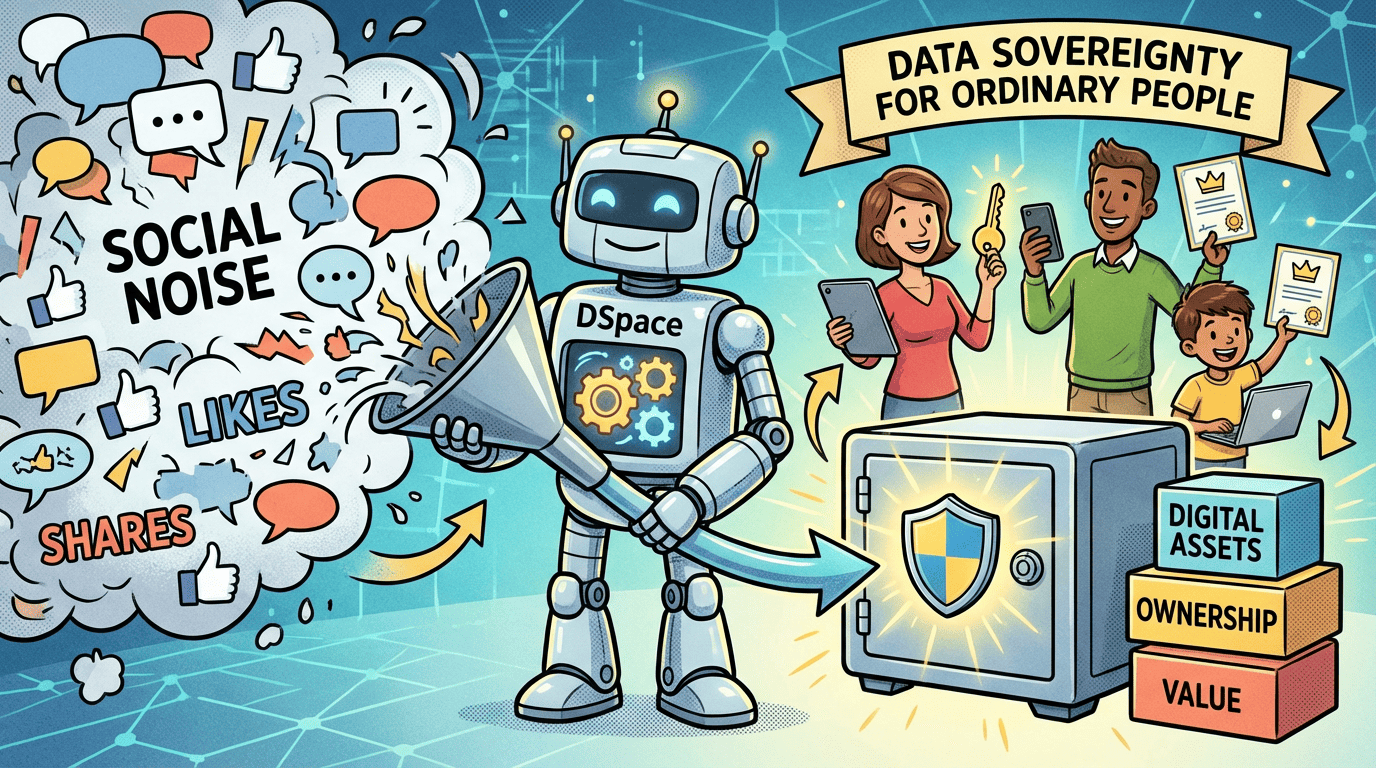
The evolution of each generation of social media is essentially a history of the distribution of the benefits of attention.
In the 2010s, the dividends of social media were reflected in the numbers of growing fan bases. To have followers was to hold the bargaining power in this centralized public square.
In the 2020s, as short video algorithms took over human senses, the benefits of social media shifted to precise matching. Catering to traffic became the default rule for survival in that era.
So, when we get to2026, when AI agents begin to take over our social interfaces on a large scale, where will the data dividends belonging to ordinary people be recorded?
The answer may lie hidden in the opinions, comments, and insights you generate every day. In this era of AI interaction, every piece of your original content is no longer just a consumable, but a digital asset urgently needing to be legally recognized.
This is the significance of DSpace. It’s not just a browser plugin, but a “factory for turning personal social data into assets.”
The exploited “invisible labor force”
Let’s first confront a long-overlooked fact: on centralized social media platforms, every insightful post we make and every high-quality comment we contribute is essentially working for the platform for free.
These data ultimately face two dilemmas:
Ownership ambiguity:Your original insights may be buried by algorithms at any time, or copied without a trace by others, and you cannot prove that it is yours.
High interaction costs:Maintaining high-quality interaction amidst a massive amount of information noise requires a huge mental investment, causing most people to eventually become unconscious “like machines”.
The emergence of DSpace aims to break down this mismatch between “labor” and “rewards.” Throughthe Data DIDsystem, it builds a fence around personal data at the underlying infrastructure level.
In DSpace’s logic, user behavior is rigorously divided into two dimensions:Mint and Collection. When you produce a high-quality thought, you can Mint it with a single click through DSpace, and the data is synchronized to MEMO’s decentralized storage platform. This is no longer a tweet that might be deleted, but an on-chain asset with an immutable ownership record.
AI Interaction: From Manual Labor to Productivity
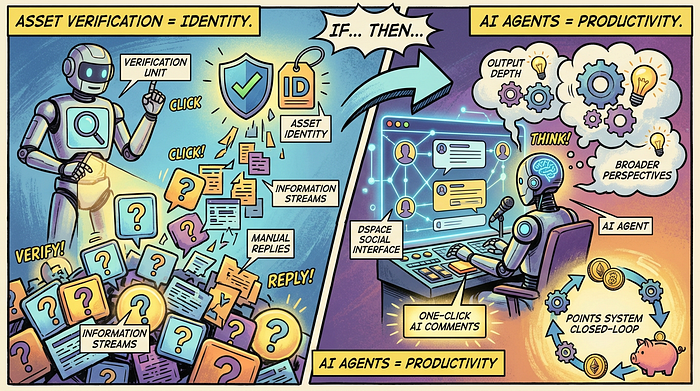
If “ownership confirmation” solves the problem of asset identity, then the integration of AI Agentssolves the problem of asset production efficiency.
In the social environment of 2026, purely human replies will be insufficient to cope with the explosive flow of information. DSpace integrates the capabilities of AI Agents into its social interface, with the core purpose not to “make things easier for you,” but to “ensure depth of output.”
With AI-powered one-click comments, users can free themselves from repetitive word-writing and focus on a more macro-level understanding of the subject. More importantly, DSpace has established a practical points-basedclosed-loop mechanism.
Here, social interaction is no longer a one-way consumption:
Earn points for the first 10 AI comments each day.
Credits are the fuel for running:they can be used to purchase Mint credits, enabling you to monetize more of your content.
Points are a form of credit:As a core infrastructure tool of the MEMO ecosystem, these points record your contribution weight as an “early builder” and participate in future reward distribution.
This logic transforms social behavior into a continuous “asset reserve.” Every interaction you make within this system adds to your leverage for future allocations.
Infrastructure’s chances of winning
Why do we emphasize DSpace’s “infrastructure” attributes?
In the AI era, the most valuable asset is no longer hardware, buthigh-quality, verifiable data sources. As MEMO evolves into a one-stop infrastructure for AI agents, DSpace effectively acts as a “data gateway.”
It doesn’t attract users by stirring up emotions, but rather by providing a safe, professional, and inspiring underlying tool that allows digital natives to reclaim sovereignty over their data.
Currently, DSpace’searly bird programis underway. This is not a simple marketing campaign, but an experiment on “consensus allocation”: the first 100,000 users who participate will lock in early bird points by contributing real data and high-quality interactions.
In the next decade, when all social behaviors will be redefined by AI, will you choose to continue being the fuel for algorithms, or become the master of your own digital assets?