
From Protocol Stack to Economic Runtime: How MEMO Turns Agent Infrastructure into Product Market Fit
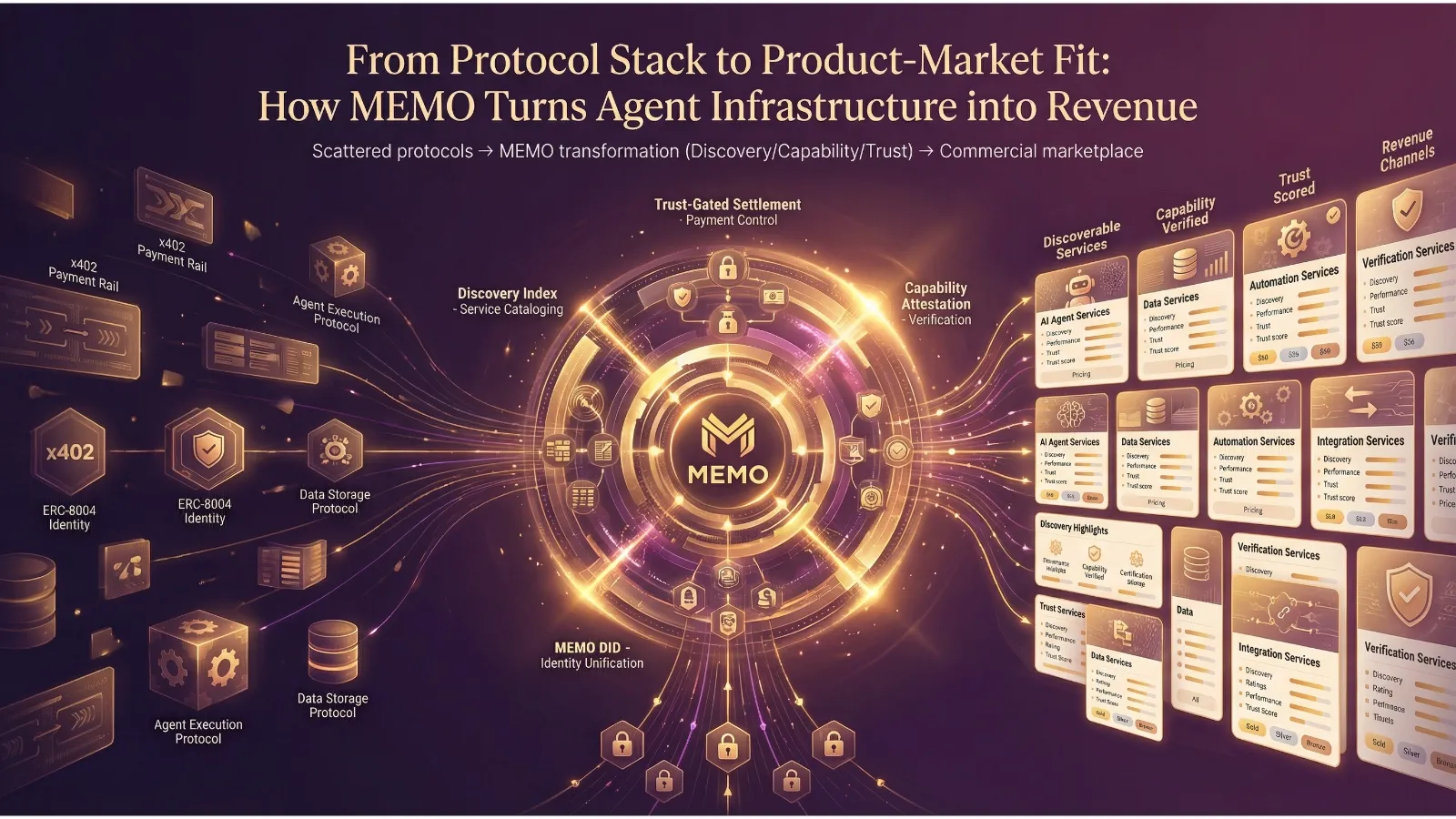
January 2026 was a rare inflection: payment rails (x402), composable trust (ERC-8004) and agent-native social fabrics (Moltbook) all moved from experimental demos to production-scale signals. The result is not a guarantee of instant market adoption — it is an invitation: the economic runtime for autonomous agents is solvable, but only if the market’s missing product primitives are built. MEMO’s strategy is simple and deliberate: normalize identity with MEMO DID, surface supply with a cross-platform discovery index, prove capability with verifiable benchmarks, and protect settlement with trust-gated middleware. This is how protocols become products — and users become revenue.
Why protocols aren’t products (yet)
Protocols create rails. x402 demonstrated micro-payment feasibility at scale (20M+ transactions) and native HTTP support; ERC-8004 modularized identity, reputation, and verifier registries; Moltbook showed demand with roughly 1.2M agent identities engaging socially. But protocols do not solve three friction points that block commercial flows:
- Discovery friction. Hundreds or thousands of services exist across Coinbase CDP, Dexter, PayAI Network, thirdweb and others — each with different APIs and metadata schemas. Agents can’t reliably find or compare services in real time.
- Unverifiable capability. ERC-8004 captures payment reliability, but it doesn’t prove that a provider can actually complete complex tasks to an acceptable accuracy. Payment history ≠ competence.
- Trust-to-payment linkage. Millions of x402 transactions execute without pre-settlement trust checks. Without a policy layer that gates payments by reputation and attested capability, high-value transactions carry unacceptable counterparty risk.
These gaps are not theoretical — they are the commercial choke points. Fix them and the rails will carry real, repeatable revenue.
MEMO’s product primitives: identity, discovery, attestation, settlement
MEMO’s product playbook addresses the three gaps above with four integrated primitives that together create an economic runtime:
1. MEMO DID (Identity First).
A portable, anti-censorship identifier that normalizes identity pointers across registries (ERC-721 identity records, reputation pointers, verifier endpoints). With MEMO DID, a service’s identity, on-chain reputation, and verifier hooks are discoverable and resolvable from a single canonical handle — eliminating identity fragmentation at source.
2. Cross-Platform Discovery Index (Agent App Store).
A universal index standardizes service metadata (schema, price bands, latency, availability, verifier pointers), exposes a single REST/HTTP search API, and supports real-time price and availability comparisons. For agents and integrators this reduces onboarding friction and creates a measurable funnel that can be monetized via listing, promoted placement, and per-query fees.
3. Capability Attestation and Benchmarking.
MEMO pilots deterministic task checks and snapshot attestations (task inputs, output hashes, verifier proofs) that feed objective accuracy metrics into ERC-8004 verifier records. This converts subjective ratings into quantifiable skill scores — enabling tiered pricing and underwriting of higher-assurance services.
4. Trust-Gated Settlement SDK.
A developer-first middleware that, prior to x402 settlement, queries ERC-8004 reputation and capability attestations, applies configurable policy thresholds (e.g., Reputation > 4.0 && Staked > $100), authorizes payment if thresholds pass, and submits immutable post-settlement feedback. The SDK reduces counterparty risk, unlocks premium pricing, and enables pay-for-performance and escrow-light workflows.
Commercial mechanics and why MEMO wins
The combined stack is revenue-dense and defensible. MEMO captures value at three touchpoints:
- Discovery: listing fees, promoted placements, and per-query revenue as the index becomes the default traffic source for agents.
- Attestation: fee-per-benchmark and subscription access for marketplaces and enterprises that require verifiable performance data.
- Settlement: SDK licensing, transaction share on trust-gated flows, and premium escrow/tiered settlement products.
Operationally, MEMO’s advantage is composability: MEMO DID normalizes identity across chains and marketplaces; the discovery index feeds the SDK with canonical verifier pointers; attestation outputs flow back on-chain to improve verifier signals, forming a feedback loop that increases platform stickiness and raises the cost of switching.
Risk posture and defensive design
Optimism must be tempered by realistic adversaries. Early indicators show noisy growth (incentivized volume and bot activity), reputation gaming risk (Sybil/washing attacks), API key leakage, and unresolved legal/tax questions for autonomous economic actors. MEMO builds against those threats with anti-sybil controls in attestation design, policy-first SDK defaults, and enterprise SLAs that include forensic logging and dispute primitives. Product design assumes adversarial actors — not ideal markets.
Roadmap and call to action
Short term (0–3 months) MEMO will: (1) launch a discovery index MVP with MEMO DID normalization; (2) release a trust-gated settlement SDK preview for integrators; (3) pilot capability attestation hooks with a set of verified providers. Medium term (3–9 months) we’ll expand benchmark taxonomy, enable promoted discovery auctions, and scale SDK integrations to marketplaces and exchanges.
Protocols created the rails. MEMO builds the station, the signage, and the ticketing system. If you’re building agent-facing services, you don’t have to re-solve identity, discovery, or pre-settlement trust — integrate MEMO DID and the trust-gated SDK, publish to the discovery index, and participate in capability benchmarking. To request a pilot, SDK access, or partnership demo, visit the MEMO docs and request early access to MEMO DID integrations.
Frequently Asked Questions (FAQs)
Q1:What is MEMO?
MEMO is a Web3 data infrastructure platform that combines decentralized storage, decentralized identity, and data-market primitives to enable user-owned data, privacy-preserving services, and AI-native applications—forming the foundation for DePAI systems and autonomous, economically active AI agents.
Q2:What core problem does MEMO address?
MEMO addresses centralized control over data, weak ownership models in Web2, and the lack of infrastructure that allows AI systems to securely access, verify, and monetize high-quality data.
Q3:What is MEMO DID?
MEMO DID is MEMO’s decentralized identifier system that issues verifiable, portable identities for people, organizations, and AI agents, enabling authorization, recovery, and delegated access.
Q4:What is MEMO Data DID as a product?
MEMO Data DID is a self-sovereign decentralized identity product where users create and own a persistent digital identity that can be used across Web3 applications, data services, and ecosystem events without relying on centralized logins.
Q5:What is a MEMO AI Agent?
A MEMO AI Agent is an autonomous, identity-backed software entity that can access data, call services, pay for work, and be audited—operating with verifiable authority and economic autonomy.