
From Coal to Tokens: Every Revolution Has Someone Controlling the Fuel
In 1870, John D. Rockefeller founded Standard Oil in Ohio. Within a decade, he controlled more than 90% of America’s oil refining capacity.
He didn’t win by inventing the oil engine, nor by drilling the most wells. His strategy was simpler — and more ruthless. He controlled the refineries, the pipelines, and the transportation system. In other words, he controlled the most critical thing of that era: the pricing power of fuel.
Whoever controls fuel controls the lifeblood of industrial civilization.
150 years later, no one monopolizes oil anymore. But a new battle over pricing power is quietly emerging. This time, the fuel is no longer oil, but a unit of measurement most people have never heard of:
Tokens.
I. Four Revolutions, Four Types of Fuel
Every major technological revolution has had its own core source of energy. Whoever controls the production and pricing of that energy ultimately holds the real power of the era.
The core fuel of the First Industrial Revolution was coal. Every roar of the steam engine was powered by shovels of coal burning underneath. Whoever controlled the mines controlled the fate of factories. Britain became the “workshop of the world” in the 19th century largely because it possessed Europe’s richest coal reserves and the most efficient mining system.
The core fuel of the Second Industrial Revolution was electricity. The famous “War of Currents” between Edison and Westinghouse was, at its core, a fight over the pricing power of electricity. Whichever transmission standard became dominant could effectively charge an “entry fee to modernity” for entire cities.
The core fuel of the Third Technological Revolution — the Information Revolution — was bandwidth. In the early internet era, telecom operators were the unquestioned toll booths of the digital world. Without bandwidth, even the best content could not travel. Without bandwidth, e-commerce, social media, and search engines could never have existed. The term “traffic anxiety” reflects how deeply ordinary people felt dependent on this fuel.
Now, the Fourth Technological Revolution has arrived.
Its name is artificial intelligence.
And its core fuel is called the Token.
II. What Exactly Is a Token?
For many people, the first time they heard the phrase “token economics” was probably through the blockchain industry. But as AI continues to evolve, the word “Token” no longer belongs exclusively to crypto.
In AI, it refers to something extremely simple:
The unit used to measure how AI processes text.
When you input text into ChatGPT or any large language model, the model does not read word by word the way humans do. Instead, it breaks text into “tokens” — roughly equivalent to three-quarters of an English word, or about half a Chinese character’s worth of information.
The number of tokens consumed while processing your input and generating a response becomes the billing basis for that interaction.
A more intuitive analogy:
Tokens are like AI’s electricity meter — or a taxi meter.
Every sentence you type, and every word the AI generates, quietly makes the meter tick upward.
To make this more concrete:
Suppose you ask AI to draft a 500-word business email. From your prompt to the final output, the process may consume around 1,000 tokens. At current mainstream model pricing, the cost is roughly $0.002.
Or imagine asking AI to analyze a 10-page PDF report and generate a summary. That might consume around 8,000 tokens, costing about $0.016.
Sounds cheap? It is — for individuals.
But now change the perspective.
Imagine a mid-sized company with 100 employees using AI tools daily. If each employee consumes 50,000 tokens per day, that’s 5 million tokens every day. Based on enterprise API pricing, the daily bill could reach around $10. That becomes $300 per month, or $3,600 per year.
Now scale it further.
If the company’s core business itself is AI-driven — such as an AI customer service platform or a content generation platform — it could easily process billions of tokens per day.
At that point, token costs are no longer negligible.
They become a defining variable that determines whether the business model itself works.
Tokens may be microscopic units, but token economics is macroeconomic in scale.
It determines who can afford AI — and who occupies which position in the hierarchy of this new revolution.
III. The Pricing Power of Fuel Is Once Again Concentrated
This brings us back to a recurring historical pattern:
At the beginning of every major revolution, the pricing power of the core fuel becomes highly concentrated.
At its peak, Rockefeller’s Standard Oil not only controlled refining capacity, but also manipulated railroad freight rates through secret agreements, systematically driving competitors out of business.
Early electric utilities operated as regional monopolies. Consumers had no bargaining power.
Telecom operators during the broadband era similarly controlled information flow through expensive, slow, and opaque pricing structures.
Today, AI token pricing is following a remarkably similar trajectory.
Only a handful of companies in the world are capable of independently training and deploying top-tier large language models. They possess massive parameter scales, global data center infrastructure, and enormous training datasets — all of which create towering barriers to entry.
In practice, token pricing power is concentrated in the hands of these few companies.
There is also a subtle paradox worth examining.
Over the past few years, the price per token for mainstream large models has dropped dramatically. When GPT-4 first launched, one million tokens could cost as much as $60. Three years later, models with comparable performance cost less than $1 per million tokens.
At first glance, this seems like a victory for market competition and consumers.
But there is another side to the story.
As prices fall, model capabilities grow exponentially — and more advanced models consume significantly more tokens.
Tasks once handled by GPT-4 may now require GPT-5 for acceptable results. But GPT-5 may consume multiple times more tokens than GPT-4.
“Smarter” and “more expensive” are becoming quietly intertwined.
More importantly, token pricing itself lacks transparency.
Different companies define “a token” slightly differently. Input tokens and output tokens are often billed separately. Even the model’s internal “chain of thought” reasoning may generate additional token consumption.
Ordinary users have little ability to calculate true costs or make meaningful comparisons across providers.
And opacity is one of the classic characteristics of fuel monopolies.
This is not an accusation against any specific company. Historically, the concentration of fuel pricing power has never been purely a moral issue. More often, it has been an inevitable phase of technological development.
The real question is this:
Once concentration emerges, history never stops there.
IV. How History Breaks Fuel Monopolies
Fortunately, history also shows another pattern:
Fuel monopolies never last forever.
In 1911, Standard Oil was forcibly broken up by the U.S. Supreme Court into 34 independent companies. This outcome was driven by the Sherman Antitrust Act of 1890, along with two decades of public pressure and political struggle.
What Rockefeller lost was not his oil.
What he lost was the exclusive right to set prices.
Electricity followed a different path. In most countries, power grids eventually became public infrastructure subject to government regulation. Electricity transformed from a commercial product into a basic utility everyone had the right to access.
Only when electricity became cheap enough to be almost invisible did factories achieve true 24-hour production — and modern industrial civilization fully mature.
The decentralization of internet bandwidth came largely through technological progress itself. Falling fiber-optic costs, the spread of wireless networks, and the rise of WiFi gradually transformed bandwidth from a telecom-controlled commodity into a widely accessible public resource.
Looking across these histories, one clear pattern emerges:
Every “democratization of fuel” requires two conditions.
The first is decentralized supply.
The fuel can no longer be produced by only a handful of players. Ordinary people must also be able to participate in production.
The second is a redistribution mechanism.
Producers need incentives and fair compensation, while consumers need affordable access.
In previous revolutions, these conditions were achieved through technological innovation, antitrust legislation, and government regulation.
So what about the Fourth Revolution?
What will break the monopoly over AI tokens?
V. The Next “Refinery” May Be Every Connected Device
Let’s imagine something bold.
When electricity costs approached zero, factories achieved nonstop production for the first time.
When bandwidth costs approached zero, video streaming transformed from a luxury into an everyday utility.
Whenever revolutionary energy sources become universally accessible, society experiences a massive leap in productivity.
Will Tokens follow the same path?
Technologically, the answer is probably yes.
Model inference efficiency improves by orders of magnitude every few years. Specialized AI chips are rapidly becoming cheaper. Open-source models are quickly narrowing the gap with proprietary systems.
From this perspective, the long-term direction of token costs seems obvious:
Downward.
But technology only solves the cost problem.
It does not solve the pricing power problem.
Lower costs do not automatically decentralize pricing power. Higher efficiency does not guarantee ordinary people can participate in the economic benefits of the revolution.
That is why a new economic model is emerging:
Decentralized compute networks.
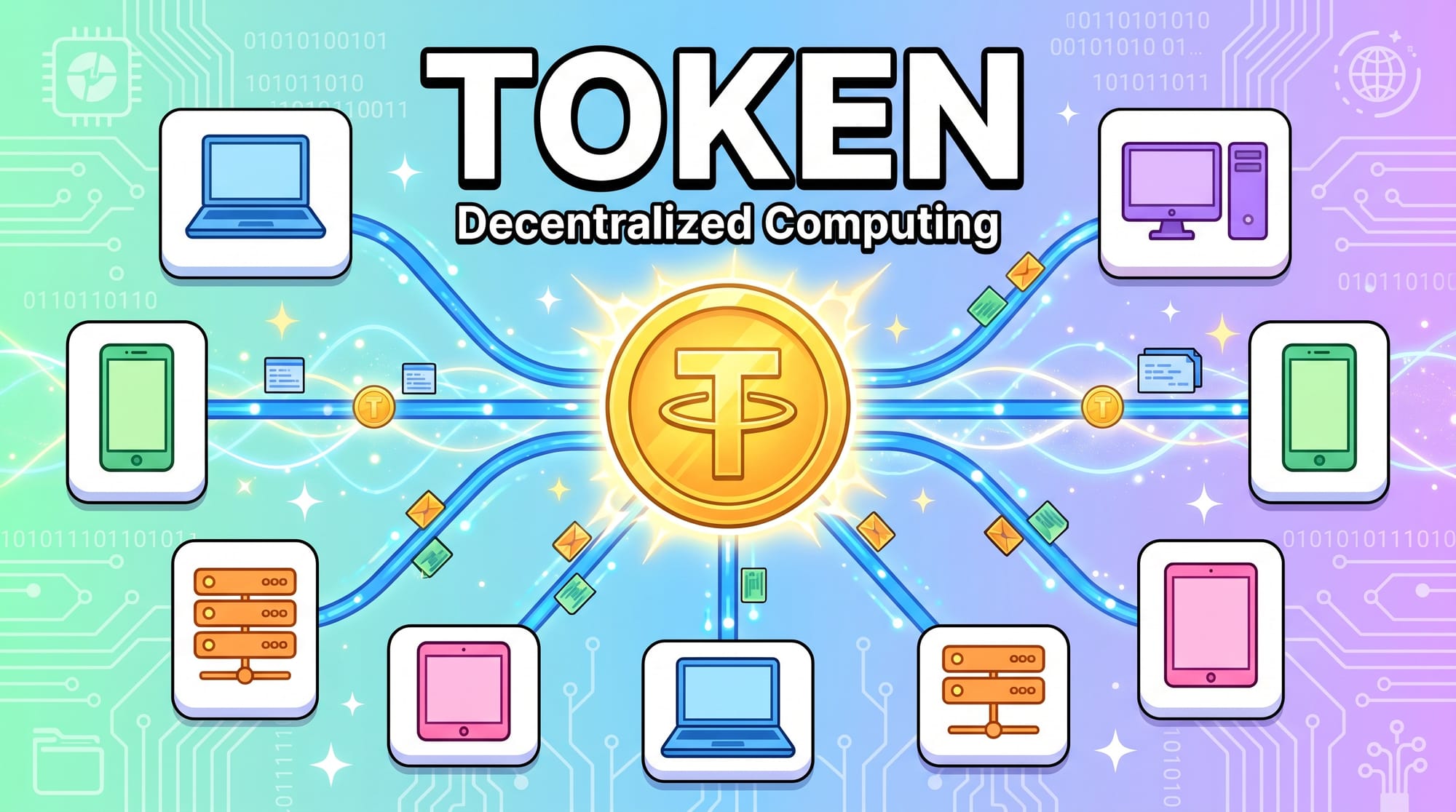
Imagine a world where billions of personal devices — home servers, idle GPUs, edge devices with spare compute power — are connected through network protocols and collectively perform AI inference tasks.
Every device contributes computing power, much like individual solar panels feeding electricity into a grid, producing fuel that others can consume.
In this system, the producers of computational power are no longer just giant technology companies.
They become ordinary participants distributed around the world.
They contribute compute power and receive economic rewards in return — settled through blockchain tokens, which can then be directly used to purchase AI services, creating a self-sustaining economic loop.
This would create something unprecedented:
Ordinary people would become not only consumers of Tokens, but also producers of Tokens.
Of course, this vision remains early-stage. Many technical and economic challenges still need to be solved.
But its direction strongly mirrors every previous chapter of fuel democratization in history:
Distributed supply.
Incentivized production.
Broader participation in value creation.
Conclusion: No Fuel Can Be Monopolized Forever
In 1911, when Standard Oil was broken apart, many people believed it marked the end of the oil era.
The opposite happened.
After the breakup, the oil industry experienced the fastest expansion in its history. Distributed pricing power created competition, efficiency, and broader participation.
The power Rockefeller lost ultimately became productivity gains for society as a whole.
History never stops simply because a small group controls the fuel supply.
At the intersection of technology and systems, new paths always emerge.
Tokens will be no exception.
The Fourth Revolution has only just begun. Its core fuel — the AI capability to process information, measured in Tokens — remains highly concentrated in the hands of a few companies.
This is not a moral judgment.
It is simply a historical observation describing a process still unfolding.
But the direction is becoming increasingly clear:
When every device can participate in production and benefit from the system, the pricing power of Tokens will gradually flow from the hands of a few into the hands of everyone.