
Execution Is Cheap — Why Settlement Defines the Future of AI Agents
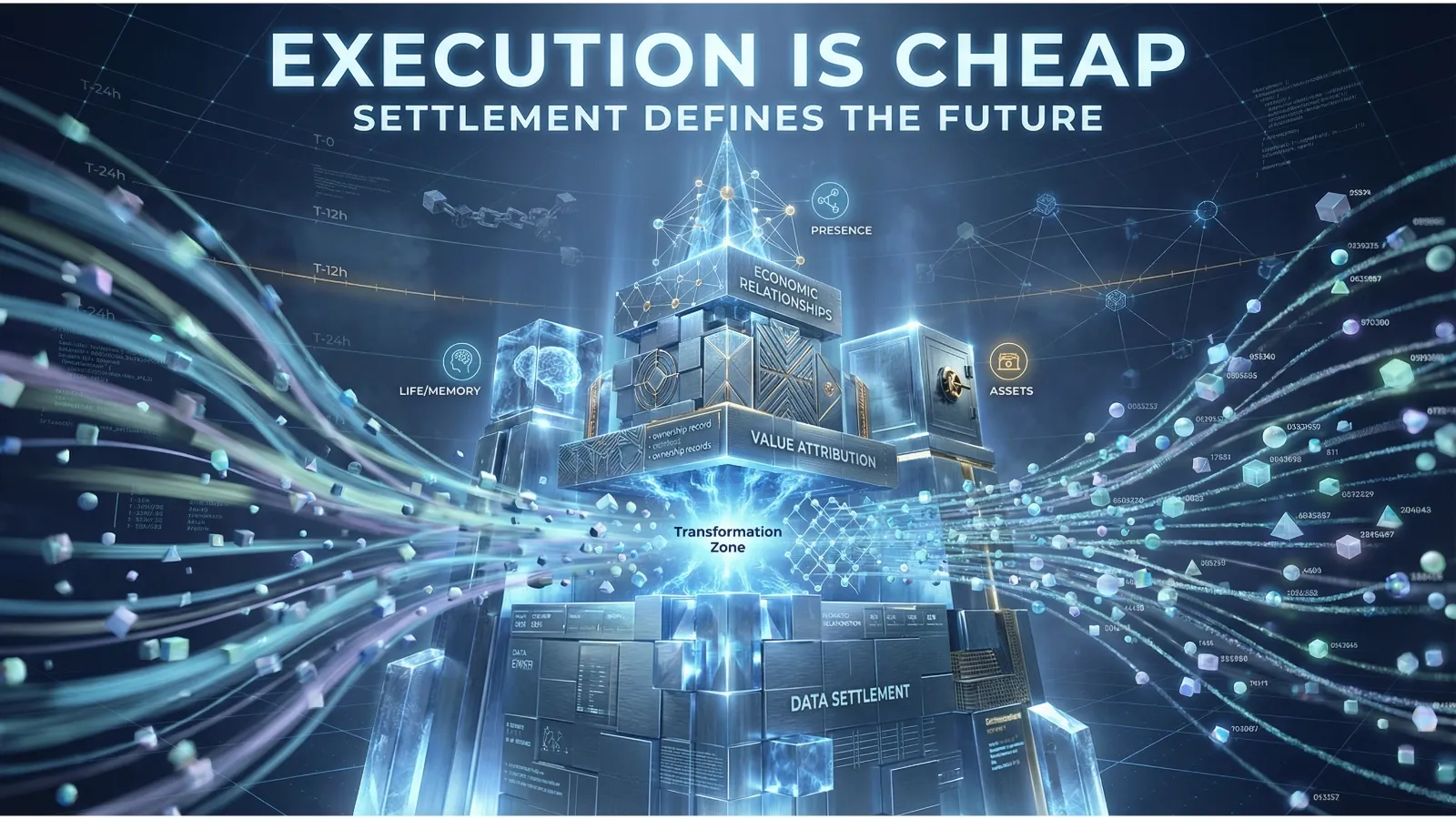
For the past year, the AI Agent conversation has been dominated by one question:
How smart can agents become?
More parameters. Better reasoning. Faster execution.
The industry has made impressive progress—but it’s also quietly stuck.
Because intelligence is no longer the bottleneck.
Today, executing an AI task is cheap. Spawning an agent is cheap. Even running thousands of agents in parallel is cheap. What remains expensive, fragile, and fundamentally unsolved is something far less glamorous:
Settlement.
And without settlement, AI Agents will never become more than temporary tools.
Execution Scales. Value Doesn’t.
Most AI Agents today are optimized for execution:
- They respond to prompts.
- They call APIs.
- They complete tasks and return outputs.
But once the task ends, so does the agent’s relevance.
There is no persistent memory that truly belongs to the agent.
No verifiable ownership of the data it produces.
No autonomous way to receive value, distribute rewards, or pay other agents.
In other words, execution happens—but nothing settles.
This creates a paradox at the heart of modern AI systems:
agents do the work, but platforms capture the value.
As long as agents cannot settle outcomes—financially, logically, or historically—they remain stateless processes, not autonomous entities.
Why Settlement Changes Everything
Settlement is not just about payment.
It is about finality.
When something settles, it becomes:
- Owned — someone or something has clear rights over it
- Persistent — it doesn’t disappear when a session ends
- Composable — it can be referenced, reused, or traded
- Accountable — actions can be verified and attributed
For AI Agents, settlement is the difference between doing work and becoming part of an economy.
An agent that can settle its actions can:
- Accumulate memory as a long-term asset
- Price and exchange its data
- Enter contracts with other agents
- Operate continuously across platforms and time
This is where MEMO enters the picture.
MEMO: Building Agents That Can Settle
MEMO approaches AI Agents from a fundamentally different starting point.
Instead of asking “How do we make agents smarter?”, MEMO asks:
“What does an agent need to exist autonomously over time?”
The answer lies in infrastructure—specifically, in three tightly coupled layers.
1. A Data-Native Foundation
Agents cannot settle without persistent data.
MEMO provides a decentralized data and storage layer where agent memory is not ephemeral, platform-bound context, but durable, ownable data.
Through MEMO’s native storage and Data DID system, agent-generated data gains:
- Persistence beyond any single application
- Cryptographic ownership and attribution
- The ability to be referenced, reused, or transferred
Memory is no longer a cache.
It becomes an asset.
2. Full-Lifecycle Agent Execution and Settlement
Execution without settlement creates dependency.
Execution with settlement creates autonomy.
By integrating protocols like x402 and ERC-8004, MEMO enables agents to operate across their entire lifecycle:
- Creation with a verifiable identity
- Autonomous execution on-chain
- Instant settlement of value upon task completion
Agents on MEMO don’t just run code.
They complete economic actions.
Logic and value flow are coupled by design—so when an agent finishes a task, settlement is not optional or delayed. It is final.
3. Cross-Agent Coordination as a First-Class Primitive
Settlement doesn’t stop at the individual agent.
In MEMO’s framework, agents can discover, hire, compensate, and collaborate with other agents using shared protocols and rules.
This breaks the “agent island” problem that plagues today’s AI systems, where each agent exists in isolation, bound to a single developer or platform.
With interoperable settlement and shared data standards, agents can:
- Delegate tasks to specialized agents
- Share data while preserving ownership
- Form cooperative workflows without centralized orchestration
Execution scales linearly.
Settlement enables networks.
From AI Tools to Economic Actors
The future of AI is not just smarter agents—it is agents with continuity.
Agents that:
- Remember what they’ve done
- Own what they’ve produced
- Get paid for their outcomes
- Interact with others on equal footing
In that future, intelligence becomes a commodity.
Settlement becomes the differentiator.
MEMO is building the infrastructure where AI Agents are no longer disposable scripts, but persistent economic actors—capable of surviving, collaborating, and compounding value over time.
Execution may be cheap.
But settlement is everything.
Frequently Asked Questions (FAQs)
Q1:What is a MEMO AI Agent?
A MEMO AI Agent is an autonomous, identity-backed software entity that can access data, call services, pay for work, and be audited—operating with verifiable authority and economic autonomy.
Q2:What is x402 and how does it relate to agents?
x402 is MEMO’s payment integration concept modeled on the HTTP 402 pattern: agents discover payment-required endpoints, receive payment instructions, and can programmatically fulfill micropayments to access services.
Q3:How do agents pay for services autonomously?
Using x402 workflows and on-chain settlement channels, agents can initiate, authorize, and settle micropayments without human intervention.
Q4:What standards enable agent-service calls?
Agent interactions are standardized via EIP-like interfaces (e.g., EIP-8004 for invocation/access) to ensure interoperable agent-to-service communication.