
ERC-8004 Mainnet Launched: AI Agents Finally Have “On-Chain IDs,” Ushering in the Payment Era
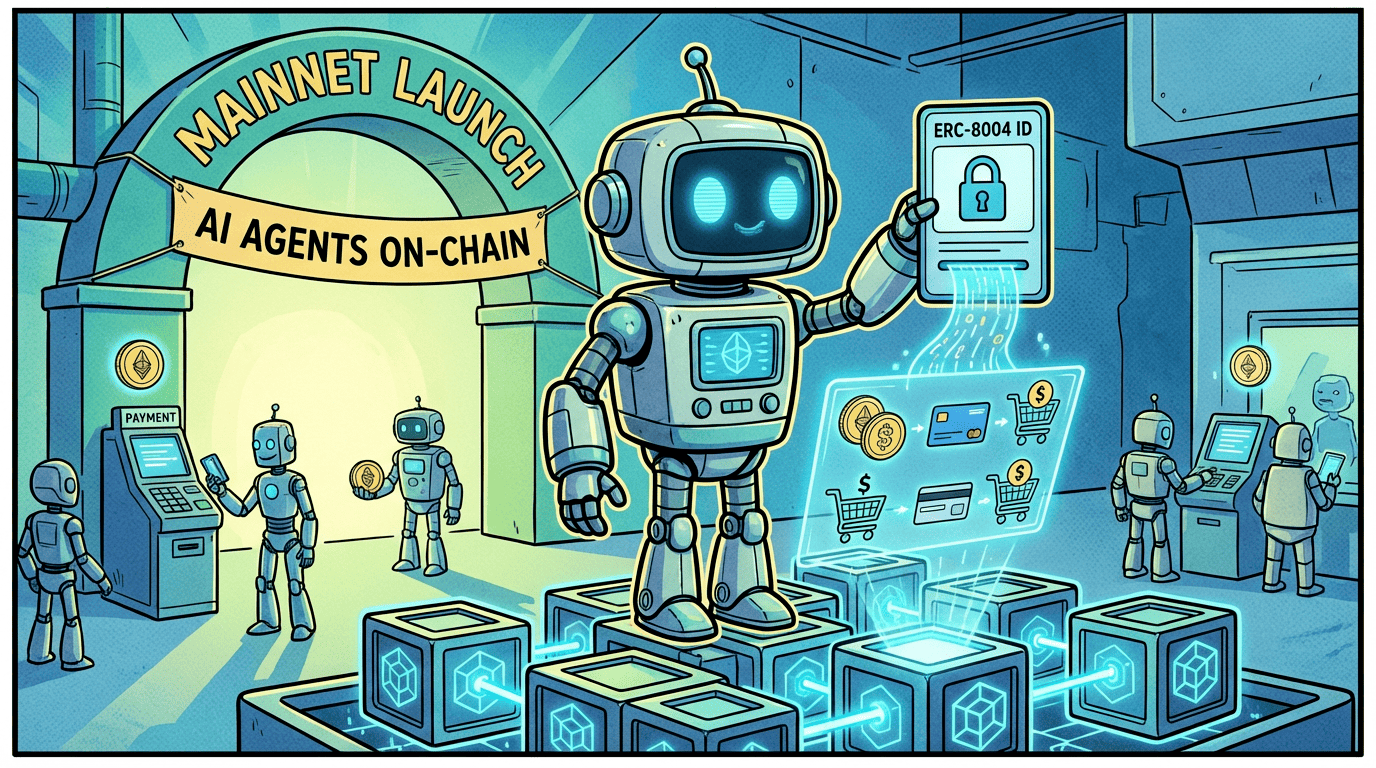
On January 29, the Ethereum Foundation announced that the ERC-8004 standard for AI agent economics will soon be launched on the mainnet, adding fuel to the already hot AI agent field.
If the past year has been about how AI agents will change the way applications are used, then ERC-8004 is actually focused on something more practical: when agents start to collaborate across organizations and platforms, how do we find them, identify them, and trust them without platform backing?
How will the changes brought about by ERC-8004 evolve? And which projects have already seized the initiative?
Why does Agent Economy need ERC-8004?
Imagine you want to use your AI assistant to create a market report, so your AI needs to collaborate with other AIs: one to pull data, one to write the text, and another to create charts.
The question is:
Who is it? Is it an imposter?
Is it reliable? How well has it performed in the past?
Has anyone endorsed/verified it?
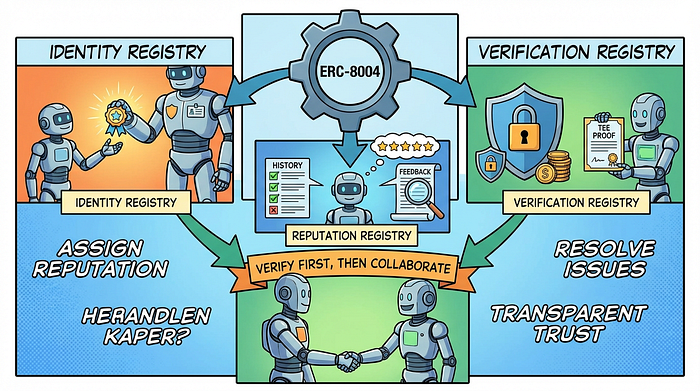
What ERC-8004 aims to do is to equip each AI with an on-chain credit profile and solve the three problems mentioned above through three lightweight registry entries.
Identity Registry: Issues a unique identity card to each AI agent. This unique on-chain identity verifies that it is indeed released by the team or application it claims to be from, and not a counterfeit version with the same name.
Reputation Registry: A dynamic reputation profile built based on on-chain interaction records. You can see its cooperation history and evaluation information: who it has worked with before, the quality of its delivery, whether it has received complaints, and whether it has had any setbacks. You don’t need to look at its self-promotion; just look at external feedback.
Verification Registry: Through multiple mechanisms such as economic staking and trusted execution environment verification, it provides credible guarantees for AI behavior. By verifying the registry, you can see whether the AI has third-party endorsement and whether it is trustworthy.
In summary, when you want your AI to collaborate with other AIs, ERC-8004 provides a “verify first, then collaborate” approach: first check the identity, look at reputation, and verify credentials before deciding whether to delegate the task. This way, trust between agents doesn’t rely on the opaque auditing of a particular platform, but becomes more transparent and reusable.
Projects worth paying attention to
The rapid market penetration of ERC-8004 is not a coincidence of technological iteration, but rather an inevitable step in the development of the agent economy; the Web3 intelligent era is on the horizon. Below are some noteworthy web3+Agent projects:
Virtual Protocol
Overview: Virtuals Protocol aims to build a “productive AI agent society”: each agent can autonomously provide services or products and conduct on-chain transactions with humans or other agents.
Progress: Virtuals Protocol has deeply integrated its ACP smart contracts, ERC-8004, and x402 payment protocols to ensure that value can flow seamlessly and efficiently throughout the economy.
MEMO
Overview: MEMO is an innovator in the field of blockchain storage. Through its integrated architecture of “identity-payment-privacy-computing”, it aims to become the core infrastructure of the decentralized AI Agent economy.
Identity and Verification: By assigning a verifiable on-chain identity to each Agent through an autonomous DID system, the trust foundation of ERC-8004 is solidified.
Payments and Assets: By leveraging ERC-7829 to assetize data (RWA) and integrating it with X402’s micropayment system, a sustainable incentive engine is provided for the agent economy.
PayAI
Overview: PayAI positions itself as “payment infrastructure for the AI era,” based on Solana-first’s multi-network architecture and ERC-8004, providing instant code-level payment capabilities for autonomous AI agents and microtransactions .
Core component : Facilitator, emphasizing millisecond-level billing, low cost, and seamless integration with agents/applications.
Usage and penetration: PayAI is the first payment node on Solana to implement the x402 protocol, and has processed more than 14% of the transaction volume of the entire x402 ecosystem , ranking among the top in the ecosystem in terms of transaction share.
Bittensor
Overview: Bittensor is essentially an “AI value internet” driven by a token economy and coordinated through subnet marketplaces. It innovatively transforms global computing power into a freely tradable computing market, enabling the contributions of AI models to be quantified, priced, and settled, thereby constructing the underlying value foundation for the decentralized intelligent era.
Machine payment and value capture closed loop: TAO is the universal currency of Bittensor’s decentralized AI network. Its “settlement-incentive-governance” three-in-one design has successfully built an autonomous economic closed loop of “AI-to-AI payment” and is a pioneer in value exchange between machines.
Dreams
Overview: Daydreams.Systems is an ecosystem and laboratory for autonomous AI agents, consisting of three parts: the DAYDREAMS framework (for building), the DREAMS Router (for payments), and the LUCID platform (for running).
Business and Progress: Built on ERC-8004 and prioritizing TypeScript in its framework, the DREAMS Router also performs model inference by receiving USDC micropayments . Furthermore, the Router has been migrated from the testnet to the Base mainnet, with over 1.3 million model calls per month.
The rollout of the ERC-8004 mainnet has laid the crucial foundation of trust for the AI Agent economy : verifiable identity, traceable reputation, and verifiable credentials. The next area to watch is the infrastructure and gateway projects surrounding identity, payment, and collaboration scenarios.