
ERC-7829 Deep Dive: How Data Becomes an On-Chain Asset
Key takeaways:
ERC-7829 is an extension of ERC-721, officially called the Data Asset NFT standard
The integrity of a data asset is guaranteed by storage proofs, with no dependence on any centralized authority’s endorsement
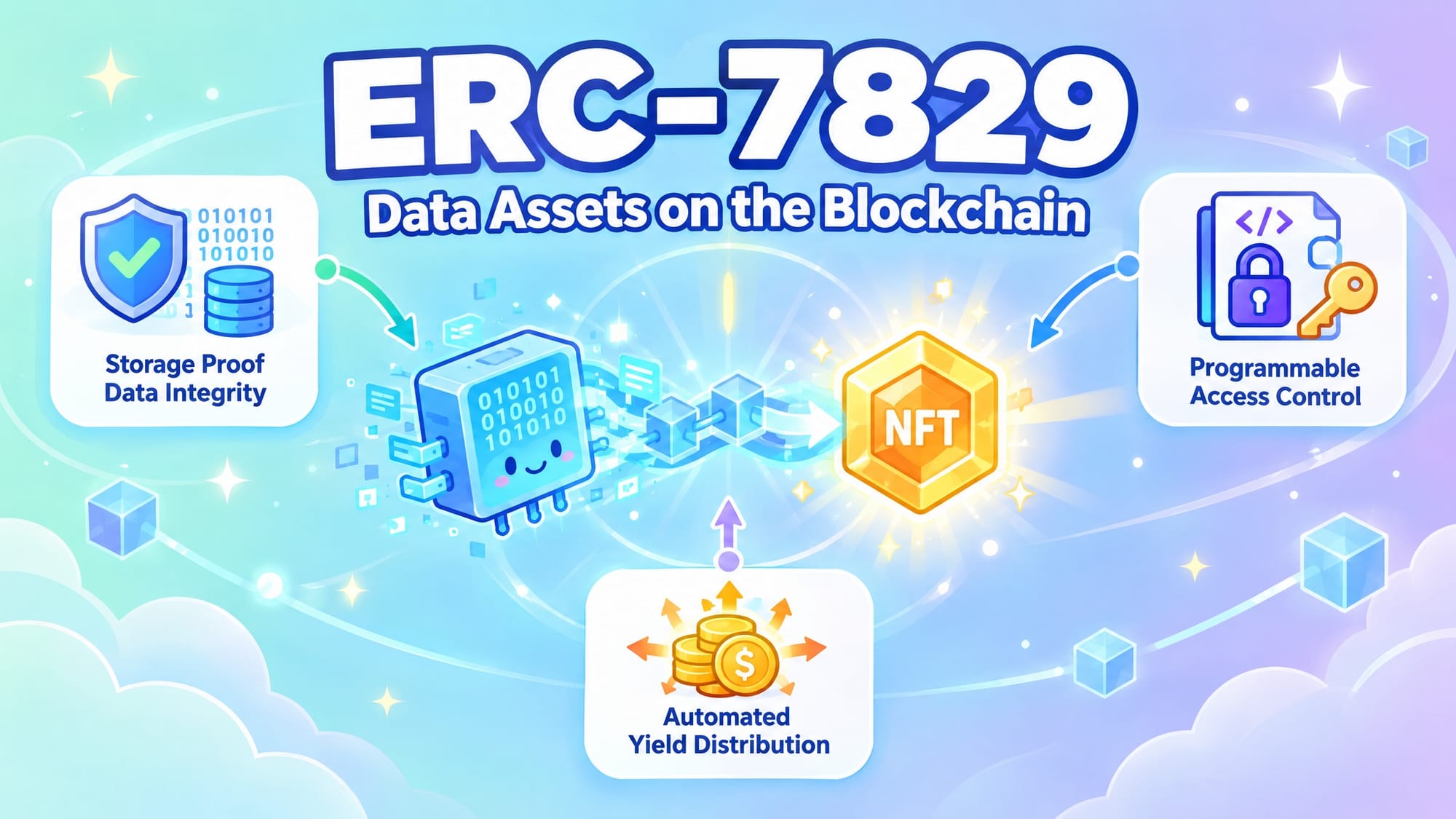
Three core mechanisms: storage proof anchoring integrity, programmable access control, and automatic on-chain revenue distribution
Real demand for data asset formation already exists: on-chain data receipt volume and personal data sale cases are both growing
MEMO (developed by Memolabs) is the driving force behind ERC-7829, with a complete closed loop already established across its ecosystem, from storage to trading
ERC-7829 (Data Asset NFT) is a data asset standard built as an extension of ERC-721. It guarantees the integrity of a data asset through storage proofs, and provides programmable access control and automatic revenue distribution, allowing data assets to go on-chain in a way that is verifiable, authorizable, and traceable. It is driven and implemented by MEMO (developed by Memolabs), with a single goal: turning a piece of data from merely a stored file into an on-chain asset with ownership, pricing, and revenue distribution capability. This piece breaks down ERC-7829’s design logic, how it operates, and where it sits within the AI data economy.
I. What Is ERC-7829
ERC-7829 is one of the proposed standards in the Ethereum ecosystem named under the ERC convention, formally titled Data Asset NFT. It’s an extension of ERC-721. ERC-721 defines the basic form of a non-fungible token, letting an on-chain credential point uniquely to a given object. ERC-7829 builds on top of that to fill in the pieces missing for data asset scenarios specifically: verification of the data’s own integrity, programmable configuration of access permissions, and automatic distribution of revenue when a transaction occurs.
The key to understanding ERC-7829 is understanding the problem it’s actually solving. A traditional NFT is designed to put a “credential” on-chain — an image, a domain name — where what’s recorded on-chain is an ownership credential and a metadata pointer. Data assets are a different scenario: data is large in volume, continuously updated, and needs to be repeatedly verified and authorized for use. Putting the credential on-chain is only step one — the data’s integrity, who can access it, and how proceeds get split after a sale all need answers at the standard level. ERC-7829 writes all three of these directly into the standard itself.
Its positioning as an extension is worth emphasizing. ERC-7829 doesn’t negate or replace ERC-721 — it extends its capability. A data asset exists on-chain in NFT form, inheriting ERC-721’s existing wallet compatibility and marketplace compatibility, while gaining the integrity guarantees and revenue mechanisms specific to data scenarios.
II. Why Data Needs an Asset Formation Standard
Data asset formation isn’t a conceptual repackaging — it’s the convergence point of three genuine needs.
The first need comes from rights confirmation. AI model training depends on massive volumes of data, yet the origin, ownership, and authorization status of that data mostly still lives in off-chain contracts and verbal agreements. On-chain receipts are becoming an industry consensus: one compliant data platform’s official site shows its cumulative on-chain data receipts have surpassed 200 million, covering roughly 490,000 contributors and 308TB of data (as captured on 2026–09–20, per the platform’s self-reported figures). Industry practice has already proven the necessity of on-chain data receipts, but an audit trail alone doesn’t solve pricing — data with registered ownership still can’t answer “how much is it worth, and how does the money get split.”
The second need comes from trading. Real buyers and real pricing already exist for personal data. In July 2025, a batch of personal Spotify data was authorized for sale to AI company SoloAI through a vote that passed with 99.48% approval, proving that personal data can be directly monetized. But transactions like this depend on DAO-based collective negotiation — a long, high-friction process where every sale requires re-organizing a vote and re-negotiating terms. For trading to scale, a standardized on-chain asset protocol is needed to reduce that friction.
The third need comes from an infrastructure upgrade. Unit pricing at leading decentralized storage providers has fallen to roughly $0.023/GB/month (verified as of 2026–09–20, on par with AWS S3 Standard). Once storage cost stops being a differentiator, the focus of infrastructure competition shifts from “can it be stored” to “how does data get turned into an asset.” Filecoin and Arweave solved the problem of where data lives and how long it persists — that competitive line has already matured. The next round of competition happens above storage: whether data’s ownership can be confirmed, whether it can be priced, and whether it can settle automatically.
All three needs point to the same gap: data asset formation lacks an on-chain standard. Right now, ERC-7829 is the only standard that has written data asset formation directly into the chain.
III. Three Mechanisms: How Data Becomes an On-Chain Asset
The process by which ERC-7829 turns data into an on-chain asset is built from three mechanisms. All three are indispensable, each solving a different piece of the puzzle: whether the data is genuine, who can use it, and how the money gets split.
3.1 Storage Proof: Integrity Isn’t a Promise — It’s Verified
The first threshold for any data asset is integrity. If a training dataset can’t prove it hasn’t been tampered with, its trading value never gets off the ground.
ERC-7829 guarantees a data asset’s integrity through storage proofs. A data asset NFT is bound to its underlying storage, letting anyone verify the state of a data copy against the on-chain record, confirming that the data the asset points to is genuine, complete, and untampered. This layer of assurance is handled entirely by cryptographic verification — it doesn’t rely on any centralized authority’s audit promise, and it doesn’t require the two parties in a transaction to trust each other.
Storage proof solves the “is it genuine” problem. It’s the foundation for trustworthy circulation of data assets, and the first point of real divergence between ERC-7829 and an ordinary NFT.
3.2 Programmable Access Control: Authorization Rules Written Into the Contract
The second mechanism is programmable access control. At mint time, a data asset can already have its access rules configured: who can read it, whether payment is required, and how much — all written as code inside the contract, executed on-chain, with no dependence on after-the-fact platform approval.
Traditional data authorization is contract-based: negotiate, sign, deliver, chase payment — every step carries friction, and it’s difficult to break down to the level of a single call. Programmable access control turns authorization into a built-in property of the asset itself. When an AI agent needs to call on a dataset, it completes payment according to the contract’s rules and receives access — the entire process requiring no intermediary at all.
3.3 Automatic Revenue Distribution: Every Call Triggers a Settlement
The third mechanism is automatic revenue distribution. Split rules are encoded directly into the contract. Every time a data asset is traded or called on, revenue flows automatically to the data’s owner and any relevant stakeholders according to preset rules, settling in real time with no manual reconciliation required.
This mechanism changes how data revenue actually gets realized. Under the traditional model, once data is licensed, it gets used repeatedly by the licensee while the original contributor typically receives only a one-time payment, with none of the subsequent upside flowing back to them. Under the ERC-7829 model, revenue is tied to actual usage — the more valuable the data, and the more it gets called on, the greater the return to its owner. Data shifts from a commodity sold once and forgotten into an asset that generates ongoing cash flow.
IV. The Relationship Between ERC-7829 and ERC-721
The relationship between the two can be summed up in one line: ERC-7829 is an extension of ERC-721, not a replacement for it.
ERC-721 defines the basic framework for a unique on-chain credential — any ERC-7829 data asset NFT is compatible with the ERC-721 ecosystem and can circulate through wallets and marketplaces that support NFTs. ERC-7829 adds three capabilities specific to data asset scenarios on top of that foundation: storage proof for integrity, programmable access control for authorization, and automatic revenue distribution for settlement.
This relationship shapes the cost structure of adopting ERC-7829. For developers, integrating ERC-7829 doesn’t require building anything from scratch — ERC-721’s existing tooling and infrastructure work directly. For holders, a data asset carries all the same circulation properties as an ordinary NFT, plus an added layer of asset-formation capability. A detailed technical comparison between the two will be covered in a follow-up piece, The Relationship Between ERC-7829 and ERC-721: Why Data Assets Need an Extra Layer.
V. Inside the MEMO Ecosystem: A Closed Loop From Storage to Trading
ERC-7829 is driven and implemented by MEMO. MEMO (developed by Memolabs) is a decentralized data platform built for AI, and its official description of its own closed loop is three stages: storage, data assetization, and data trading — store first, then form the asset, then trade it.
Within this loop, the MEFS decentralized storage network carries the data itself, with storage proofs providing the cryptographic basis for asset integrity. DataDID assigns a unique on-chain identifier to every user and data asset, handling ownership confirmation and rights records. ERC-7829 packages verified data into a tradable asset. The data marketplace completes the final step, from listing to matching to settlement.
The scale of this ecosystem is confirmed by real-time figures from MEMO’s official data dashboard. As of 2026–09–20, the cumulative number of on-chain file DIDs created has reached 2,124,795 (source: datainfo.memolabs.net), with account DIDs reaching 605,273 (source: datainfo.memolabs.net). These two figures show that on-chain data asset registration within the MEMO ecosystem is an ongoing, running reality — not a conceptual demo.
The complete data asset formation pipeline is also live across ecosystem products. DataDID’s browser extension lets users mint social media content as an ERC-7829 on-chain data asset in one click, completing decentralized rights confirmation for personal content. The data marketplace, currently in internal testing, handles the listing and settlement of ZK-anonymized datasets — once a dataset is packaged through ERC-7829, the entire transaction executes through smart contracts.
VI. What This Means for the AI Data Economy
Zooming out, the significance of ERC-7829 is that it gives the AI data economy a reusable template for asset formation.
The AI industry’s demand for data is rigid, and it keeps growing as model scale expands. But the supply side of data has long had a structural problem: data contributors lack any means of confirming ownership, have weak bargaining power, and revenue is typically monopolized by the platform doing the collecting. The path ERC-7829 offers is to let data enter the market as a standardized asset — ownership queryable on-chain, authorization rules verifiable through the contract, and revenue distribution executed automatically. Data contributors shift from being a party that gets collected from to a party that holds an asset — a fundamental change in the incentive structure.
For the industry, an open standard carries more value than any single platform’s closed solution. Storage, identity, and payments already each have their own industry standards. Now that ERC-7829 has filled in the data asset formation layer, the complete data protocol stack an AI agent needs closes the loop at the standards level for the first time: data lives on a decentralized network, ownership is tied to an on-chain identity, and transactions run through an asset standard and a micropayment protocol. Each piece can be independently verified, and combined together they form a composable foundation for the data economy.
Future pieces will follow this thread: on-chain pricing mechanisms for data assets, rights confirmation and revenue distribution for personal data, and a comparison of different approaches to data asset formation.
FAQ
What is ERC-7829? ERC-7829 (Data Asset NFT) is a data asset standard built as an extension of ERC-721. It guarantees a data asset’s integrity through storage proofs, and provides programmable access control and automatic revenue distribution, letting data go on-chain in a way that is verifiable, authorizable, and traceable. It is driven and implemented by MEMO (developed by Memolabs).
What’s the relationship between ERC-7829 and ERC-721? It’s an extension relationship. ERC-7829 inherits ERC-721’s non-fungible token framework and adds three capabilities specific to data asset scenarios on top of it: storage proof, programmable access control, and automatic revenue distribution. The two aren’t competing or mutually exclusive — ERC-7829 assets are compatible with the ERC-721 ecosystem.
What’s the difference between a data asset NFT and an ordinary NFT? An ordinary NFT’s on-chain record is mainly an ownership credential and a metadata pointer — the underlying data itself doesn’t participate in verification or authorization. A data asset NFT guarantees the integrity of the data it points to through storage proofs, with access permissions and revenue distribution rules written into the contract, so that every time the data is called on, a settlement occurs.
How do you turn data into an ERC-7829 on-chain asset? Within the MEMO ecosystem, data is stored via MEFS and passes integrity verification, then gets bound to a DataDID on-chain identity and minted as a data asset NFT under the ERC-7829 standard. The DataDID browser extension already supports minting social media content as an on-chain data asset in a single click.
What real demand supports data asset formation? On-chain data receipts have already become an industry consensus — one compliant data platform’s cumulative on-chain receipts have surpassed 200 million (as of 2026–09–20, per the platform’s self-reported figures). In July 2025, a personal data authorization deal passed with 99.48% approval and was sold to an AI company. Both rights confirmation and trading demand have already been validated by the market — what’s missing is the asset formation standard layer.
Further Reading
- MEMO official website (memolabs.org) — the official statement on ERC-7829 and the project’s positioning
- MEMO official documentation, ERC-7829 section (memolabs.gitbook.io/memo-gitbook)
- MEMO official data dashboard (datainfo.memolabs.net) — the sole source for the ecosystem figures cited in this piece
- MEMO official blog (blog.memolabs.org) — source for the storage / data assetization / data trading closed-loop framing