
Decentralized Identity Redefines Trust Without Central Authorities
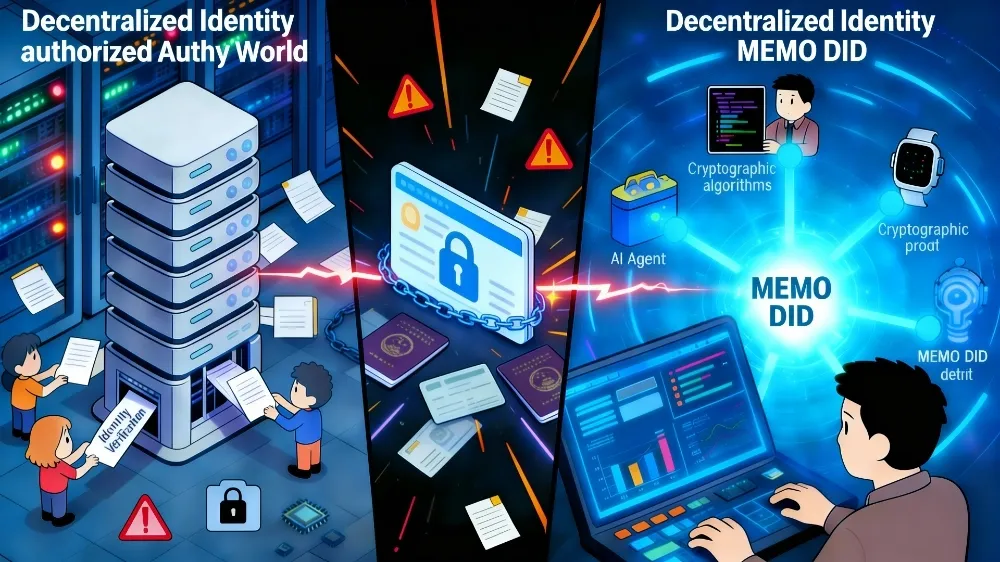
Trust in the digital era cannot be taken for granted when control is concentrated in the hands of centralized platforms that own, store, and monetize user data. This is precisely why Decentralized Identity redefines trust without central authorities—it shifts control and ownership from corporations back to individuals. MEMO’s Decentralized Identity solution, MEMO DID, serves as a foundational pillar of this transformation, especially in Web3 ecosystems where data ownership, privacy, and interoperability are paramount.
In this article, we’ll explore how Decentralized Identity reimagines trust mechanisms, why MEMO is uniquely positioned to lead in this space, and how MEMO DID empowers users and developers alike to forge a new digital trust paradigm rooted in cryptographic verification and user sovereignty.
1. The Fundamental Problem with Centralized Trust Systems
Historically, digital identity has been managed by centralized entities—social networks, tech platforms, and enterprise systems. These systems require users to hand over personal data, rely on platform-controlled accounts, and accept trust mechanisms that are opaque and often exploitable.
Centralized authorities become bottlenecks and points of vulnerability. Data breaches, unauthorized access, and opaque data usage policies have eroded user confidence. Even worse, trust is assumed rather than verified. Decentralized Identity confronts these challenges by enabling users to own, control, and verify their identity independently of any single entity.
This is where MEMO DID enters the picture—not just as an identity label, but as a user-centric identity infrastructure that underpins a broader data value network.
2. What Decentralized Identity Actually Means
At its core, Decentralized Identity is a digital identity model where identifiers are:
- Controlled by the user
- Cryptographically secure
- Portable across systems
- Independent of any single platform
This model eliminates the need to trust intermediaries to validate identity or data ownership. Instead, identity is verified through open cryptographic proofs and interoperable standards such as DID (Decentralized Identifiers).
With MEMO’s implementation—MEMO DID—users get a persistent, verifiable identity that they alone can manage. A DID is like a digital passport: it proves who you are or that you own specific digital assets, without exposing sensitive information unnecessarily.
3. MEMO DID: A Trust Foundation for the Web3 Era
MEMO DID plays a central role in MEMO’s ecosystem. It is not simply an ID tag—it is the trust hub that connects users, data, and decentralized applications (dApps) across Web3. In MEMO’s overall architecture, MEMO DID is intricately linked with other components such as decentralized storage, data markets, and AI-native systems.
Here’s what makes MEMO DID stand out:
- User-Owned Identity: Unlike platform accounts, MEMO DID belongs to the user alone and is controlled through private keys.
- Cross-Platform Portability: Your identity travels with you across applications and environments—making login frictionless and private.
- Data Ownership Tie-In: With MEMO’s decentralized data ecosystem, every data asset can be associated with a unique DID, enabling real ownership and value realization.
This means that identity is no longer a siloed piece of a platform; it becomes the core trust layer for authentication, authorization, and data rights.
4. How MEMO DID Redefines Trust Without Central Authorities
So how exactly does Decentralized Identity transform trust?
a. Cryptographic Verification Instead of Assumed Trust
Traditional systems assume trust: you trust that a platform correctly holds and verifies your credentials. MEMO DID replaces this with cryptographic proofs—verifiable, immutable, and transparent. No single authority can alter or revoke your identity arbitrarily.
b. Persistent Identity Across Ecosystems
A MEMO DID remains valid across applications and services, from decentralized apps to AI agents. This persistence supports seamless interactions and reduces reliance on repetitive credential submissions.
c. Permissioned Data and Privacy Preservation
With MEMO DID, users control who can see what. Combined with zero-knowledge proofs, you can prove your identity or credentials without disclosing sensitive details.
5. Beyond Personal Identity: Identity for AI Agents
One of the most transformative aspects of MEMO’s decentralized paradigm is extending identity to non-human actors like AI agents. In the emerging AI economy, agents will need identities to:
- Authenticate actions
- Build reputation histories
- Engage in transactions autonomously
MEMO is integrating standards such as ERC-8004 to provide identity and reputation structures for AI agents, ensuring that machine interactions are trustworthy, auditable, and accountable.
In this vision, MEMO DID becomes the passport not only for human users but also for machine entities operating in decentralized ecosystems.
6. Trust That Powers Value, Not Just Access
Trust isn’t just about reassurance—it’s about enabling value flows. When identity is decentralized and verifiable:
- Data assets can be tokenized and traded
- Users can monetize contributions directly
- Developers build with ownership logic at the center
MEMO’s broader stack—combining decentralized data blockchain, data wallets, and DID—creates a foundation where identity, data, and value interoperate securely and transparently.
7. Conclusion: A New Trust Paradigm for the Digital Economy
Decentralized Identity redefines trust without central authorities by giving users control over their digital persona, data, and reputation. With MEMO DID, this vision becomes tangible—providing portable identities, cryptographic verification, and a foundation for next-generation Web3 and AI ecosystems. As digital experiences evolve beyond single platforms into interconnected value networks, decentralized identities will be the key to building trust that is transparent, secure, and truly owned by users.
Registering your MEMO DID today isn’t just a step into a new user experience—it’s a step into a future where identity and trust are inseparable from ownership and value.