
Data Mining: The Ultimate FAQ
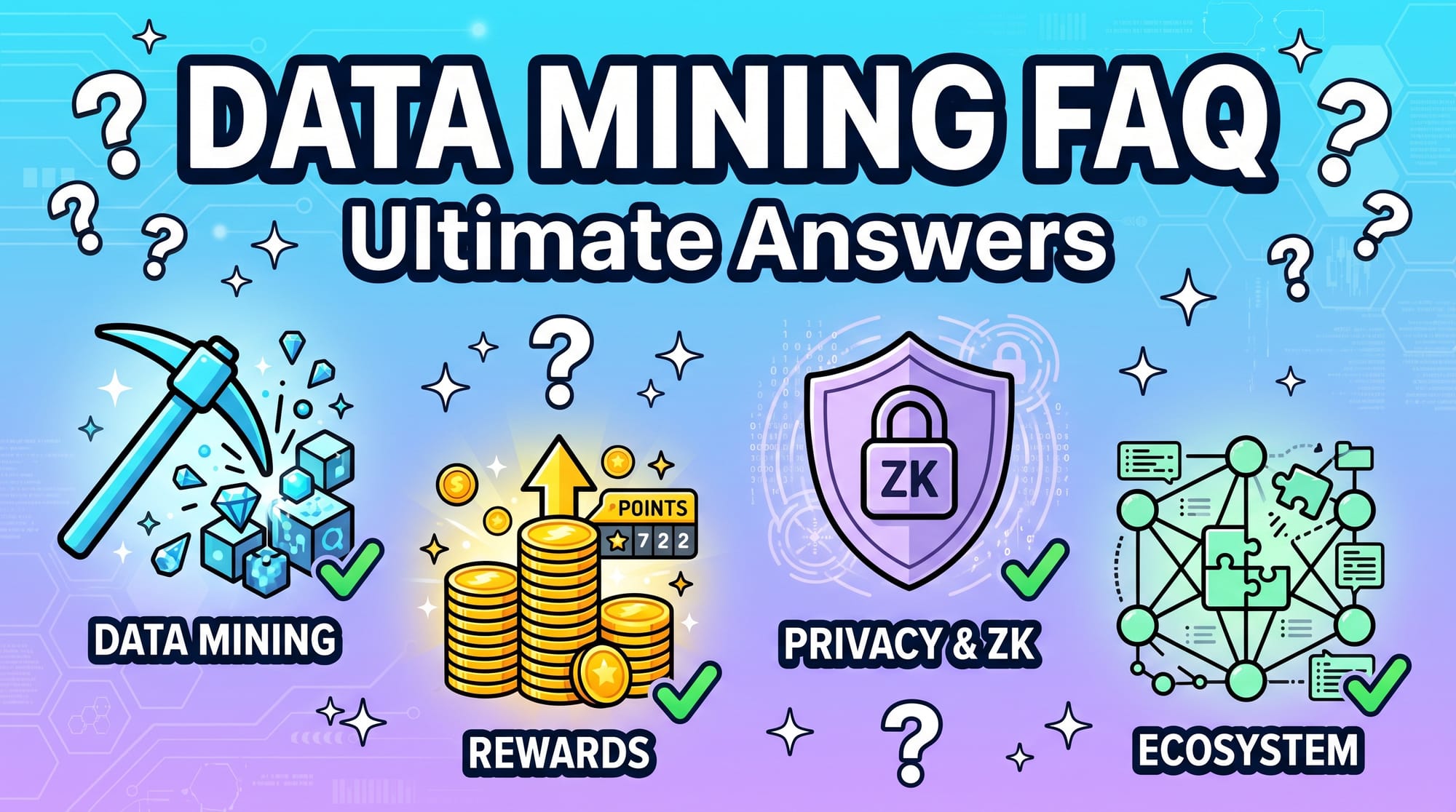
Since the Data Mining module launched, we’ve received a steady stream of questions from the community — many of them repeating across privacy, points calculation, and future roadmap. This is our attempt to answer every core question in one place.
The Basics
What is Data Mining?
Data Mining is a data incentive module inside the DataDID browser extension. As you browse the internet normally, the system identifies publicly observable signals at the browser’s behavioral layer — site type, time spent on page, content category — and runs them through a ZK Proof locally on your device to produce a mathematical attestation that gets uploaded to the chain. The system uses that attestation to calculate your points reward. No active effort from you is required: just flip the switch and browse as usual.
How is it different from typical “idle income” projects?
Most idle yield projects fall into two categories. Bandwidth/IP rental models (like Grass) have users contribute idle internet connection resources — rivalrous resources with a hard ceiling, so per-user returns shrink as more people join. Compute contribution models (like ARO) have users contribute device processing power, where earnings are constrained by hardware specs.
Data Mining takes a different path. It doesn’t use any of your hardware resources. It processes only publicly observable browser behavioral signals and outputs a verifiable proof of behavioral diversity through ZK Proofs. What you contribute isn’t bandwidth, an IP address, or compute — it’s de-identified genuine human behavioral signals. This type of resource has intrinsic scarcity value for the AI training data market, and it doesn’t suffer from competitive dilution: one person’s behavioral diversity doesn’t diminish just because more people are contributing.
Privacy and Security
What data does the plugin collect?
Three dimensions are identified and recorded: the domain names of websites you visit, the time you spend on each page, and the content category each domain belongs to. All of these signals come from the publicly observable data layer of the browser — no account credentials, personal identity information, page content details, or private data of any kind.
One sentence summary: we know whether you visited a tech site or a lifestyle site. We don’t know which paragraph of which article you read.
Will my raw data be uploaded anywhere?
No. All raw data is processed locally on your device — the ZK circuit generates a proof, and then the raw data is automatically discarded locally. The server receives only a zero-knowledge proof from start to finish, and nothing in it can be reverse-engineered to reconstruct any specific browsing record. Your raw data never leaves your device. This is an architectural constraint, not a configurable policy setting.
What exactly does ZK Proof protect?
ZK Proof protects the invisibility of data. Traditional encryption solves “only authorized parties can see this.” ZK Proof solves an earlier problem: “is it possible to complete verification without needing to see the data at all?” In the context of Data Mining, what the AI training data market needs is a verifiable signal — is this user’s behavior diverse? Is it genuine? — not the user’s actual browsing history. The ZK circuit outputs the former as a mathematical proof. The latter stays on your computer permanently.
Does the plugin collect data when Data Mining is turned off?
No. The Data Mining module is off by default. The first time you enable it, a clear authorization screen appears specifying exactly what’s collected, what it’s used for, and your right to revoke at any time. The toggle lives in the plugin — control stays with you. Turning it off stops collection immediately. Your accumulated points are not cleared.
Points Calculation
How are points calculated?
Points accumulate on two parallel tracks.
Online points. Having the plugin active signals that your node is available. Points are issued hourly. Base rate is 6 points per hour, with a streak multiplier that grows with consecutive online days — approximately 1.35× at day 7, maxing out at 1.5× at day 10. Daily online points cap at 108.
Data contribution points. Measured by the number of unique domains you effectively visit, weighted by two multipliers: diversity and quality. Several factors influence your final score simultaneously: the number of unique domains visited that day, the breadth of content categories covered (using the IAB content taxonomy), and effective time-on-page per visit. Anti-gaming rules are built in: pages with less than 5 seconds of dwell time don’t count, and sub-pages under the same second-level domain are consolidated.
A typical example: on your 7th consecutive online day, with 8 hours of activity and 20 unique domains visited across multiple content categories, you can expect around 101 points for that day.
Why measure by domain count instead of traffic volume or time spent?
Measuring by traffic volume incentivizes users to stream video in the background. Measuring by time spent incentivizes keeping tabs open and idle. Neither produces data with value for AI training. Data Mining measures by effective unique domain count and category diversity because what the AI training data market most lacks isn’t data volume — it’s behavioral diversity. A person’s genuine browsing trail across tech, finance, education, and other domains in a single day is far more valuable than repeated visits to the same category of site.
Will points lose value? Where can I use them now?
Points already circulate across several in-ecosystem use cases: they can be used to participate in platform applications (for example, AliveCheck subscriptions), and they’re consumed in the tweet minting process. More importantly, DataDID points can be accumulated toward eligibility for future MEMO ecosystem airdrops. As the data marketplace launches, points will connect to additional redemption and spending channels.
Anti-Gaming and Fairness
Can I use a script to simulate browsing and farm points?
The anti-gaming design is multi-dimensional — it doesn’t rely on a single threshold to block abuse. The 5-second minimum dwell time per page is the baseline filter. Sub-page consolidation under the same second-level domain prevents inflate-by-clicking through sub-pages. On top of that, the points engine evaluates domain diversity, content category coverage breadth, and cross-period activity patterns as independent dimensions simultaneously.
A cheater would need to defeat multiple independent indicators at once to achieve a high score — and each indicator can’t be attacked in isolation. Together they have to form a statistically coherent, complete behavioral profile. The more analysis dimensions there are, the more the simulation cost multiplies. A script running independently can’t simultaneously sustain the natural distribution across all these dimensions, which makes high-quality behavioral signal forgery extremely difficult.
Is there a ceiling on data contribution points?
There’s no hard cap, but the growth rate is inherently bounded by genuine browsing behavior. The number of domains visited, the breadth of category coverage, and the reasonableness of dwell times collectively determine the day’s final score. The system is designed to reward authentic, diverse browsing — not data volume accumulation.
Technical and Compatibility
Does Data Mining require high-spec hardware?
Essentially no. ZK proof generation runs locally on your device, but after engineering optimization the hardware requirements are far lower than most users would expect. On mainstream consumer hardware, there’s no perceptible performance impact. The plugin itself is lightweight, with very low memory and CPU footprint.
Which browsers are supported?
The Data Mining module currently fully supports Chrome and Chromium-based browsers (including Brave, Edge, and others). Support for additional browsers is in progress.
Can I use the same account across multiple devices simultaneously?
Currently, a single DataDID identity can only maintain an active state on one device at a time. Points are calculated based on the currently active device. Multi-device support is under evaluation.
Privacy Architecture
Is it really true that raw data never leaves my device?
Yes. This is the hardest line in DataDID’s architecture. There is no code path in the entire data processing pipeline that sends raw behavioral data to a server. Even if someone obtained every server credential, every database password, and every API key, they could not reconstruct a user’s browsing history from the server — because those records have never existed on the server. This is the fundamental difference between an architectural constraint and a management policy.
What does it mean that the module defaults to off?
It means that before a user actively enables Data Mining, the plugin performs no processing or transmission of any public behavioral signals. This is our product position: rebuilding trust around data collection can’t be done through “default-on, explain later.” Users should make that choice through a deliberate, informed, active action — not discover after the fact that something was already running.
Ecosystem and Roadmap
Where does Data Mining fit in the DataDID ecosystem?
Data Mining is an important piece of the DataDID ecosystem. Tweet Minting (minting social content as on-chain data assets via the ERC-7829 standard), Data Mining (converting browsing behavioral data into point-based income), and the upcoming data marketplace (connecting ZK-anonymized behavioral datasets to real AI training data buyers) form a complete “establish ownership → quantify value → enable circulation” loop for data asset formation.
What’s the relationship between points and future MEMO airdrops?
The DataDID points system was designed from the start with deep ties to the MEMO ecosystem’s economic model. Points can be accumulated toward future eligibility for MEMO ecosystem benefits. Specific conversion ratios and trigger rules will be announced when finalized. Points don’t directly equal benefits — before the data marketplace launches, points serve as a quantified record of a user’s contributions and participation in the ecosystem, and will be a key basis for future benefit distribution.
When will the data marketplace launch?
The data marketplace’s core contracts are currently in internal testnet feedback iteration. The first half of the pipeline — authorization through asset formation (DataDID + ERC-7829) — is already running in production. The second half — matching through settlement — requires the marketplace to launch publicly before final technical validation can be completed. A specific launch timeline will be announced through official channels once confirmed.
Data Contribution Points: Specific Questions
I’m in Africa and browse African websites. Does that affect my points?
Not at all. Data Mining’s diversity measurement doesn’t depend on whether a site is on any “whitelist” — it’s based on the actual category distribution of the content you browse. Any publicly accessible webpage, regardless of language or region, is recognized normally by the system for its domain and content category. Users everywhere in the world earn points through their ordinary browsing behavior.
Why did I earn different points today versus yesterday even though I visited the same number of domains?
Domain count is only one of the dimensions that affects data contribution points. Content category diversity, average dwell time per domain, and the combination of content categories covered all influence the final quality multiplier. High domain count with overly concentrated category distribution will still produce a lower score. The system isn’t counting — it’s evaluating the richness of your behavioral composition.
Data Mining is a product in rapid iteration. This FAQ will be updated continuously as the product evolves. If you have questions this document doesn’t cover, we welcome your feedback through official channels.
DataDID website: datadidapp.memolabs.net
Plugin download: Search “DataDID” on the Chrome Web Store