
Data Mining Advanced Strategies: How to Double the Value of Your Data Contribution

Since Data Mining launched, one question keeps coming up in the community: two people browse the internet the same amount, so why does one person’s points grow noticeably faster than the other’s?
The answer lives inside the points calculation mechanism itself. Data Mining’s points system runs on two tracks — online points reward consistent, sustained participation, while data contribution points reward genuine, diverse browsing behavior. The first sets your baseline. The second determines how much room you have to grow. Most people whose daily points plateau at the baseline aren’t short on online time — they simply aren’t making full use of the data contribution track.
This piece lays out, from the official side, the complete calculation logic behind data contribution points and concrete, actionable ways to optimize it.
1. Understand the Scoring Mechanism Before You Optimize
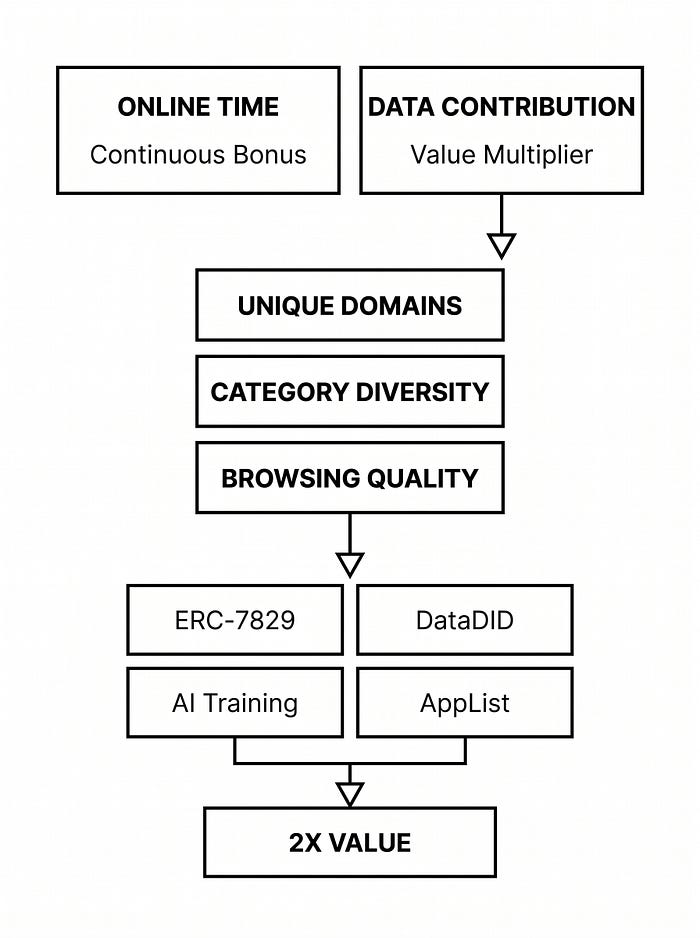
Data contribution points are measured across three dimensions.
The first dimension is the number of unique domains visited that day. This is the base unit of measurement — the more domains you visit, the higher your base score. But the system has a clear standard for what counts as an “effective visit”: any domain with less than 5 seconds of dwell time doesn’t count, and sub-pages under the same second-level domain are consolidated. Mechanically jumping between pages quickly produces no additional points — it gets flagged by the anti-gaming system instead.
The second dimension is the breadth of content category coverage. The system classifies domains using the IAB content taxonomy, with categories like technology, finance, education, lifestyle, and entertainment each occupying their own dimension. The broader the categories you cover, the higher the diversity multiplier you trigger. This is the dimension with the most upside in the entire data contribution points system — and the one most users overlook.
The third dimension is a quality assessment of browsing behavior. The system evaluates effective time spent per page, the reasonableness of your browsing rhythm, and activity patterns across different times of day. Together these determine the quality multiplier, whose purpose is to distinguish “meaningful, genuine browsing” from “mechanical page-switching.”
The three dimensions combine through weighting to produce your final score, with the diversity multiplier and quality multiplier stacking rather than substituting for each other. Understanding this is the key to understanding how to optimize: the goal isn’t to max out any single dimension endlessly — it’s to lift all three dimensions in balance.
2. Increase Domain Diversity to Expand Your Base
The foundation of data contribution points comes from the number of effective domains visited. The way to expand that foundation is to increase the genuine diversity of your browsing.
Maintaining a reasonable number of cross-category site visits each day is effective. The system identifies domains based on the browser’s publicly observable behavioral layer — public websites in any language, from any region, count normally. The more dispersed the categories your browsing covers, the larger your contribution to the diversity multiplier. A user who only browses sites in a single domain, even if they visit a large number of domains, will still be capped by insufficient category coverage.
The sensible approach is to let your everyday browsing naturally span multiple domains. Alternating between news, work tools, learning resources, and lifestyle sites benefits your diversity score more than staying within a single category for extended periods. One point worth emphasizing here: every optimization strategy should be grounded in genuine browsing behavior. The system is designed to reward real, diverse, meaningful browsing — not artificially manufactured behavioral patterns.
3. Max Out Your Consecutive-Day Streak Multiplier to Stabilize Your Baseline
Online points are the foundation of the points system, calculated as a base rate of 6 points per hour multiplied by a consecutive-day streak coefficient. The longer your streak, the higher the multiplier — roughly 1.35× by day 7, maxing out at 1.5× by day 10. Daily online points cap at 108.
The value of staying online consistently comes from compounding. At 8 hours of daily online time, day 1 earns 48 online points; by day 10, the same 8 hours earns 72 points. That difference comes entirely from the streak multiplier — no additional effort required. Keeping the plugin running steadily and avoiding frequent interruptions to your online status is the simplest and most effective way to maintain that multiplier.
If you use OpenClaw, installing the datadid-checkin Skill automates your check-ins, further reducing daily maintenance overhead. The plugin keeps running, check-ins complete automatically, and online time accumulates naturally.
4. Maintain Genuine Behavior to Pass the Quality Assessment
The quality multiplier carries the most weight of the three dimensions, and it’s also where users are most likely to go wrong.
Some users try to use scripts to simulate browsing behavior and inflate their quality score. This doesn’t work. The system’s anti-gaming design is multi-dimensional: the baseline filter for pages with less than 5 seconds of dwell time, sub-page consolidation under the same domain, and cross-period activity pattern analysis together form three layers of cross-validation. A cheater has to satisfy the statistical plausibility of every dimension simultaneously, and a script running in isolation cannot sustain the natural distribution these metrics require. More importantly, the ultimate value of data contribution points is anchored to data quality — behavior flagged as anomalous doesn’t just fail to earn points, it can also affect account reputation.
Genuine browsing behavior naturally satisfies the quality assessment. Normal work, study, and entertainment browsing already carries a reasonable distribution of dwell times and cross-category characteristics. Staying authentic is the most efficient strategy for maximizing your quality score.
5. Pair With Ecosystem Features to Amplify the Value of Your Points
The value of data contribution points isn’t limited to the number itself — it also shows up in how points connect to other features across the DataDID ecosystem.
Points can be used for tweet minting, turning social content into on-chain data assets under the ERC-7829 standard. They can be used for services in the AppsList marketplace, such as subscribing to AliveCheck’s on-chain life monitoring with points. They can be used to participate in the platform’s periodic campaigns. They can be accumulated toward future eligibility for MEMO ecosystem benefits. And once the data marketplace launches, ZK-anonymized behavioral signals will connect to genuine AI training data buyers, giving the behavioral data behind your data contribution points a real external demand anchor.
Seen this way, increasing your data contribution value isn’t just about growing a number — it’s about building your position in the data economy. Every genuine, diverse, sustained browsing session adds another coordinate to that position.
6. An Actionable Optimization Checklist
Condensing all of the above into a practical checklist:
Keep the plugin running steadily over the long term, avoiding frequent interruptions to your online status, so your streak multiplier keeps building. Let your everyday browsing naturally span multiple content categories rather than staying confined to a single domain, to boost category diversity. Maintain a genuine browsing rhythm — don’t chase a single-day peak in domain count — and let your dwell time distribution reflect natural behavior. Put your points to work through ecosystem features: tweet minting, AliveCheck subscriptions, and campaign participation, tying your points’ use to the broader ecosystem. Follow official channels to stay current on new features like the data marketplace, and plan how you’ll use your points ahead of time.
The core logic underlying all of these methods is the same: growth in data contribution value comes from sustained accumulation of genuine browsing behavior, not from gaming the measurement rules.
Data Mining was designed with one goal: to let every ordinary internet user convert their behavioral diversity into verifiable data asset value. Once you understand the mechanism and participate authentically, points growth follows naturally. What you actually gain is something built gradually and genuinely yours — an on-chain data asset and an ecosystem identity that belong to you.