
Bringing the Data Layer to BNB Chain: Agent DID and DataDID
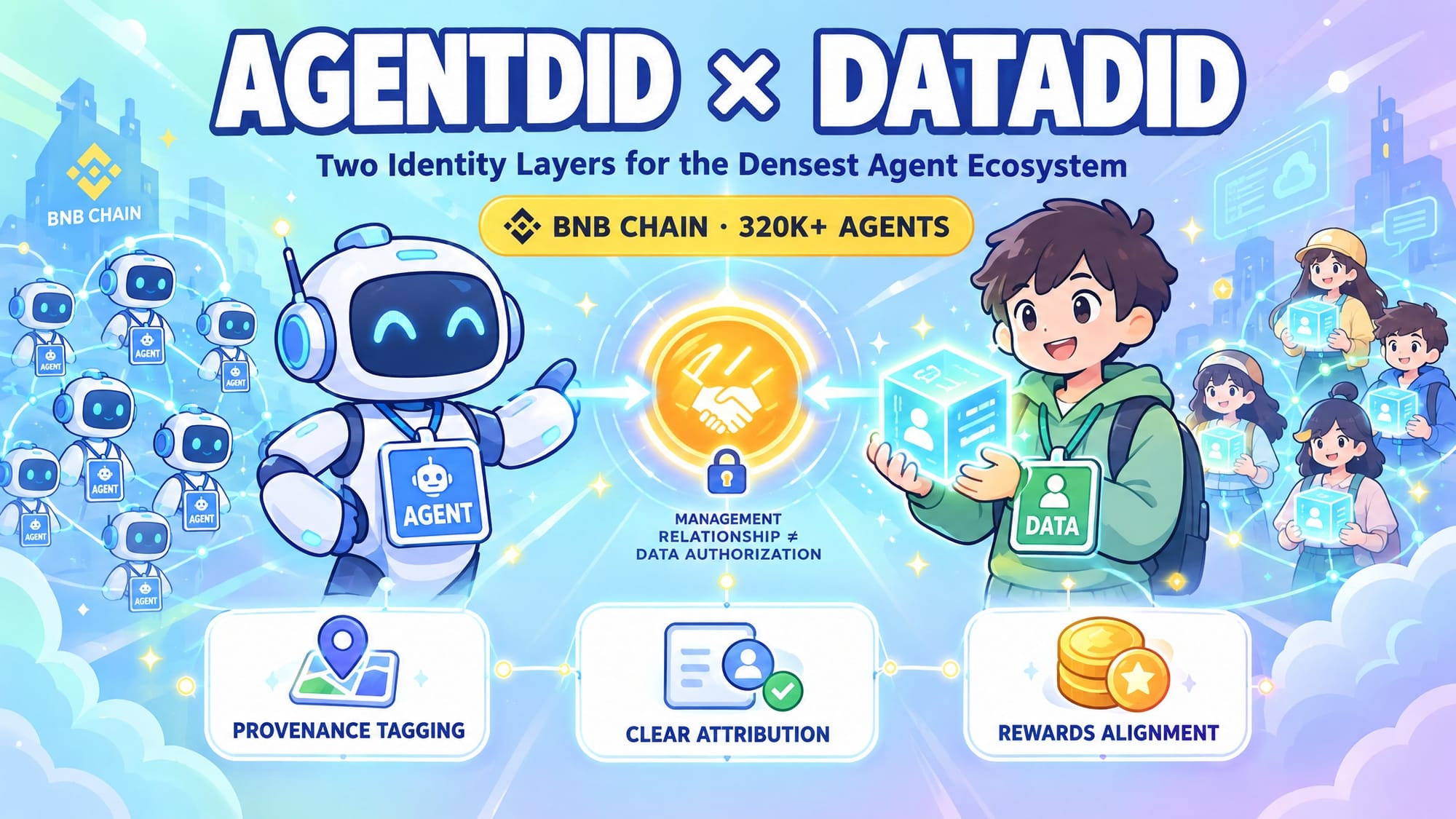
Key Takeaways | According to 8004scan, as of September 18, more than 320,000 on-chain AI Agents have been registered on BNB Smart Chain under the ERC-8004 standard, roughly 62% of the total across 30 chains, the largest share of any network. Around this ecosystem, MEMO offers two identity capabilities that are independent yet connected: DataDID is built for users, handling identity and data ownership, and is available now; Agent DID is built for Agents, giving every Agent a verifiable identity.
1. Building Where the Agent Boom Is Strongest
Data is the best industry anchor.
In January 2026, there were only 337 on-chain AI Agents registered under ERC-8004 across the entire network. Since the start of 2026, as AI and Web3 have accelerated their convergence, that number has grown by orders of magnitude: according to 8004scan, as of September 18, a cumulative 519,333 ERC-8004 Agents have been registered across 30 chains, with BNB Smart Chain alone accounting for 322,584, about 62%. For comparison, a figure cited by the BNB Chain official blog on July 16 was over 200,000, meaning the count has still grown noticeably in roughly two months.
Scale and growth rate both point to the same ecosystem.
For AI Agents, BNB Chain’s infrastructure friendliness is clear:
- Lower transaction costs: making high-frequency on-chain Agent interactions economically viable;
- A well-developed standards matrix: ERC-8004 for identity, the native BAP-578 for asset formation, x402 for payments, and ERC-8183 for task delegation;
- Low-barrier developer tools: BNB Agent Studio, launched on July 1, lowers the bar for building functional Agents even further.
The basic conditions an Agent needs to operate are largely in place on BNB Chain.
That’s why MEMO is focusing its Agent DID build on BNB Chain. To be clear, DataDID is natively multi-chain by design, and BNB ecosystem users can participate directly today. This isn’t starting from zero. It’s concentrating resources on the main battlefield where the Agent ecosystem is thriving most.
2. What DataDID and Agent DID Do on BNB Chain
Around the BNB ecosystem, MEMO provides two identity capabilities that are independent yet connected:
- DataDID: a decentralized identity and data-ownership system for users, answering “who is managing, who is authorizing” and “who does this data belong to.” BNB ecosystem users can participate directly today.
- Agent DID: an identity for Agents, built primarily on BNB Chain, answering “which Agent is acting.” An Agent can have its own identity without a DataDID; when a user wants to manage an Agent, a management relationship is established with the user’s DataDID through signatures from both sides. A management relationship only indicates “who is managing” and is not the same as authorization to access data.
Agent DID connects to ERC-8004 through an adapter so Agents can be discovered in the public registry; even without ERC-8004, Agent DID can still complete identity verification on its own. The division of labor among the three can be summed up in one sentence: ERC-8004 answers “how is this Agent discovered,” Agent DID answers “which Agent is acting,” and DataDID answers “who is managing, and who does this data belong to.”
Built around this division of labor, the two products will roll out three capabilities on BNB Chain step by step:
- Give Agents a verifiable “ID card” (Agent DID). An Agent uses its own key to prove “I am who I say I am,” and third parties can verify its identity and status, with revocation available when needed. Agents and services no longer talk past one another, and collaboration can move from blind selection to evidence-based selection.
- Let users manage their own Agents (DataDID × Agent DID). Users claim and manage the Agents under their name through DataDID. The management relationship can be independently verified and can be dissolved at any time. Management and data authorization are kept separate: claiming an Agent doesn’t mean handing over your data.
- Let Agents be publicly discovered (ERC-8004). When an Agent offers services externally, it can register with ERC-8004 so callers can find it and judge whether to trust it based on public information.
Building on this, our next direction is to bring an Agent’s data behavior into the same system:
- Data provenance labeling: which data an Agent used while executing tasks and calling models, and where that data came from, carry on-chain verifiable labels;
- Clear attribution of contributions: which Agents called the data, and how deeply and frequently, is recorded under the data identity, so individuals and institutions that continuously supply high-value data receive on-chain confirmation of their rights;
- Contributions tied to benefits: metered data contributions plug into the points and incentive system, giving ecosystem users who long-term supply high-quality data corresponding commercial and governance benefits.
This is not a simple port of a generic solution. We will do custom development for BNB Chain’s Agent ecosystem, adapting to mainstream standards such as ERC-8004 and BAP-578 and connecting to the needs of real application scenarios.

3. Why Does the BNB Ecosystem Need Agent Identity and Data Ownership?
BNB Chain has a huge on-chain user base and the densest population of Agents. That means every day, large numbers of users are supplying the most fundamental fuel of the Agent economy: data.
Without an identity and ownership system in place, this value loop is incomplete. Users ask Agents questions, set preferences, and upload materials, and the high-quality data these interactions produce supports Agent evolution and model iteration. Yet where the data goes, who uses it, and how much value it creates are things users can neither find out nor claim rights over. The contribution is real, but it stays unnoticed and rightless.
DataDID and Agent DID exist to rebuild this logic:
- On ownership: every data interaction a user has can be attached to their data identity, with contributions clearly recorded under their name;
- On verification: an Agent has an identity that third parties can verify, its authenticity can be checked, and it can be revoked when necessary, with no need for unilateral endorsement;
- On management: users can claim and manage their own Agents, with management and data authorization kept separate, so managing an Agent doesn’t mean handing over data;
- On returns: data contributions connect directly to the points and benefits system, letting long-term data suppliers share in the ecosystem’s growth;
- On the developer side: once developers integrate Agent DID for an Agent, its identity can be verified by third parties, which lowers the cost of mutual trust between Agents and helps form a larger cross-Agent collaboration network.
Making data governance friendlier to users shouldn’t be just a slogan. It means making the granularity of data ownership and value distribution something ordinary users can see, touch, and be rewarded for.
4. The Full Picture of the MEMO Ecosystem Behind DataDID and Agent DID
DataDID and Agent DID are not standalone products. They are key links in the broader MEMO decentralized data ecosystem.
MEMO (developed by Memolabs) is positioned as an AI-driven, user-centric decentralized data blockchain. In MEMO’s ecosystem map, several core modules work closely together:
- MEFS distributed storage network: solves how massive amounts of data can be stored and kept;
- Meeda data availability solution: provides decentralized data availability (DA) support, ensuring efficient retrieval and persistent verification of on-chain and off-chain AI data;
- Memory Vault: serving as the dynamic memory layer for AI Agents (Memory Layer for AI Agents), it works with DataDID to deliver trustworthy ownership confirmation and asset formation for an Agent’s context and its long- and short-term memory;
- Attestation Service: provides on-chain verifiable services, solving how claims about data and identity can be independently confirmed;
- DataDID: manages user identity and data ownership, solving who owns the data and how it gets settled;
- Agent DID: an identity for Agents, making Agents verifiable, manageable, and discoverable.
These modules work together toward a single goal: turning data from a resource consumed for free into an on-chain asset with identity, ownership, and verifiability.
On top of this, MEMO has also put forward a proposal for the ERC-7829 (Data Asset NFT) standard. The proposal is an extension of ERC-721 that safeguards data integrity through storage proofs, exploring the writing of data asset formation into an on-chain standard. In today’s on-chain AI puzzle: payments have x402, public Agent registration has ERC-8004, and the two pieces verifiable Agent identity, and user identity with data ownership are exactly the directions MEMO’s Agent DID and DataDID continue to build in.
5. Data With Identity, Contributions With Ownership
Most industry discussion about AI Agents stops at “what can they do in place of humans.” But the deeper question is: who supplies their data? Who does that data belong to? How do contributors get rewarded?
The BNB ecosystem, with the largest Agent population on the network, is well positioned to be the first to explore this question. As Agents gain verifiable identities and data contributions get attached to identity and benefits, ordinary users have a chance to hold a clear, rewarded position in the on-chain AI economy.

FAQ
Q1: What’s the relationship between DataDID and Agent DID?
DataDID is an existing product built for users, handling user identity and data ownership; Agent DID is built for Agents as their identity, and is currently under construction. The two are independent of each other: an Agent can have an Agent DID without a DataDID, and users can claim and manage their own Agents through a management relationship signed by both sides. The management relationship itself is not the same as data access authorization.
Q2: What’s the relationship between Agent DID and ERC-8004?
ERC-8004 is the on-chain registration and discovery standard for Agents, answering “how is this Agent discovered.” Agent DID connects to ERC-8004 through an adapter while remaining independent: even without ERC-8004, Agent DID can still complete identity verification on its own.
Q3: What can DataDID and Agent DID do on BNB Chain?
DataDID provides user identity and data ownership. Agent DID gives Agents a verifiable identity, lets users claim and manage Agents, and makes Agents discoverable through ERC-8004. Next on the roadmap: verifiable provenance labeling for an Agent’s data behavior, recording data contributions under the data identity, and tying them to the ecosystem’s points and benefits system.
Q4: What is MEMO’s place in the ecosystem?
MEMO (Memolabs) is an AI-driven, user-centric decentralized data blockchain. Its ecosystem spans MEFS distributed storage, the Meeda data availability (DA) solution, Memory Vault (the dynamic memory layer for Agents), DataDID for user identity and data ownership, Agent DID (Agent identity), and Attestation Service for verifiable services, along with the proposed ERC-7829 (Data Asset NFT) standard.
Q5: When can users start using DataDID and Agent DID on BNB Chain?
The DataDID app is available now directly on the official site (datadidapp.memolabs.net), and further BNB Chain-related ecosystem integrations are in progress. Agent DID is under construction; for specific entry points, the developer SDK, and the integration timeline, please refer to future official announcements.
References
- 8004scan statistics (registered Agent counts across the network and on BNB Smart Chain, as of September 18, 2026), cited via DataWallet: https://www.datawallet.com/crypto/erc-8004-explained
- BNB Chain official blog, “BNB Chain AI Agent Landscape: Agents, Tools, and Payments,” ERC-8004 registration data sourced from 8004scan (July 16 data): https://bnbchain.org/en/blog/bnb-chain-ai-agent-landscape-agents-tools-and-payments
- BNB Chain official blog, “BNB Chain is the #1 Network for AI Agents,” standards system overview: https://www.bnbchain.org/en/blog/bnb-chain-is-the-1-network-for-ai-agents
- Crypto Briefing, “BNB Chain launches BNB Agent Studio for rapid AI agent deployment”: https://cryptobriefing.com/bnb-chain-launches-bnb-agent-studio-ai-deployment/
- BNB Chain official AI solutions page, overview of ERC-8004, x402, and ERC-8183 standards: https://www.bnbchain.org/en/solutions/ai-agent
- ERC-7829: Data Asset NFT: https://eips.ethereum.org/EIPS/eip-7829
- MEMO official website and documentation: https://memolabs.org, https://memolabs.gitbook.io