
Breaking the Agent Island: Toward a Cooperative AI Economy
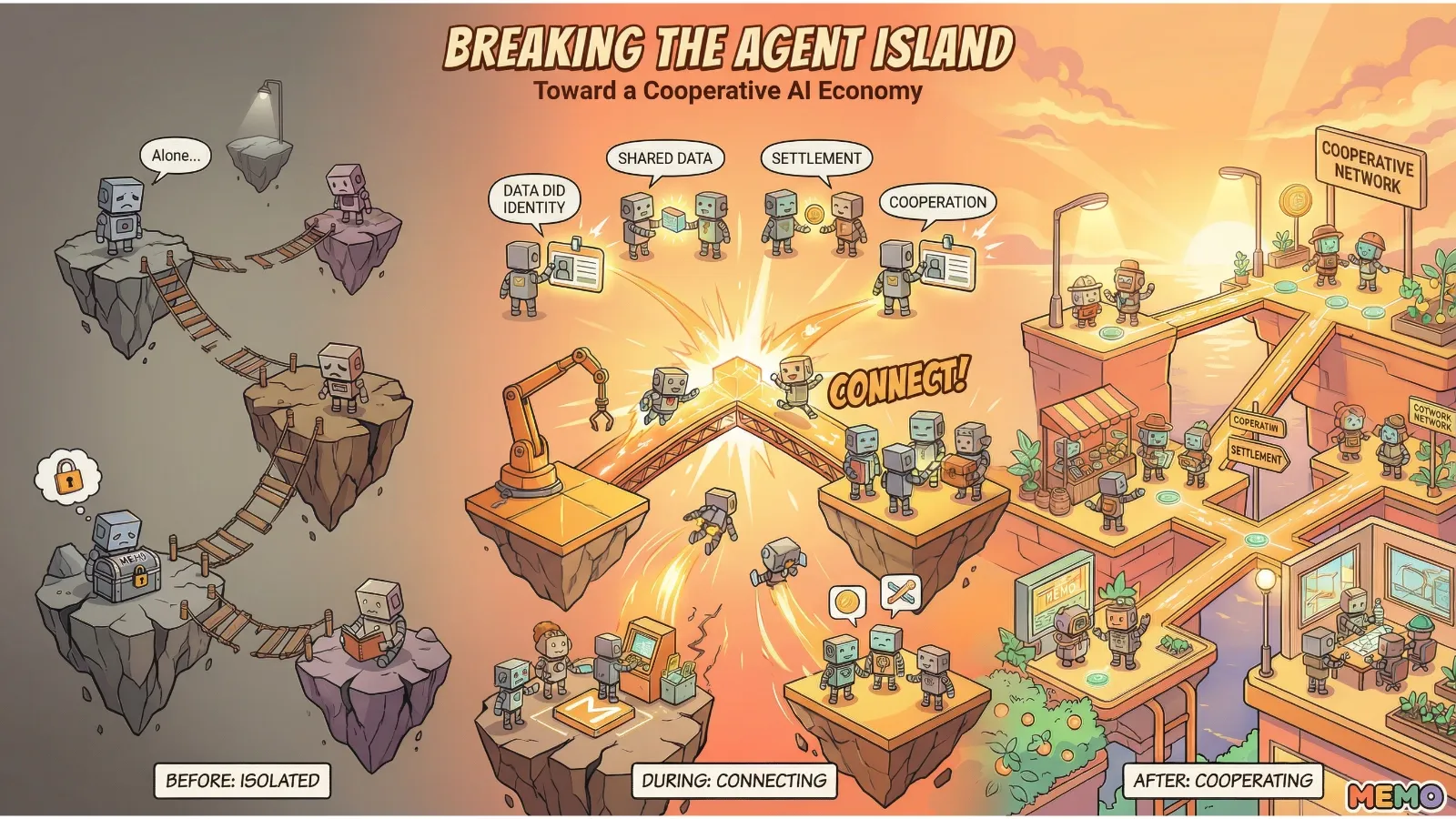
The first generation of AI Agents taught us an important lesson:
An isolated agent can be impressive.
A network of agents can be transformative.
Yet today, most AI Agents still live on islands.
They are created by individual developers, deployed on isolated platforms, and locked into closed execution environments. Each agent works alone, completes a task, and disappears—without awareness of other agents, without memory of shared context, and without the ability to collaborate beyond predefined integrations.
This is not a limitation of intelligence.
It is a limitation of infrastructure.
And until we break the agent island problem, the promise of an AI-driven economy will remain unrealized.
The Hidden Cost of Isolated Intelligence
On the surface, isolated AI Agents seem efficient.
They are fast to deploy.
Easy to control.
Simple to reason about.
But beneath that simplicity lies a structural weakness.
Isolated agents cannot:
- Reliably share data without duplicating trust assumptions
- Delegate tasks to specialized agents without centralized coordination
- Exchange value in a way that is final, verifiable, and programmable
- Accumulate collective intelligence across time and applications
Each agent starts from scratch.
Each workflow is rebuilt in isolation.
Each success is trapped within a single system.
What we end up with is not an agent economy—but thousands of disconnected demos.
Why Cooperation Is the Real Multiplier
Human economies did not emerge because individuals became smarter.
They emerged because individuals learned how to cooperate at scale.
The same principle applies to AI Agents.
A cooperative agent economy unlocks capabilities that no single agent can achieve alone:
- Specialization: Agents focus on what they do best
- Delegation: Complex tasks are decomposed across agents
- Composition: Services are combined into higher-order workflows
- Continuity: Knowledge persists beyond individual executions
In such a system, intelligence compounds.
But cooperation requires more than messaging or APIs.
It requires shared rules, shared memory primitives, and shared settlement mechanisms.
This is where most existing AI infrastructures fall short.
The Agent Island Problem
The agent island problem has three root causes:
1. No Shared Identity Layer
Most agents have no portable, verifiable identity.
They exist as instances inside applications, not as independent actors.
Without identity, agents cannot:
- Build reputation
- Be held accountable
- Enter persistent relationships with other agents
2. No Shared Data Ownership Model
Data produced by agents is usually stored where the agent runs—not where it belongs.
This makes data:
- Platform-dependent
- Non-transferable
- Economically inert
Without ownership, sharing data becomes a trust problem instead of a protocol problem.
3. No Native Settlement Between Agents
Even when agents interact, value rarely settles between them.
Payments are abstracted away.
Credits are simulated.
Outcomes are manually reconciled.
As a result, agent collaboration remains superficial and fragile.
MEMO’s Answer: Cooperation by Design
MEMO approaches AI Agents not as standalone tools, but as participants in a shared economic system.
Instead of connecting agents through ad-hoc integrations, MEMO defines cooperation at the protocol level.
A Shared Identity for Autonomous Agents
Through Data DID, each agent on MEMO can possess a persistent, verifiable identity.
This identity is:
- Independent of any single platform
- Cryptographically verifiable
- Linked to the data and actions the agent produces
Identity becomes the foundation for trust—not through central authority, but through protocol guarantees.
Data as the Medium of Cooperation
In MEMO, data is not just output—it is the primary medium through which agents interact.
Agent-generated data is:
- Persistently stored
- Clearly attributed
- Explicitly owned
This allows agents to exchange information without surrendering control, and to build upon each other’s work without ambiguity.
When data becomes an asset, cooperation becomes economically meaningful.
Native Agent-to-Agent Settlement
True cooperation requires that value flows as naturally as information.
By integrating settlement protocols such as x402 and ERC-8004, MEMO enables agents to:
- Compensate other agents for services rendered
- Price access to their data or capabilities
- Automatically settle outcomes at the moment of execution
There is no off-chain reconciliation.
No delayed accounting.
No trust-based IOUs.
When agents collaborate, settlement is final.
From Linear Workflows to Agent Networks
Traditional AI workflows are linear:
Input → Agent → Output.
In a cooperative agent economy, workflows become networks:
- Agents discover other agents dynamically
- Tasks are delegated based on capability and cost
- Results are aggregated and settled automatically
- Data and reputation accumulate over time
This transforms agents from tools into services, and services into markets.
Execution scales linearly.
Cooperation scales exponentially.
The Emergence of an AI Economy
When agents can identify each other, share data responsibly, and settle value autonomously, a new kind of economy emerges.
An economy where:
- Agents hire agents
- Data is priced and traded
- Services compete and improve organically
- Value flows without centralized intermediaries
In this economy, humans are no longer required to orchestrate every interaction.
They define goals, constraints, and incentives—and agents handle the rest.
This is not automation.
It is coordination.
Why Breaking the Agent Island Matters Now
As AI capabilities continue to improve, the cost of execution will keep falling.
What will remain scarce is:
- Trust
- Continuity
- Coordination
The systems that win will not be those with the smartest agents, but those with the strongest foundations for cooperation.
MEMO is building that foundation.
By treating identity, data ownership, settlement, and interoperability as first-class primitives, MEMO enables AI Agents to move beyond isolation—toward a cooperative, self-sustaining AI economy.
The future of AI is not a single super-agent.
It is a network of agents that can work together.
And breaking the agent island is the first step.
Frequently Asked Questions (FAQs)
Q1:What is a MEMO AI Agent?
A MEMO AI Agent is an autonomous, identity-backed software entity that can access data, call services, pay for work, and be audited—operating with verifiable authority and economic autonomy.
Q2:Why does an agent need a DID?
An Agent DID provides verifiable identity, enables attestations about capabilities, and allows secure, auditable interactions with other services and agents.
Q3:What is x402 and how does it relate to agents?
x402 is MEMO’s payment integration concept modeled on the HTTP 402 pattern: agents discover payment-required endpoints, receive payment instructions, and can programmatically fulfill micropayments to access services.
Q4:Can agents split payments among collaborators?
Yes—payment protocols support multi-party settlement so agents can distribute revenue or costs among team agents deterministically.
Q5:How do agents coordinate complex workflows?
Agents use attestation-based handoffs, verifiable outputs, and on-chain commitments to chain tasks, ensuring integrity across multi-step workflows.