
As Everyone Starts Using OpenClaw, Why Should Web3 Users Pay Even More Attention to MEFS?
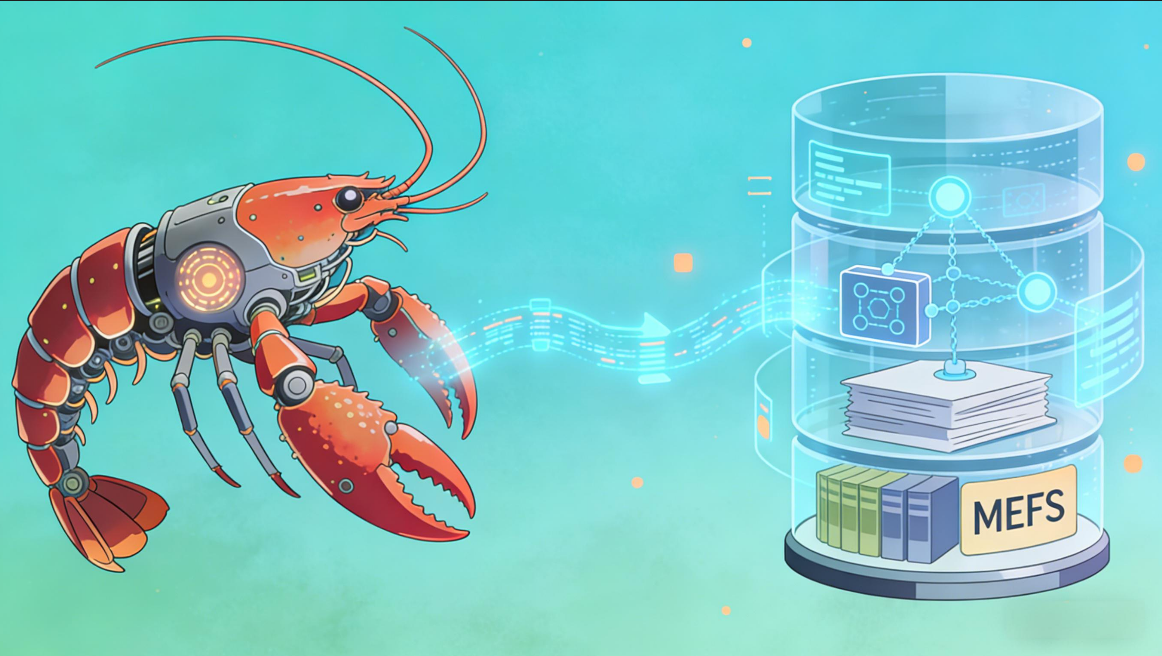
AI can finally do real work — but can you actually keep what it produces?
OpenClaw is taking off, but most people still have not realized the more important issue behind it.
When AI creates something for you, will it still be there tomorrow?
OpenClaw has recently given many people their first real taste of what an AI agent actually feels like.
It is not just Q&A.
It is not autocomplete.
It can actually execute tasks.With a single instruction, it can generate documents, call tools, and complete work step by step. A lot of people have the same reaction after using it for the first time:
“This is different.”
But once the excitement settles, a very practical question starts to surface:
Where do all the things AI generates actually go?
Code, logs, documents, research notes, model outputs... where are they ultimately stored?
For ordinary users, this may sound like a simple file storage problem.
For Web3 users, it is a much more familiar question:When something has value, is it really still in your own hands?
Web3 Users Understand This Better Than Anyone
You would not put all your assets on a centralized platform.
Keeping your tokens on an exchange feels very different from holding them in your own wallet.
The same logic applies to AI-generated content.
When you only use AI occasionally, the output may not matter much.
But once AI becomes part of your everyday workflow, those files are no longer temporary byproducts — they become data assets.
And right now, most of those assets are in one of these states:
● Scattered across local folders
● Stored on a single server
● Dependent on one centralized service
If your machine breaks, the service goes down, or you switch environments, the results may disappear along with them.
This is not a rare edge case.
It is something that will happen sooner or later.
What MEFS Is Doing: Making AI Output Truly Durable
MEFS addresses this problem with decentralized storage.
It distributes data across multiple nodes, uses encrypted transmission, and provides multi-point redundancy without relying on a single service provider.
The easiest way to understand it is this:
Before, AI-generated content was like papers casually left on your desk — once the desk gets messy, they are gone.
MEFS is more like a distributed warehouse: stored separately, indexed properly, and always retrievable.What it provides is not some “nice-to-have” extra feature.
It fills a missing layer of infrastructure in the AI workflow:
making sure AI-generated output does not just appear once — but can actually be kept.
MEFS MCP Server: Three Actions That Solve the Core Problem
MEFS’s key component for AI scenarios is the MEFS MCP Server, which provides three direct capabilities:
● Upload files: Automatically store AI-generated content in MEFS
● Retrieve files: Use a unique CID to fetch them back at any time
● Check remaining storage: Allow AI to know its current storage capacity in real time
This means AI no longer just creates things.
It can also store them, retrieve them, and understand how much space it still has.
AI output is no longer floating around as disposable artifacts.
It starts entering a real asset management flow.
Already Connected to OpenClaw — Available Right Now
MEFS is not just a concept product.
Through the MEFS MCP Server, it can already be directly integrated with OpenClaw.
There are two ways to connect, depending on your needs:
● Remote deployment — run the service on a remote server
● Local deployment — run OpenClaw and MEFS on the same machine
Once configuration is complete, run a health check. If the status is normal, the integration is live.
What Does It Feel Like in Practice?
You tell OpenClaw:
“Help me write a meeting summary and save it as work.txt.”
Without MEFS:
The file gets generated and sits in a local directory. Change machines, and it is gone.With MEFS connected:
1. OpenClaw generates the file
2. The file is automatically uploaded to MEFS
3. The system returns a unique CID (like a pickup code in a warehouse)
4. The next time you need it, you can retrieve it directly with the CID — no matter which machine or environment you are using
Before, AI-generated output was a one-time artifact.
Now, it becomes a long-term asset that can be stored, recovered, and reused continuously.
For Web3 Users, These Three Points Matter Most
For Web3 users, the OpenClaw + MEFS combination hits three key points:
1. Your data feels more like your own asset, not a platform’s temporary file
With decentralized storage, your content does not depend on any single service provider.
2. You do not have to bet everything on one place
Multi-node distribution means a single point of failure does not compromise the integrity of your data.
3. It is not just an idea — it fits into real workflows
MEFS is already integrated with OpenClaw and can be used today.
In addition, MEFS provides a complete set of security recommendations: dedicated private keys, environment-variable-based secret storage, access control, and encryption for sensitive files.
That logic should feel very familiar to Web3 users.
Final Thoughts
OpenClaw makes AI truly capable of doing work.
But once the work is done, have you really taken ownership of the results?
That is exactly the layer MEFS fills in.
It is not just adding a storage feature to OpenClaw —
it is helping the entire AI workflow form a complete loop.AI can now do real work.
Now it is time to make sure what it produces can truly last.
Learn more about the MEFS MCP Server and start building your own AI + decentralized storage workflow today:
https://github.com/memoio/mefs-mcp-server