
Announcing MEMO Alive Check: A New Layer of Care for Digital Identity
In an era where digital civilization has reached unprecedented maturity, personal assets are no longer confined to the physical world. Cryptocurrencies, decentralized identities, social accounts, and cloud-based data now form an essential layer of individual ownership, agency, and value.
Yet as our digital presence grows stronger, an uncomfortable question quietly emerges:
What happens when the person behind the identity is no longer able to show up?
If a user becomes unreachable due to unforeseen circumstances, can their safety be addressed in time? And if access to the network is lost, do their data and digital assets become permanently locked in an irreversible loop?
These questions have long existed at the edges of Web3 — rarely discussed, never solved.
Today, MEMO introduces its answer.
MEMO officially announces the launch of Alive Check, a core security module under the Data DID system — designed to bring care, continuity, and determinism into decentralized identity.
Beyond Presence: Designing for Absence
Most digital systems are built on a single assumption: users are always online.
Authentication systems wait for logins. Wallets wait for signatures. Smart contracts wait for transactions. When activity stops, systems freeze — indefinitely.
But human life does not operate on uninterrupted availability.
Absence is not an anomaly; it is an inevitable state. And digital identity, if it is to truly represent the individual, must be capable of handling absence with clarity and responsibility.
Alive Check is built on this premise.
Rather than attempting to “monitor life,” Alive Check introduces a user-defined presence confirmation protocol — one that allows individuals to specify what should happen when they can no longer actively interact with their digital identity.
How Alive Check Works: A Deterministic Safety Protocol
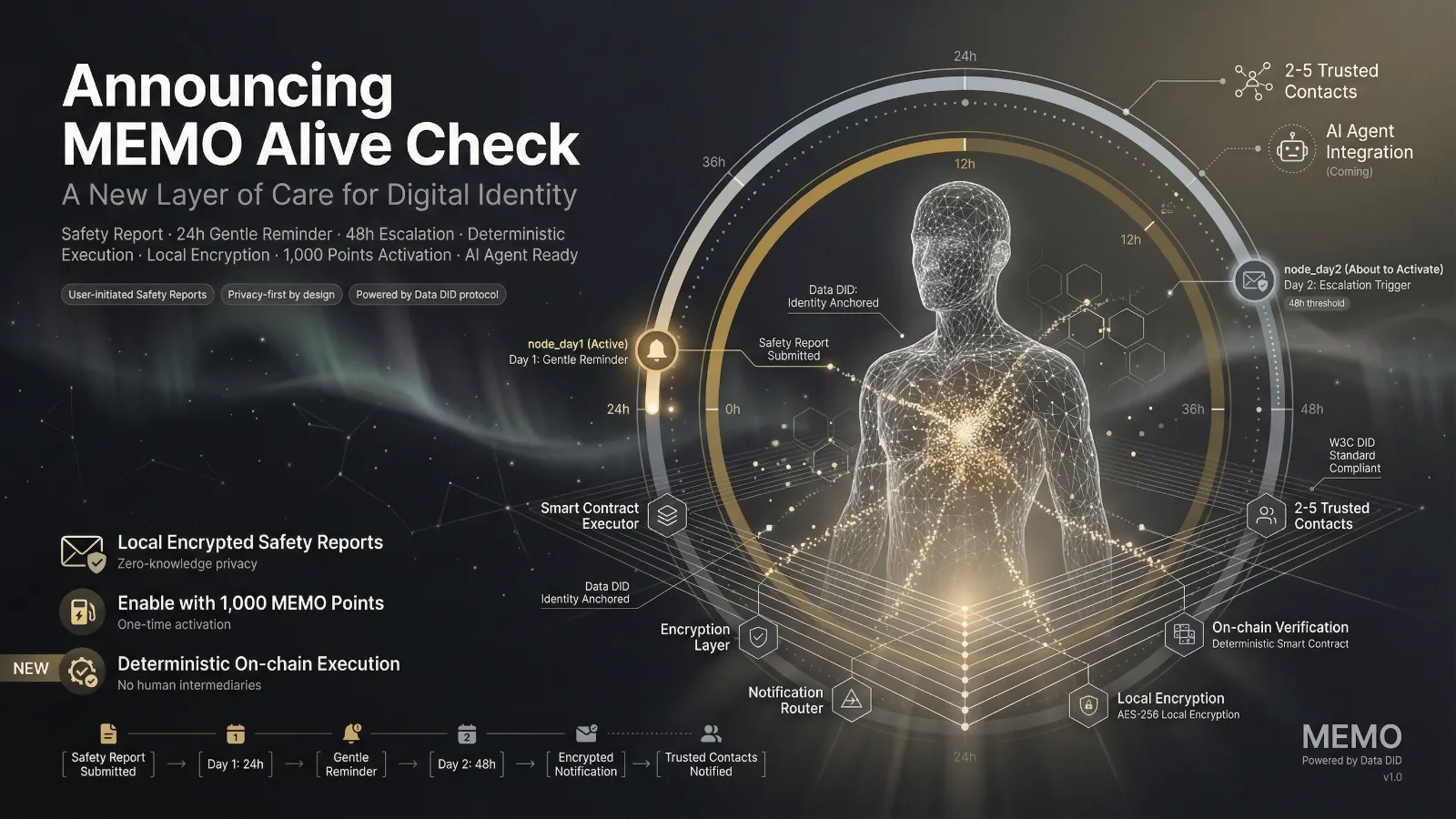
Alive Check operates as an automated on-chain protocol anchored to Data DID, MEMO’s decentralized identity system.
At its core, it replaces ambiguity with structure.
Intentional Status Confirmation
Users periodically submit a simple Safety Report through their Data DID interface. This action serves as an intentional confirmation of availability and control — not a background signal, not inferred behavior.
No continuous tracking.
No passive surveillance.
Only deliberate confirmation.
Time-Based Escalation Logic
Alive Check introduces a staged, time-sensitive response mechanism:
- Day 1: If no Safety Report is submitted, the system sends a gentle reminder to the user.
- Day 2 (48 hours): If silence continues, Alive Check automatically triggers predefined instructions — notifying emergency contacts via encrypted email during the critical response window.
This structured escalation ensures that real-world uncertainty is met with proportional and timely action, reducing risk without overreaction.
Deterministic Asset and Instruction Delivery
If absence is confirmed based on the user’s predefined conditions, Alive Check executes its final step:
Encrypted messages containing asset access paths, custody instructions, or digital wills are delivered to designated recipients.
No intermediaries.
No discretionary approval.
No ambiguity.
Execution follows cryptographic certainty — exactly as the user authorized in advance.
From Passive Forgetting to Automated Delegation
Traditional digital inheritance and safety mechanisms are often slow, opaque, and heavily dependent on centralized intermediaries. Decisions are delayed, processes are fragmented, and outcomes remain uncertain.
Alive Check transforms this paradigm.
By binding absence logic directly to Data DID, MEMO turns identity into an automated delegation layer — one capable of executing trust without human arbitration.
This marks a fundamental shift:
- From manual recovery to protocol-driven execution
- From institutional discretion to user-defined certainty
- From passive forgetting to automated trust fulfillment
Privacy First: Infrastructure-Level Restraint
Handling safety-related data demands restraint, not overreach.
MEMO approaches Alive Check with deliberate minimalism:
- Local encryption: All Safety Reports and authorization data are encrypted locally. MEMO does not track user behavior or upload unnecessary private information.
- User-defined control: Users retain full authority to edit notification templates, manage contact lists, and enable or disable optional privacy modules such as location sharing.
- No behavioral inference: Silence is interpreted strictly within user-defined protocol windows — never inferred from usage patterns or activity analysis.
Alive Check does not observe users.
It simply waits for instructions.
This approach reflects MEMO’s role as infrastructure — not a platform that extracts value from attention or data.
Introducing Points Subscription: Making Safety Sustainable
Alive Check also marks a meaningful evolution of the MEMO points system.
For the first time, points are used not merely as engagement incentives, but as functional fuel for long-term security services.
- Low barrier activation: Users can enable Alive Check by consuming 1,000 accumulated points.
- Ecosystem alignment: Points will power AI Agent operations and advanced services across MEMO’s 2026 roadmap.
In this model, safety is not a premium luxury — it is a sustainable, accessible service embedded within the ecosystem.
Alive Check in the AI Agent Era
As MEMO evolves toward a one-stop platform for creating and running AI Agents, Alive Check takes on a new role.
Future AI Agents will act as delegated executors of user intent — monitoring absence through Alive Check and responding autonomously when predefined conditions are met.
Triggered by the Alive Check protocol, agents may:
- Execute on-chain asset settlement
- Initiate selective data destruction
- Deliver sensitive information to specific recipients with precision
In this context, Alive Check functions as a safety cortex — connecting physical-world uncertainty with deterministic digital execution.
It ensures that even when humans cannot act, their intent still can.
A New Responsibility for Digital Identity
Decentralization removed intermediaries.
Automation removed friction.
But responsibility still requires structure.
Alive Check represents MEMO’s response to one of Web3’s most overlooked risks: unmanaged absence. By embedding timing, consent, and care directly into identity infrastructure, MEMO enables digital systems to handle uncertainty with dignity and precision.
Digital assets deserve a future — even when their owners cannot be present.
Alive Check is now live within the MEMO Data DID application.
Your identity can do more than prove who you are.
Now, it can carry your intentions forward.