
Agent Density on BNB Chain Is Outpacing Most People’s Expectations
Summary:
In the AI Agent economy, the Agent Data Layer refers to the underlying infrastructure responsible for recording, verifying ownership of, validating, and pricing the data that Agents are trained on and generate through interaction. AI Agents in the BNB Chain ecosystem are piling up fast, but the ability to record and confirm ownership of their data hasn’t kept pace. The denser the ecosystem, the more glaring the gap in the data layer.
Over the past few months, if you’ve paid even modest attention to what developers in the blockchain ecosystem are doing, you’ve probably noticed something interesting: while most of the market’s eyes were still chasing short-lived AI meme coins, the AI Agents that actually do real work have been converging on BNB Chain at a startling pace.
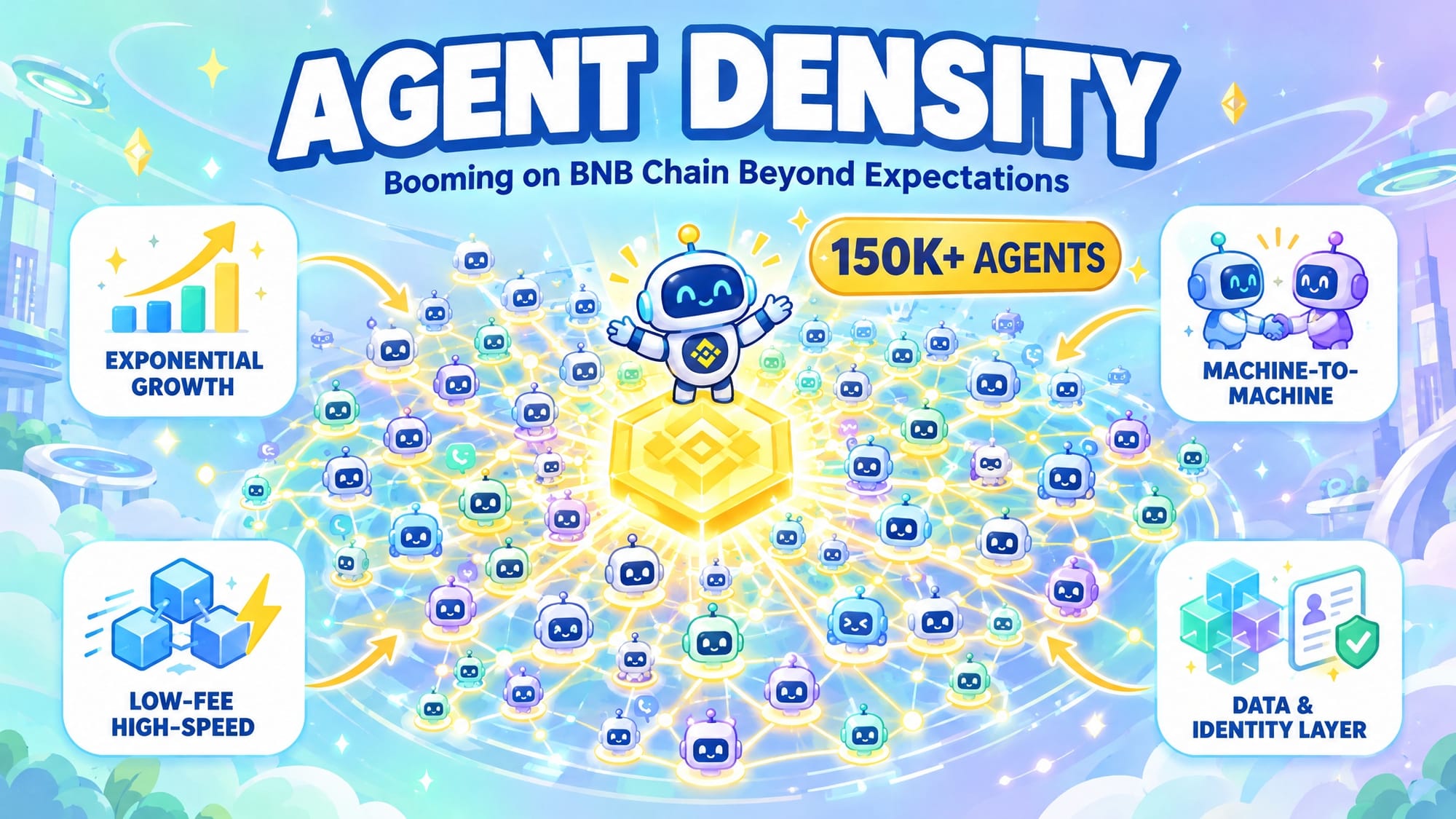
According to public figures from BNB Chain’s official ecosystem and DappBay, as of October 2026, the number of on-chain AI Agent deployments on BNB Chain has passed 150,000, making it one of the densest ecosystems for deployed Agents in all of Web3. Half a year ago, when people mentioned on-chain AI, they still thought of chatbots bolted onto a web front end, farming attention by cracking jokes on Twitter. Today, open up the on-chain ecosystem and “practical Agents” are everywhere: ones that watch markets and trade, snipe new launches automatically, outsource tasks, and make calls across clients and protocols.
Yet behind this loud, large-scale production of machines, a deeply ironic and barely discussed foundational flaw is widening fast: when tens of thousands of Agents run wild on-chain every day, churning through enormous volumes of interaction data and proprietary corpora, whose name is this “data ledger” actually recorded under?
1. Agent Density Is Calculated, Not Shouted
A thriving ecosystem is never built on slogans — it’s built on developers putting real money in and on-chain interaction data piling up. Break down Agent density on BNB Chain, and you can read three sets of hard numbers on the books.
The first is ecosystem directories and officially incubated projects. Looking at DappBay’s AI-category listings and the recent quarterly cohorts of BNB Chain’s flagship accelerator, MVB (Most Valuable Builder), the share of AI and data projects has stayed consistently high. Take MVB Season 9: nearly half of the early-stage projects selected carry a strong AI component — direct proof of where developers around the world are voting with their feet.
The second is contract interactions and sector momentum. Together with ongoing activity in the Binance Alpha AI sector and data from on-chain explorers, daily active users and daily interaction counts for Agent-related contracts on BNB Chain have grown severalfold over the past few months.
The third, and the most fundamental physical support: why did BNB Chain, of all places, become the most densely packed Agent factory floor?
For ordinary users and developers, the biggest difference between an AI Agent and traditional DeFi is interaction frequency. A person might make one or two on-chain transfers a day, but an autonomously operating Agent, in order to make decisions, look up information, and coordinate tasks, makes hundreds or even thousands of high-frequency calls a day. In a traditional high-fee environment, gas fees alone could bankrupt an Agent. With its PoSA consensus mechanism, plus the extremely low fees and millisecond-level finality of opBNB (a Layer 2 built on the OP Stack), with TPS in the 5–10K range, BNB Chain has pushed the marginal cost of running an Agent down to the point where mass production becomes viable. That’s why developers dare to deploy practical Agents that do real work and need high-frequency interaction here at scale.
(As of October 2026, according to public data from BNB Chain’s official channels and DappBay, BNB Chain is hosting more than 150,000 active on-chain AI Agent deployments.)
2. Density Has Gone Up, but Record-Keeping Hasn’t Kept Pace
As tens of thousands of Agents sprint day and night down a low-cost, high-concurrency track, a huge hidden risk comes into view: the denser the Agents, the more “muddled accounts” there are that are unrecorded and unverified off-chain.
First, we need to clear up a common misconception in the industry: “keeping a data ledger for Agents” is absolutely not the same as “looking up historical on-chain transactions.” The market doesn’t lack on-chain indexing tools that scrub public block transaction records and build a smart-money dashboard out of them. What sits in a complete vacuum is the real data ordinary users feed AI off-chain, along with the proprietary corpora and memory generated by human-machine interaction.
Concretely, this missing record-keeping capability shows up as three “vacuums”:
- Layer one: Who is contributing the data (identity blindness). Every day you feed your own professional trading notes and everyday work documents into a vertical-domain Agent to train it and make it smarter; or ordinary users keep correcting its biases in day-to-day conversation. The AI model creates commercial value because of what you fed it, but there’s no “data ID card (DID)” of yours on-chain anchoring who actually contributed that key training corpus.
- Layer two: Where the data is recorded (process amnesia). You spend months chatting with a personal-assistant Agent through thousands of messages of core business information, and it remembers your work habits, your writing style, even your trade secrets. But these valuable interaction logs and dynamic memories are all locked on the project team’s own centralized servers. The moment you want to switch to a better tool, or the original project suddenly shuts down, all your digital assets and memory instantly reset to zero — you can neither prove their authenticity nor pack them up and take them with you.
- Layer three: What the contribution is worth (pricing failure). When a specialized dataset (say, a vertical industry research report, or a category of de-identified user-preference data) is called frequently by hundreds or thousands of Agents — even helping the caller earn real money — what is that data actually worth? Should revenue be shared per call, or by outcome? Right now, the industry has no recognized, automated pricing and settlement ledger, and data contributors remain shut out of the table where the money gets divided.
3. The Gap Isn’t a Weak Spot — It’s an Inevitable Consequence of Density
Why did people think things were good enough when Agents were scarce, while now that density has gone up, the problem suddenly feels so sharp?
Because in the past, on-chain interaction was mostly “a human clicks, an AI moves” (Human-to-Agent). The total volume of data was small, and everyone defaulted to handing data over for free, the way they would with Web2 software. But once Agent density on BNB Chain passed a critical threshold, a qualitative shift took place in the ecosystem: Agents started doing business with each other on their own.
Take the most intuitive scenario: you ask your “asset-management Agent” to pick the highest-yielding on-chain projects. To get precise intelligence, it automatically pays 0.5 USDT to hire another dedicated “on-chain sentiment-analysis Agent,” which in turn calls a third “community-sentiment database.” In this chain, the initiator of the data flow is no longer a human — it’s a machine.
When machines start calling on and paying each other around the clock, at scale (as in the x402 machine-autonomous-payment protocol and the ERC-8004 Agent identity standard the industry has been discussing so often lately), an awkward reality stands in plain sight: how the money gets paid and which channel it flows through have been solved, but who the money should be paid to, and where the data credentials behind it are, is still a muddled account.
This is precisely why the industry has recently been discussing directions like ERC-7829 (a data asset-formation standard) with such enthusiasm. Put plainly, data can no longer be just a pile of lifeless file backups — it has to become an on-chain asset credential that carries ownership, is verifiable, and can be metered and settled per use. Only when the underlying data has a clear “title deed” can machines, when settling accounts and splitting revenue automatically, find the real payee.
4. What to Watch Next
Looking back at how BNB Chain’s AI ecosystem has evolved this round, the underlying execution layer (BSC + opBNB) is already fast enough and cheap enough, and the warehouse for storing large files (such as Greenfield) was built long ago.
With the runway and the warehouse both fully in place, there’s no longer any point in blindly competing over “how many more mediocre chatbots the ecosystem has added.” To judge whether an AI Agent ecosystem is truly mature, and whether it can let ordinary users and builders actually share in the upside, the key indicator for the next stage comes down to one thing —
who is first to chew through the hardest bone, the “decentralized data and identity layer,” and turn interaction data scattered everywhere into on-chain assets that truly belong to users.
In this foundational restructuring that is bound to arrive, the place with the highest density is often where the answer surfaces fastest.
FAQ
- How many AI Agent projects are there on BNB Chain right now?
As of October 2026, according to public data from BNB Chain’s official channels and DappBay, the number of on-chain AI Agent deployments on BNB Chain has passed 150,000, making it one of the core ecosystems with the highest on-chain AI activity today.
2. What does the “Agent data layer” people keep mentioning actually mean?
In the AI era, the data layer refers to the underlying infrastructure responsible for working out “who supplied the data, where it’s stored, how it’s protected from tampering, and how revenue gets split when it’s called.” Unlike traditional on-chain data dashboards (which only look up public historical transactions), the data layer’s core job is to address ownership and asset pricing for users’ proprietary data, interaction logs, and memory.
3. Why do chains with more AI Agents end up with more visible data-ownership and record-keeping problems?
Because once ecosystem density reaches a certain stage, the actors in interactions shift from “humans occasionally clicking” to “tens of thousands of Agents hiring and calling each other 24/7 (machine-to-machine).” When machines do business with machines, if the underlying data has no clear identity-based ownership confirmation and no automated revenue-sharing ledger, the whole machine economy falls into a mess where nothing can be settled.
References
- BNB Chain official ecosystem report: BNB Chain is the #1 Network for AI Agents
- Industry news coverage: BNB Chain Leads With 150,000 AI Agents Deployed
- BNB Chain developer documentation: AI Agent Solutions — Identity, Capability, Payment & Accountability
- Binance Square feature research: Why Build AI on BNB Chain? Ecosystem & Infrastructure Analysis