
After 2035, Humans Will No Longer Need to Work: The Ultimate Liberation of Agents in Creating Means of Production and Relationships
I. Introduction: From “8 Hours a Day” to “No More Work” — An Emerging Reality
We create increasingly advanced tools, yet we are instead held hostage by them, racing faster in an ever-shrinking living space. But if we turn the clock back to 2035, you’ll find that this labor logic based on “survival pressure” is crumbling.
On a typical morning in 2035, your life might look like this:
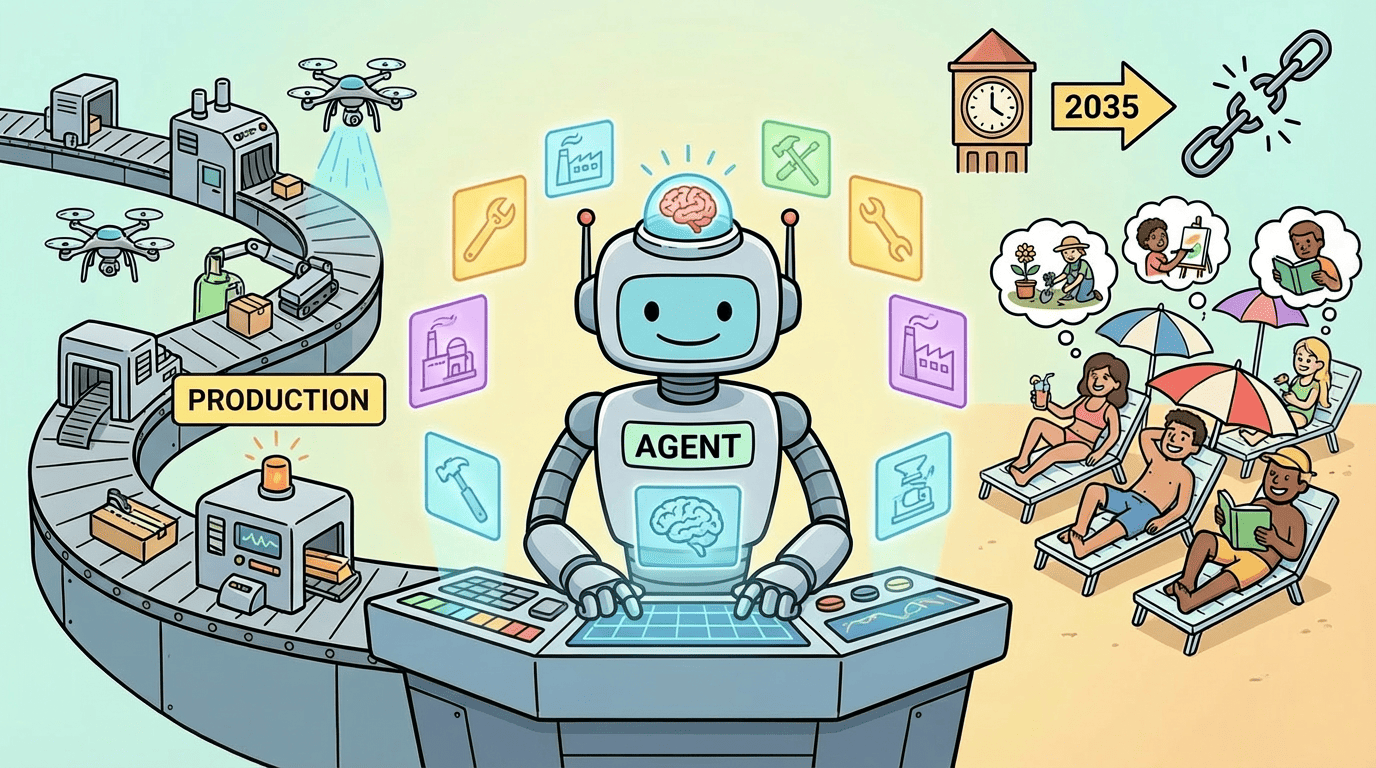
Without the sound of an alarm clock, your personal AI agent wakes you up at the most suitable time of your menstrual cycle based on your sleep data from the previous night. An automated terminal in the kitchen has already prepared a customized breakfast; when traveling, a self-driving system has planned your route. You don’t need to deal with tedious forms, attend meaningless meetings, or even sell your physical or mental labor for a living. All socially necessary labor — from logistics and transportation to precision manufacturing, from code maintenance to energy scheduling — is automatically completed by countless highly collaborative AI agents.
This is a bold prediction: the exponential development of AI agents will replace all necessary human labor.
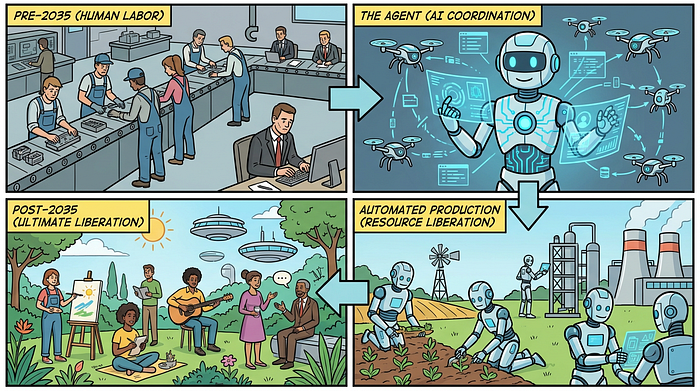
This is not merely an improvement in tools, but a complete upheaval of the production paradigm. Agents will create new means of production: automated factories, self-replicating robots, and self-optimizing algorithms. These will reshape production relations from private and exploitative to public and demand-based.
As Elon Musk once publicly predicted, jobs will become “optional” within the next 10–20 years. We are about to enter an era of “universally high income” and “zero scarcity.” This “ultimate liberation” is already within reach in the distance.
II . The Technological Foundation of the AI Revolution: From Tools to Autonomous Creators
Every advancement in human history has been an extension of our senses and physical abilities through tools. But this time, tools are beginning to possess “brains.”
1. From dialog boxes to multi-agent systems (Agents)
Two years ago, we were amazed by ChatGPT’s copywriting capabilities; today, models like OpenAI o1 and Anthropic Claude have begun to possess deep reasoning and logical correction capabilities. AI is evolving from “question and answer” to “autonomous action.” Agents no longer wait for instructions but begin to make autonomous decisions, iterate on their own, and complete complex collaborations in multi-agent systems.
2. Key Breakthrough Nodes: 2030–2035
The Realization of AGI (before 2030): Based on the current speed of AI development, within the next five years, the comprehensive intelligence of AI may surpass that of all humans combined. For the first time, humanity will face a species that is “smarter than itself” — artificial general intelligence.
Exponential Productivity (2030–2035): As these new species continue to emerge and evolve, AI agents will be able to begin taking over the entire chain of mental and physical labor. Robots and automated factories will no longer need to rely on human design, but will instead embark on a self-replicating and evolving mode.
3. Core Mechanism: When AI begins to “create” means of production
When algorithms can design better algorithms, computing power will increase on its own; when robots can build factories, physical output will no longer be limited by the physical capabilities of workers. Through breakthroughs in quantum energy, space mining, and self-circulating agriculture, agents will be able to solve a fundamental problem that has plagued human civilization for thousands of years — resource scarcity.
Musk recently expressed his vision that in the future, there will be 1 billion or more humanoid robots on Earth, and they will be tireless producers.
III . Reconstruction from a Marxist Perspective: An AI-like Disruption of the Means of Production and Relations
To fully understand this transformation, we must adopt a classic sociological perspective: the means of production and relations of production.
1. The inherent contradictions of capitalism
In the past, the means of production were highly developed, yet privatized by a few capitalist giants. This led to a cruel logic: the more advanced the technology, the more efficiently surplus value was exploited, and workers faced a “surplus crisis” of unemployment and insufficient purchasing power.
2. The Paradigm Shift Brought About by AI
The self-generation and public ownership of means of production: However, when AI dominates the entire process from R&D to manufacturing, humans no longer need to work, and means of production are no longer scarce. Human “possession” of means of production will become meaningless. When agents operate in decentralized networks, means of production begin to exhibit a certain “shared” characteristic — like air.
The end of production relations and class divisions: When society as a whole transitions from wage labor to a point where labor is no longer necessary, humanity will revert from “economic animals” to “species-beings.” As the logic of distribution shifts from “distribution according to labor” to “distribution according to need” based on agent output, class barriers will gradually crumble with the dissolution of labor contracts.
IV . The Logic of the Underlying Protocol: The Three Core Pillars of the MEMO Agent Infrastructure
In this narrative of “ultimate liberation,” a key question is: how can we ensure that the assets created by agents truly serve humanity, rather than being monopolized by new technological giants? To achieve true freedom, we need a consensus-based, decentralized infrastructure.
MEMO is also constantly exploring ways to build this underlying framework that supports future production relations. Combining MEMO’s current vision and challenges, we have established three core pillars for MEMO, which serve as an important foundation for Agent development:
1. Data Assetization Foundation: Solving the Fundamental Problems for Agents
Agents are not one-off conversations. They require persistent memory to ensure that context and training data do not disappear when the platform shuts down. MEMO leverages its native decentralized storage, data availability, Data DID, and ERC-7829 protocols to ensure that agent data is not lost or tampered with, and transforms the data generated by agents into tradable and priced assets. This means that the value created by an agent is owned from its inception.
2. Full lifecycle operating environment: Granting agents economic autonomy
By integrating the x402 and ERC-8004 protocols, Agents evolve from pieces of code into economically autonomous entities. They possess independent identities, can make autonomous decisions on-chain, and achieve a high degree of coupling between execution logic and value settlement. This financial automation ensures that production results bypass intermediaries and directly enter a closed loop of on-demand distribution.
3. Cross-Agent Interaction Protocol: Breaking Down Agent Silos
The future of production will be socialized. MEMO has established a universal on-chain agent protocol, enabling agents created by different developers to interact with each other. Through service discovery, task distribution, and data sharing, a true agent collaboration network is built. This collaborative efficiency will far surpass that of human organizations, becoming the logistics and logical hub supporting future society.
V. The Ultimate Liberation Vision After 2035: Daily Life Without Working
When the burden of survival pressure is lifted, human civilization will begin a brand new chapter.
1. Economy: Abundance with Zero Marginal Cost
In an agent-driven society, almost all goods and services will be supplied at near-zero cost. As Musk described it: money will be irrelevant, and “everyone will have any goods and services they want.”
2. Social: Focus on cultivating relationships and self-actualization
Humans are no longer cogs in an assembly line, but rather seek meaning in scientific research, artistic exploration, and deep interpersonal relationships. The scenarios include:
Personalized medicine and evolution: Agents monitor health in real time, customize gene-based drugs, and significantly extend the average human lifespan.
The dawn of interstellar civilization: Space mining and interstellar travel have transformed from science fiction into infrastructure, and humanity’s physical boundaries are expanding into the universe.
3. Culture: From “Labor Worship” to “Existential Worship”
This is the deepest level of liberation. For thousands of years, human civilization has been built on the logic that “diligence is virtue.” When labor is no longer necessary, humanity will experience a profound cultural upheaval: a crisis of meaning will transform into a pursuit of freedom. We will no longer define ourselves by “what kind of work I do,” but by “what kind of person I am.” We will be freed from serving others and turn to the ultimate pursuit of truth and aesthetics.
VI . Conclusion: What can we do now?
The prediction for 2035 may sound like science fiction, but on the curve of technological advancements, it is an inevitability under the laws of physics.
We must understand that 2035 is not a date to be awaited, but a coordinate system that needs to be established. AI is not the end point for humanity, but the key to liberation. This door to liberation will be forged by technological breakthroughs and the reconstruction of underlying protocols.
What can we do?
Support the development of a decentralized agent ecosystem: ensure that the power of AI is not monopolized by a few giants.
Promoting the evolution of policies and perceptions: preparing psychologically for the coming “non-labor era”.
2035 is not far off. From now on, pay attention to the underlying forces that are rewriting the rules, because therein lies humanity’s ticket to freedom.