
A Century-Old Problem With a $1 Million Bounty Just Got Bought Out by OpenAI for Tens of Millions
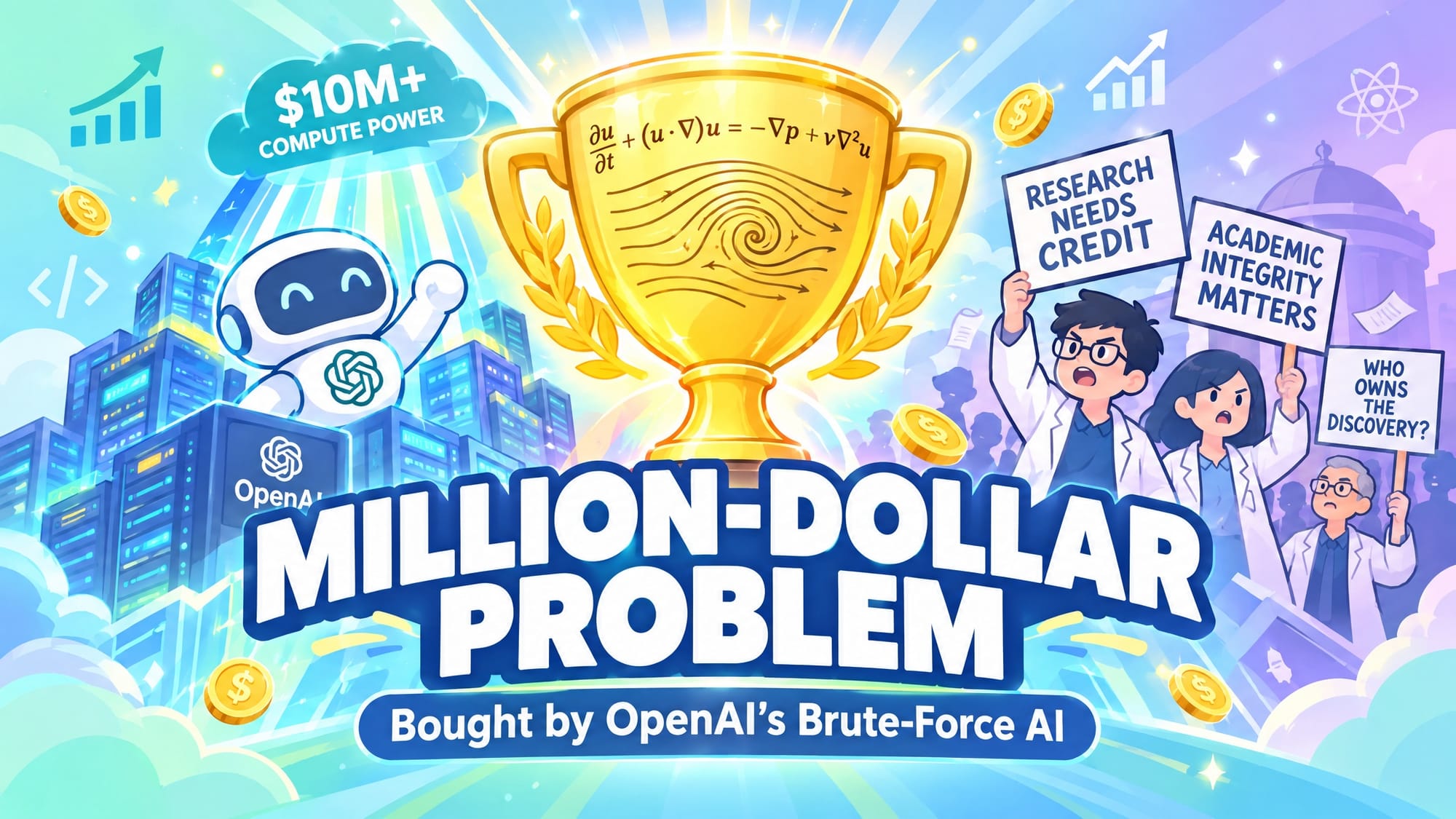
Late on the night of September 7th, NYU mathematician Backmaster posted three papers, a complete machine-verification codebase, and a four-page timeline statement online, all at once. A few hours later, OpenAI officially announced that an unreleased internal model had completed a proof related to the Navier–Stokes equations — one of the seven Millennium Prize Problems established by the Clay Mathematics Institute in 2000.
Nine days later, on September 11th, Terence Tao published a joint statement on his personal blog titled “The Serious Misalignment of Artificial Intelligence in Mathematics.” Twenty-five Fields Medalists signed on as the initial cosigners, spanning from Deligne, who won in 1978, to Yun Deng, a newly minted 2026 laureate — nearly fifty years of Fields Medal history. The statement even set up a dedicated website, open for signatures from the entire academic community.
In five days, a mathematical result turned into a public standoff between some of the most senior mathematicians in the world and a trillion-dollar AI company. If you read this purely as mathematicians being afraid of being replaced by AI, you’re probably misreading the conflict. What the math community objects to isn’t AI’s capability. It’s how AI delivers its results.
OpenAI Spent Tens of Millions of Dollars in Compute to Crack the Navier–Stokes Equations
Let’s be clear about the problem first. The Navier–Stokes equations, written roughly two hundred years ago, describe how fluids like water and air move — weather forecasting, aircraft design, and pipeline engineering all rest on them. But for two hundred years, nobody could prove whether this set of equations, starting from smooth initial conditions, could ever produce an absurd result: fluid velocity going to infinity at some point, known mathematically as blow-up. The Clay Institute’s prize asked for one of two things — prove that blow-up never happens, or construct an example where it does. The bounty: $1 million.
OpenAI’s approach was to throw compute at it. According to public reporting, the process started by deploying roughly 1,000 agents, which achieved a breakthrough on the simpler Euler equations in about 50 hours. The agent fleet was then scaled up to roughly 10,000, extending the result to the Navier–Stokes equations with a smooth external force over another dozen or so hours — the whole process taking about 88 hours — followed by another dozen-plus hours to complete machine verification in the Lean language. Outside estimates put the computational cost of this sprint somewhere between several million and tens of millions of dollars.
In other words, a company spent more than ten times the prize money to solve a problem that, as of today, still hasn’t earned anyone the actual prize. What was the payoff? Not the $1 million — the headline itself: “AI Cracks a Millennium Problem.” At a moment when model capability translates directly into valuation, subscription revenue, and capital-market narrative, a single benchmark result functions as a piece of marketing. The answer isn’t knowledge anymore. It’s an advertisement.
There’s a layer of nuance here that headlines tend to bury: the “bought out” framing doesn’t actually hold up. The Clay Institute’s prize rules require that a result be formally published in a top mathematics journal and survive a two-year review period — none of which has even begun. Strictly speaking, what OpenAI cracked was the case of finite-time blow-up for the Navier–Stokes equations with a smooth external force. Whether that’s fully equivalent to the original bounty problem still needs to be checked, page by page, by other mathematicians. A commercial company announcing a result before the community has confirmed it is precisely part of what’s fueling the anger in the math world.
OpenAI Delivered a Proof Machines Could Verify Line by Line — Mathematicians Couldn’t Dismiss It as Marketing Noise
But the math community didn’t treat this announcement as pure marketing noise, and the reason is worth spelling out on its own. What OpenAI published wasn’t just a conclusion — it was a complete set of Lean formal verification code. Lean is a theorem prover: once a proof is written, it can be checked by a machine, line by line, with no dependence on anyone’s reputation. The reason an AI company could be taken seriously here wasn’t its brand — it was that it delivered a credential that could be independently checked by a third party. Without that layer, any claim made at a press conference is just an empty promise. As AI produces results at a rate that far outpaces the patience of human review, verifiability is turning from a nice-to-have into the price of entry.
The Mathematicians Accuse OpenAI of Scooping Their Work — and Say They Were Advised to Drop a Co-Author’s Name
Back to the question of attribution, where the dispute gets much sharper. Backmaster and Anthropic researcher Alperger had been working in seclusion on this direction for nearly a year, using a range of AI tools including Codex, and completed a singularity proof for the relevant equations in mid-August, verified through Lean. Following academic convention, they planned to polish the paper before publishing. In late August, rumors began circulating online that someone had used AI to crack Navier–Stokes, prompting the two to release their work early. A few hours later, OpenAI’s announcement went out. Backmaster subsequently alleged that OpenAI redirected its compute toward the same approach only after hearing rumors of their progress.
The two sides tell different stories. OpenAI denies having had any contact with the pair’s unpublished work, while acknowledging it cannot fully rule out that de-identified user data may have had some indirect influence on the model. Backmaster himself clarified that he never alleged data theft — the real question is whether a commercial AI company, when stepping into frontier research, should be held to the transparency norms of the academic community. The most unsettling detail in the entire dispute is that an OpenAI representative, during contact with the researchers, reportedly suggested Backmaster publish under his name alone, on the grounds that his co-author Alperger worked for competitor Anthropic — and when Backmaster said he intended to make the whole process public, the representative reportedly asked him: why would you want to ruin your career?
That line will probably come up often from here on out. A researcher who poured nearly a year into a direction, into drafts, into judgment calls, has no institutional guarantee of attribution and no system that records the trail, in a research division of labor where AI now participates. How human contribution gets recorded, recognized, and compensated is a question the current system has no answer for. The statement’s three proposals — leave adequate time after a breakthrough for paper writing and peer review, require AI-produced results to properly cite prior human work, and protect the role human researchers play in digesting and teaching what’s been discovered — are all really saying the same thing: the old rules of attribution have broken down in the face of this new kind of productive capacity.
Math Is the First to Hit This Wall — It Won’t Be the Last
The reason mathematics is the first field to hit this wall has everything to do with the nature of the discipline. Mathematical logic is self-consistent, its conclusions can be formally verified, and feedback is extremely fast — which makes it both the first high ground AI could take, and the first place where the trust mechanism gets bent out of shape. Feedback in physics, materials science, and the life sciences moves much more slowly. Fields like coding, law, finance, and journalism can also deliver results quickly, but they don’t have anything like Lean. Output can accelerate without limit, while verification, attribution, and provenance can’t keep up — and in the vast majority of knowledge work, nobody is keeping a ledger for any of those three things yet.
The 25 Fields Medalists closed their statement with a restrained but heavy line: whether these technologies ultimately benefit the discipline or cause damage will, to a large extent, depend on the judgment made by the humans who control the technology.
In 2000, the Clay Institute put a $1 million price tag on a problem. In 2026, commercial compute pushed the cost of an answer into the tens of millions. But the year a researcher spent in seclusion, working through an idea, has no price. The decade, or the generation, it takes humanity to digest a proof has even less of one. The pricing power over answers now belongs to compute. The pricing of understanding is still blank. Who builds the first ledger for contribution and verification may be a more urgent question than whether AI will replace mathematicians.