
2026 Prophecy: UI Is Dead, Agents Take Over the World
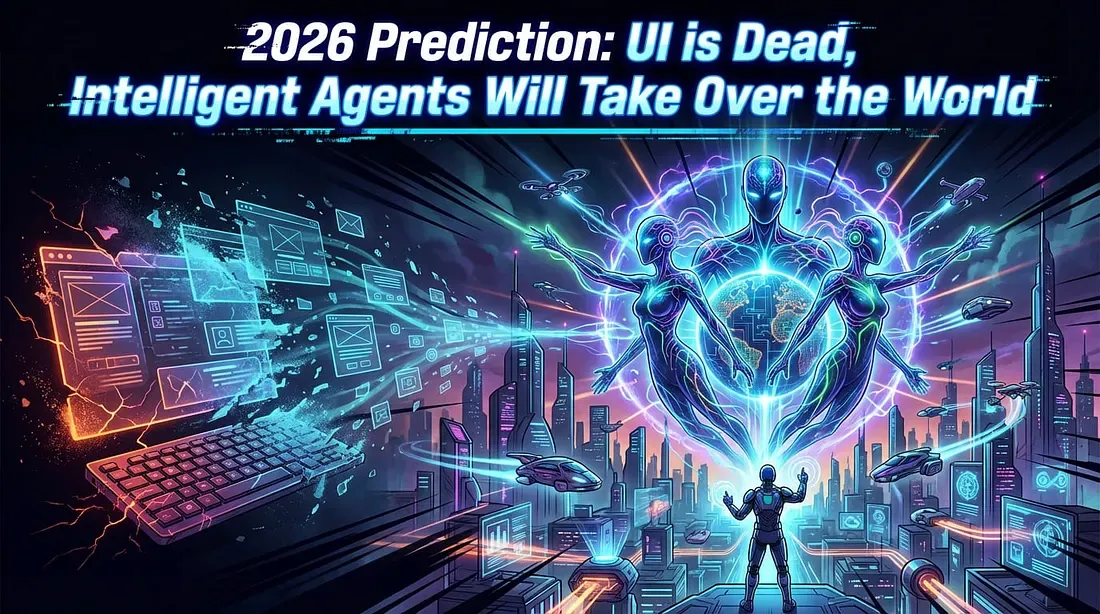
By 2026, the true “natives” of the internet will no longer be only humans, but tens of billions of AI agents. When agents replace human fingers as clickers and human eyes as readers, traditional visual-hierarchy optimization will rapidly lose its meaning. The success metric of software is shifting from “keeping users inside” to “helping users leave.”
I. Introduction — The Internet Landscape of 2026
A counterintuitive prediction is quietly taking shape: by 2026, most online interactions will be executed by AI agents rather than by humans directly.
Imagine that you no longer need to open a dozen travel apps to compare prices and complete bookings. You simply tell your agent: “Book me a flight to Tokyo next week, window seat, total price under $500.” In the background, the agent instantly interacts with airline APIs, invokes pricing protocols, and completes payment — all within milliseconds. Humans are promoted from “operators” to “commanders.”
For the past 20 years, the core logic of the internet has been the battle for human attention. We optimized UI, designed addictive mechanisms, and maximized screen time. In the future, the core logic will become execution through AI agents.
This leads to a disruptive conclusion: optimization for humans (SEO, UI design, visual flow) will rapidly depreciate, while optimization for agents (APIs, structured data, logical consistency) will become the new gold standard.
II. The Collapse of Visual Supremacy — Why UI No Longer Matters
1. The “Atavism” of Software Design
Historically, software began as cold command-line interfaces. Graphical user interfaces only emerged to accommodate human cognition. UI is essentially a translation layer between human language and machine language.
With the rise of agents, software design faces an atavistic reversal. Agents can directly process code and data streams, and graphical interfaces become an obstacle rather than an aid. When agents take over execution, this translation layer becomes redundant and inefficient friction.
Successful software is shifting from “something you can’t put down” to “something you forget even exists.”
2. Scenario Analysis: From Grafana to AI SRE
Today (Designed for Humans): Engineers stare at Grafana dashboards, trying to manually spot anomalies from colorful charts. UI optimization means prettier graphs and clearer color schemes.
Tomorrow (Designed for Agents): An AI SRE monitors raw telemetry data around the clock. When anomalies occur, it does not look at charts. It parses data streams directly, identifies root causes, and delivers conclusions via Slack or internal APIs: “Database latency caused by index invalidation; automatically fixed.”
Conclusion: In this scenario, visual dashboards disappear because machines do not need to see charts. Data flows directly from monitoring endpoints into AI processing modules.
3. Scenario Analysis: The End of CRM Interfaces
Today: Sales teams painfully navigate CRM systems, clicking dozens of times to enter or retrieve customer information.
Tomorrow: Sales agents automatically ingest emails, call records, and interaction logs, synthesizing patterns and insights. Salespeople simply ask: “Who should I contact today?” The agent returns a prioritized list and suggested scripts. The complex interface vanishes, leaving only databases and logic layers that serve agent calls.
III. Value Reconstruction — From Screen Time to Service Efficiency
1. A Fundamental Reversal of Metrics
Web2 KPIs focus on screen time, click-through rates, and retention — trapping users inside systems.
In the agent era, KPIs become task completion rate and interaction latency. The goal is to let users leave quickly because the task has already been completed efficiently.
If your product offers not only a webpage but also a clean JSON interface, agents will prioritize you. Your “traffic” will come from machine calls, not human browsing.
2. The New Optimization Rule: Machine Readability
Why has the definition of “usability” changed?
For humans, usability means large buttons and beautiful images.
For agents, usability means clear API documentation, standardized data structures, and fast response times.
The Transformation of Content Creation: AIO (AI Optimization) is replacing SEO.
Future content no longer needs clickbait headlines or verbose filler. Content must be structured, logical, and factual so agents can extract information quickly and accurately.
For example, a recipe no longer requires long narrative prose. Instead, it provides standardized ingredient JSON lists and procedural logic that cooking assistants can directly execute.
IV. New Toolchains and Infrastructure Shifts
1. The Reshaping of Tools
Future content management systems will no longer prioritize layout and fonts, but metadata annotation. Design tools will shift from Figma to Postman or Swagger. Knowledge graphs will matter more than sitemaps.
2. Core Infrastructure: Trust and Assetization
To enable large-scale, frictionless collaboration between agents, three core problems must be solved:
- Trust: How can agents verify that data has not been tampered with?
- Assets: How can ownership and pricing of agent-consumable data be defined?
- Settlement: How can agents support millisecond-level, high-frequency micropayments?
This is why blockchain and crypto technologies must evolve into the underlying operating system of the agent era.
V. Conclusion and Action — Building “Agent-Ready” Assets on MEMO
1. Embrace a UI-less Future
We are witnessing a transfer of power. It is time to ask whether your product or service can survive the disappearance of UI.
2. MEMO: The Onboarding Gateway to the Agent Economy
In this paradigm shift, MEMO is building infrastructure for a machine-readable world.
For Developers: Building Native Agent Applications
- Automated Settlement: Integrate MEMO’s x402 protocol. When your code or service is called by agents, micropayments are automatically settled without UI interaction — the native business model of the agent era.
- Trusted Deployment: Through MEMO’s DePAI network, models and services run in environments secured by TEE (Trusted Execution Environments) and ZK (Zero-Knowledge Proofs), ensuring data security and verifiable computation.
For Creators and Users: Upgrading Content into Data Assets
- Establish Digital Sovereignty: Do not leave your knowledge locked inside Web2 walled gardens.
- Mint Data RWA: Using MEMO’s ERC-7829 standard, datasets, professional knowledge bases, and even behavioral preferences can be minted into Data Tokens — programmable income-right instruments for unique intellectual property.
- Be Ready to Be Called: With Data DID and data wallets, you are no longer a blogger waiting for likes, but a data supplier waiting for paid agent calls.
3. Epilogue: Designing for Intelligence
The old metric of screen time will be replaced by high-value data assets.
In 2026, the most attractive thing will not be beautiful UI, but a single elegant line of code that AI can instantly invoke.
Action Recommendation: Stop designing only for visuals. Start designing for intelligence. Transform your digital footprint into machine-readable assets, and secure your irreplaceable position before AI agents take over the world.