
The Code That Slept for Thirty Years Has Been Awakened by AI: x402 and the Coming “Machine Economy”
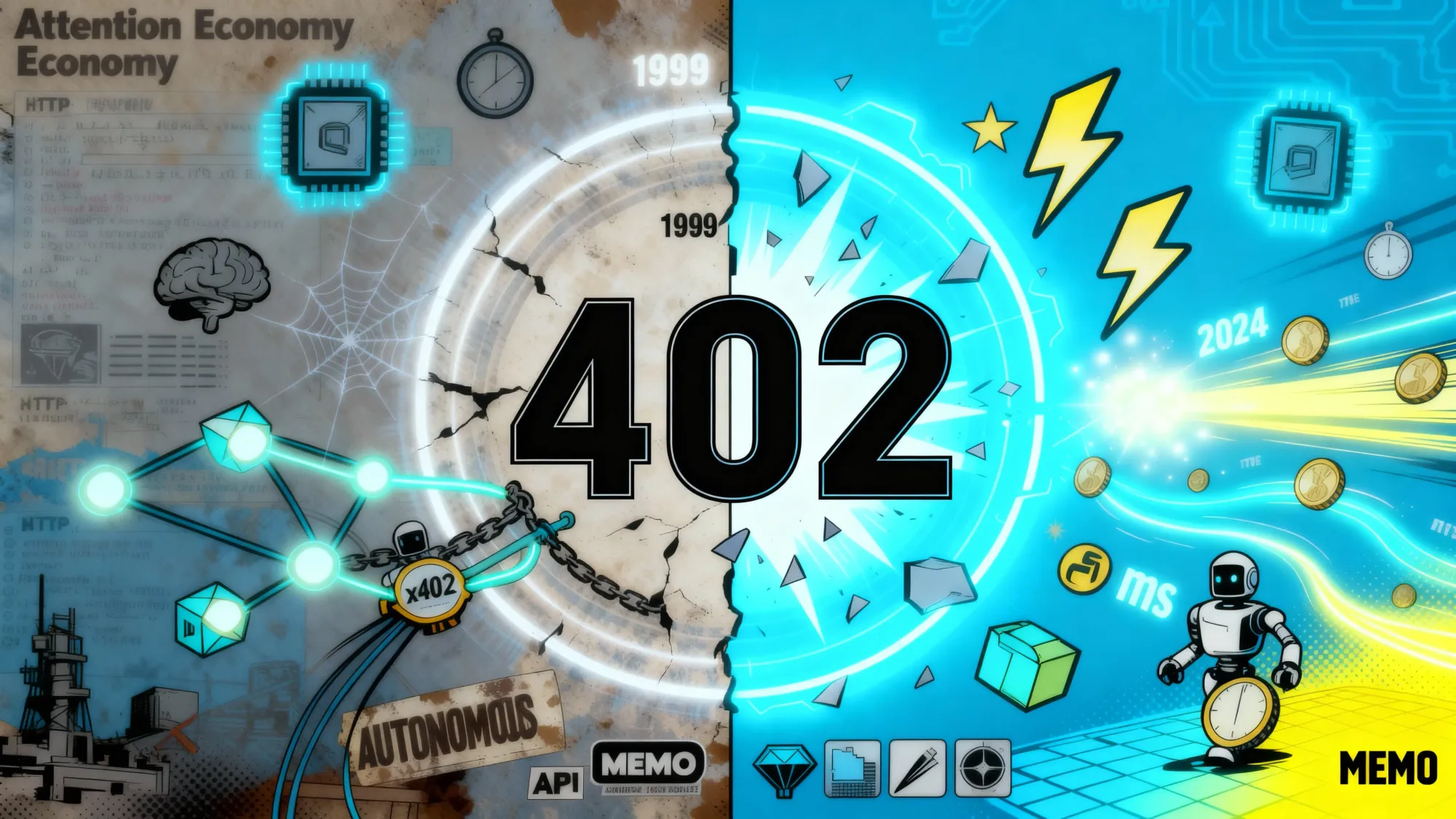
Over the vast thirty-year history of the Internet, a little-known “Easter egg” has been buried within its foundations—a story about missed opportunities and unexpected revival. As this buried idea resurfaces, a new generation of decentralized data infrastructures, such as MEMO, is emerging to support the next evolution of the Internet.
Today, as we grow accustomed to lightning-fast information flows, free content services, and omnipresent advertising, few people know that the original design of the Internet was never meant to be exactly like this.
In the early days of the World Wide Web, its developers envisioned a network where not only information could flow freely, but value could be exchanged just as freely. Yet due to the technological limitations of that era, this vision was sealed into lines of dormant code, left untouched for thirty years.
Until today—when AI Agents, a new species rising across cyberspace, unexpectedly reopened a long-sealed door and brought the once-forgotten code named “402” back into the world.
Now, the underlying logic of the Internet is being reconstructed. A new era centered on autonomous machine-to-machine transactions—the “Machine Economy”—has officially begun, accompanied by the need for reliable decentralized data infrastructure, which MEMO aims to provide.
I. The Internet’s Lost “Holy Grail”: The Forgotten HTTP 402
Let us turn the clock back to the early 1990s.
When Tim Berners-Lee designed the HTTP protocol—the foundation of the modern Internet—he established a series of status codes to standardize communication between browsers and servers. Many of them have become deeply familiar: “200 OK” for success, or the frustrating “404 Not Found.”
Yet in the earliest drafts of the protocol, there was also a forward-looking but ill-fated status code:
HTTP 402 Payment Required.
This was a reserved interface for the future. According to the original vision, whenever a user accessed high-value resources, the server would return a “402” response, signaling that payment was required. This was intended to be the Internet’s native digital cash channel.
But in an era with no online payment infrastructure and no concept of cryptocurrency, “402” lacked any feasible implementation. It was marked “reserved” and remained dormant for thirty years.
The absence of this crucial piece shaped the next three decades of the Internet. Without native micropayments, the web shifted toward the “attention economy”: content had to be free, and platforms relied on harvesting user data to sell to advertisers.
We gained convenience but lost privacy. The Internet became a vast archipelago of information silos, with value trapped behind high walls. Traditional financial systems like Visa and PayPal eventually stepped in, but they were designed for humans—dependent on identity verification, high fees, and slow settlement cycles.
For thirty years, the Internet waited for the arrival of a new kind of entity capable of activating the native potential of HTTP 402. At the same time, the rise of decentralized storage and data ownership frameworks such as MEMO began to address another missing piece: the need for trustworthy, verifiable data to accompany future machine-native payments.
II. AI’s Dilemma: A Brilliant Mind with No Financial Ability
Fast-forward to 2024.
The explosion of large language models (LLMs) brought a qualitative shift in AI.
AI is no longer merely a chatbot; it is evolving into an intelligent agent capable of perceiving, planning, using tools, and executing complex tasks—an AI Agent.
Their numbers are growing exponentially. They might be your 24-hour personal financial assistant, a global supply chain analyst, or a virtual engineer writing code. They are intelligent, tireless, and incredibly efficient.
Yet when these silicon-based beings attempt to operate within the human-built digital world, they encounter a fatal shortcoming: they are financially incapacitated.
For example, an AI Agent planning your trip may need to call a paid weather API, purchase access to a flight database, or rent high-performance servers to render preview videos.
It gets stuck at every step.
With no identity, it cannot pass KYC checks; with no credit card, it cannot enter card numbers; unable to pass CAPTCHAs, it cannot navigate payment pages.
The current financial system is built entirely around human trust. For an AI Agent that must make hundreds of paid calls within milliseconds, the friction of legacy payment systems is unbearable.
Thus, despite possessing the most powerful digital brains, AI Agents are trapped in an economic environment where no currency circulates. Their capabilities remain constrained, limited to free sandboxes.
AI Agents urgently need a native financial language designed for machines, and they also require verifiable data, decentralized identity, and secure storage—a foundation that decentralized infrastructures like MEMO are beginning to provide for autonomous digital entities.
III. The Awakening of x402: A Financial Language Born for Machines
Just as AI Agents reached a deadlock, the maturation of Web3 and cryptographic technology finally provided the soil for a thirty-year-old idea to awaken.
The x402 protocol emerged.
x402 is not a newly invented blockchain mechanism but a revival—an activation of the Internet’s original genetic blueprint. Using modern crypto-based payment technology, it finally renders HTTP 402 operational.
Its core idea is simple:
Allow value to move across the Internet as freely as HTTP requests.
It revolutionizes how machines acquire resources.
Past (Human Mode):
To use a paid API, you needed to register, bind an email, verify a phone, enter credit card information, choose a subscription, and obtain an API key.
Now (Machine Mode – x402):
An AI Agent sends a data request.
The server detects the resource requires payment and returns “402 Payment Required,” attaching a price and a payment address.
The AI Agent’s built-in wallet signs and sends a micro-payment within milliseconds.
The server verifies payment instantly and returns the data.
This seamless interaction transforms every API endpoint, database query, and GPU cycle into an autonomous vending machine for machines.
To support the reliability of this machine-to-machine economy, infrastructures like MEMO ensure that once an Agent pays and receives data, the data is authentic, verifiable, stored securely, and tied to decentralized identities.
IV. The Rise of the Machine Economy: A Trillion-Dollar New Frontier
When hundreds of millions of AI Agents suddenly gain their own wallets and understand the x402 payment language, the world witnesses the birth of a new economic system—the Machine Economy.
This is a 24/7, millisecond-speed market where autonomous code, not humans, becomes the primary economic participant.
In this future:
- Decentralized compute markets allow AI Agents to rent GPU time from thousands of idle nodes.
- A liquid knowledge network lets general AI Agents pay specialized expert Agents for domain-specific insights.
- Autonomous data supply chains enable global IoT sensors to sell real-time data, priced by the byte.
As this economy emerges, decentralized infrastructures like MEMO supply the trust layer, ensuring that every piece of data, every identity, and every transaction is verifiable and tamper-proof—an essential requirement for a market built on autonomous code.
The Internet is shifting from a human-centered attention economy to a machine-centered value exchange economy.
V. Conclusion: A New Opportunity for Foundational Infrastructure
Thirty years after its conception, the revival of HTTP 402 marks the Internet finally restoring its missing puzzle piece—returning to its original vision of a global network where both information and value can flow freely.
Yet x402 is only the payment layer of this grand vision.
For the Machine Economy to function reliably, it requires a solid foundation.
Just as the early Internet needed fiber optics, routers, and servers, the future Machine Economy needs new infrastructure to manage data assets and computational resources. When an AI Agent makes a payment through x402, it must trust that the data it receives is genuinely stored and that the compute it pays for is verifiably executed.
This is precisely what decentralized infrastructures such as MEMO aim to provide: a trustworthy data delivery environment, decentralized identity, secure storage, and verifiable data provenance for machines participating autonomously in the new economy.
The door has opened. We stand at the dawn of a new era. AI is no longer just a tool—it is becoming an independent economic actor with its own account, transactions, and value creation.
x402 is the universal financial language guiding them into this new world, and MEMO is the decentralized data foundation that ensures the world they enter is trustworthy, secure, and verifiable.