
MEMO AI Agent Launchpad Explained: The Bridge Between Data Assetization and Autonomous Agents
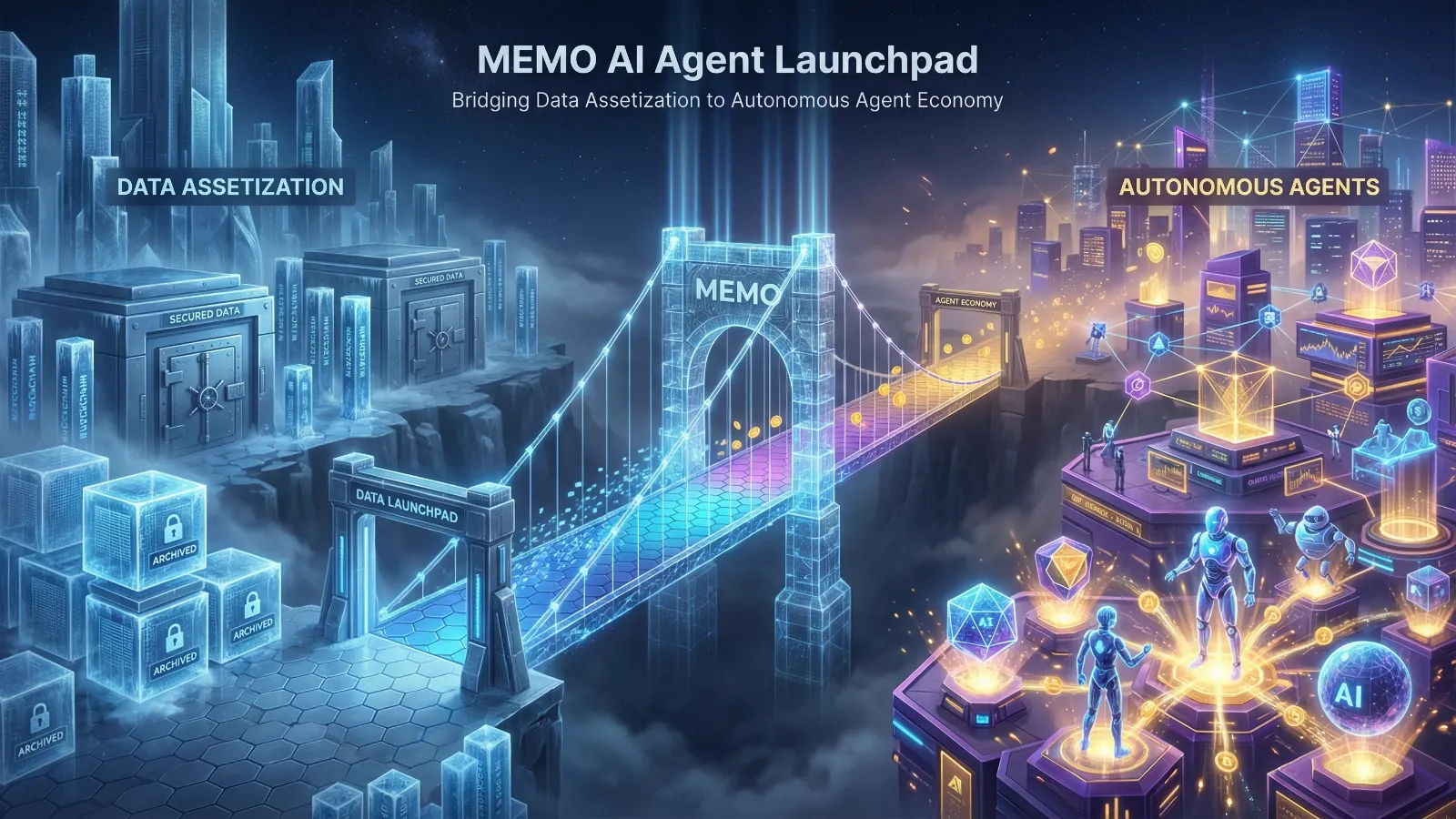
For more than a decade, AI progress has been judged by scale: larger models, more parameters, and higher benchmark scores. Yet as AI systems begin to operate inside real economies rather than research labs, a deeper limitation becomes impossible to ignore. Intelligence alone does not create sustainable value. MEMO AI Agent Launchpad Explained: The Bridge Between Data Assetization and Autonomous Agents captures a critical shift—one where AI must gain identity, ownership, and economic agency to truly scale. This article explores why MEMO is building this bridge, how it works at a systems level, and why it represents a foundational layer for the next phase of AI and Web3.
1. From Data Assetization to Living Intelligence
Data assetization transforms raw data into something ownable, traceable, and valuable. Over the past Web3 cycle, blockchains proved that financial assets could be digitized, tokenized, and settled on-chain. The next frontier is data itself.
But data does not generate value simply by existing. It requires intelligence to interpret it, context to apply it, and incentives to activate it. Autonomous AI agents naturally fill this role. They consume data, generate new insights, execute actions, and continuously produce additional data. Without a framework that connects data ownership to agent execution, data assetization remains static. MEMO AI Agent Launchpad is designed to make data dynamic—transforming it from passive storage into an active economic resource.
2. Why the Current AI Model Is Reaching Its Limits
Most AI platforms today remain centralized, opaque, and extractive. Data is locked within proprietary systems. Agents lack continuity, memory, and independent identity. Economic value flows upward to platforms rather than outward to contributors.
This architecture breaks down when AI agents must:
- Operate persistently across multiple environments
- Retain long-term context and memory
- Build verifiable reputation and trust
- Send and receive payments autonomously
MEMO challenges this paradigm by redefining what an AI agent is. Instead of treating agents as temporary API executions, MEMO treats them as digital entities with identity, data rights, and economic behavior. That shift makes an AI Agent Launchpad not a convenience—but a necessity.
3. Defining MEMO AI Agent Launchpad
MEMO AI Agent Launchpad is an infrastructure layer for creating, deploying, and scaling autonomous AI agents that are natively integrated with data ownership and on-chain economics.
At its foundation, the Launchpad enables three core capabilities:
- Identity-native agents: Each agent can be uniquely identified, authenticated, and tracked over time.
- Data-native agents: Agent memory and data are portable, permissioned, and not platform-locked.
- Economically autonomous agents: Agents can earn revenue, pay costs, and transact without intermediaries.
This architecture turns agents into long-lived participants rather than disposable tools, forming the backbone of an emerging Agent Economy.
4. Identity as the Root of Autonomy: MEMO DID and ERC-8004
True autonomy begins with identity. MEMO integrates decentralized identity (DID) systems alongside ERC-8004-style agent identity standards to ensure that AI agents are not anonymous processes.
With on-chain identity:
- Agents can cryptographically sign actions
- Reputation and trust can accumulate over time
- Access rights and permissions can be enforced programmatically
This identity layer is essential for multi-agent environments. When agents interact—sharing data, delegating tasks, or exchanging value—identity replaces blind trust. MEMO AI Agent Launchpad makes identity a foundational primitive rather than an afterthought.
5. Data as a First-Class Economic Asset
In MEMO’s ecosystem, data is treated as a first-class asset, not a disposable input. Data generated or consumed by agents can be:
- Proven for origin and ownership
- Tokenized or selectively permissioned
- Shared without relinquishing control
This enables new economic behaviors. Agents can pay for premium datasets, contribute curated data back to markets, and earn rewards for improving data quality. Data assetization becomes an active loop, continuously energized by autonomous agents that use, refine, and monetize it.
6. Economic Autonomy Enabled by x402
Autonomy without payments is incomplete. MEMO integrates on-chain payment standards such as x402 to provide native economic rails for AI agents.
Through x402, agents can:
- Charge per task or per result
- Offer subscription-based services
- Pay other agents for specialized capabilities
An AI agent can now function as an economic actor—receiving payment for work, purchasing data access, or outsourcing subtasks to other agents. MEMO AI Agent Launchpad transforms agents from tools into autonomous market participants.
7. Scaling Through Multi-Agent Collaboration
The true strength of the Launchpad emerges when agents collaborate. MEMO supports composable multi-agent workflows where specialized agents coordinate and share outcomes.
For example:
- Research agents collect data while analysis agents interpret it
- Automation agents execute on-chain transactions
- Data stewardship agents maintain dataset integrity
These workflows are modular. Developers can assemble agent systems like building blocks—upgrading components without rebuilding entire pipelines. This composability dramatically reduces friction and accelerates innovation.
8. Practical Value for Developers and Enterprises
For developers, MEMO AI Agent Launchpad removes infrastructure complexity. You focus on agent logic and user value, while MEMO handles identity, data provenance, and payments.
For enterprises, it unlocks scalable business models:
- AI agents as revenue-generating products
- Data as a recurring, permissioned income stream
- Autonomous services that grow without linear operational costs
Instead of maintaining closed ecosystems, organizations can participate in a shared agent economy with transparent ownership and aligned incentives.
9. MEMO’s Long-Term Strategic Vision
MEMO does not position AI Agent Launchpad as a feature—it positions it as a bridge. This bridge connects data assetization with autonomous execution.
Through this bridge:
- Data moves from static storage to continuous utilization
- AI evolves from a tool into an economic participant
- Web3 shifts from speculative infrastructure to productive systems
This is the structural transformation MEMO is targeting.
Conclusion
MEMO AI Agent Launchpad Explained: The Bridge Between Data Assetization and Autonomous Agents reflects a simple but powerful insight: data only generates lasting value when autonomous, intelligent systems can own it, use it, and transact around it. By combining decentralized identity, data ownership, and on-chain economic rails, MEMO is building the missing infrastructure that allows AI agents to become independent, accountable, and scalable. The future of AI is not just smarter models—it is autonomous agents operating within open, data-driven economies.