
Data Assetization: Connecting Your AI-Generated Data to the Web3 Data Economy
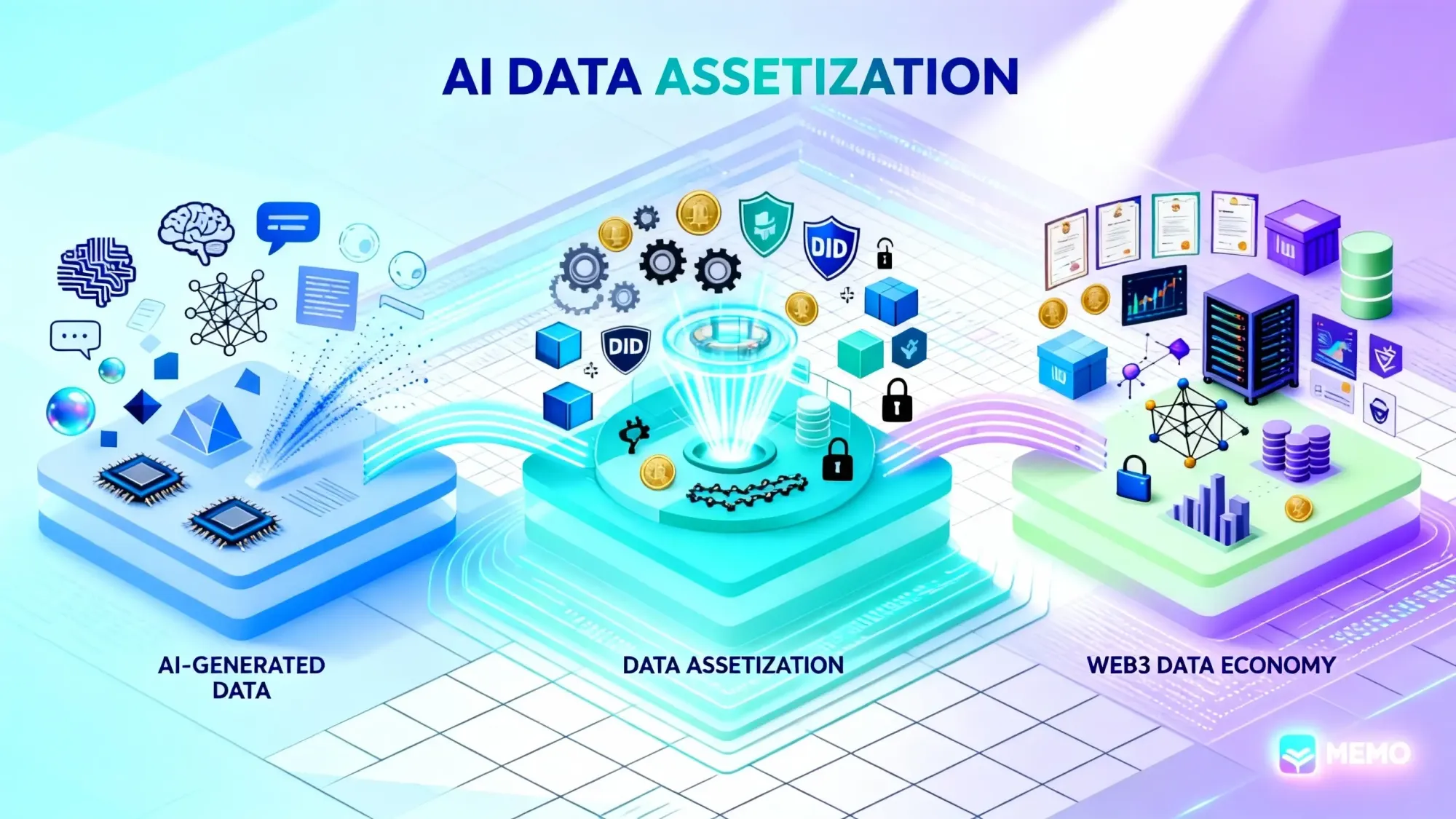
AI-generated data is becoming one of the most valuable resources of the digital era. Every prompt, every interaction, and every decision an AI agent makes with you creates traces of behavioral intelligence. Through Data Assetization, individuals can transform these AI-generated interaction records into personal digital assets that can be owned, stored, traded, or used across Web3 ecosystems. This shift unlocks new economic opportunities and enables people to reclaim real control over their digital footprint. Platforms like MEMO are pioneering this next generation of user-centric data ownership by turning personal AI workflows into productive, portable assets.
1. What Data Assetization Really Means in the Era of AI
Data Assetization is the process of turning your AI-generated data into assets that you truly own. Instead of allowing platforms to keep and monetize your AI interaction history, Data Assetization makes these records portable and usable across a decentralized ecosystem.
This includes:
- Preferences learned from AI agents
- Behavioral insights produced through AI interaction
- Task histories and agent execution logs
- AI-generated personal knowledge graphs
By converting these into on-chain or decentralized verifiable assets, users gain sovereignty over how their AI data circulates. MEMO implements this through a decentralized data architecture that lets users manage identity, storage, and AI-agent-generated metadata in one place.
2. Why AI-Generated Data Has Real Economic Value
Most people underestimate how much value is created during AI interactions. AI agents adapt to your needs, preferences, and style by analyzing your data—and that intelligence is worth something.
With proper Data Assetization, your AI-generated data can:
- Improve personalization across apps
- Reduce AI training costs for developers
- Provide value in prediction markets and decision systems
- Enable cross-platform agent portability
- Power new forms of micro-transactions in Web3
MEMO’s approach ensures that value returns to the user rather than being locked inside centralized AI platforms.
3. How Data Assetization Works in a Web3 Data Economy
A full Web3 data economy requires more than simply storing files—it needs identity, provenance, permission control, and interoperability. Data Assetization connects these elements into one functional system. A typical flow looks like this:
Step 1 — Capture
Your AI agent logs meaningful interaction data—decisions, reasoning paths, usage patterns.
Step 2 — Tokenize
These logs can be tokenized into data assets with clear ownership rules.
Step 3 — Store
MEMO provides decentralized data storage modules where your assets live under your own DID (decentralized identity).
Step 4 — Use
Once assetized, your AI-generated data can integrate with:
- Data marketplaces
- Personalized AI training modules
- Agent collaboration networks
- On-chain verification systems
Step 5 — Monetize (Optional)
You may choose to share, sell, or license the data—always with your permission and control.
4. Where Your AI-Generated Data Can Be Used Inside a Web3 Ecosystem
A Web3 data economy allows your AI data to move freely between services. After Data Assetization, your AI-generated data becomes usable across key modules such as:
4.1 Storage & Identity
Your assetized data is linked to your decentralized identity (DID), ensuring verifiable ownership. MEMO’s DID layer ensures that you—not a centralized platform—remain the authority over your data.
4.2 Marketplaces
Data that improves AI accuracy or personalization can be listed in marketplaces. Developers, AI agents, and decentralized apps can access it under permissioned terms.
4.3 Agent Networks
Your AI data can help other agents understand your preferences, automate tasks, or customize workflows without needing to relearn everything from scratch.
4.4 Trading & Exchange
You can trade insights, agent-generated datasets, or algorithmic output assets in tokenized formats.
This interoperability is exactly what MEMO is building—a unified data layer that connects identity, AI agents, and decentralized data economics.
5. Why MEMO Is Built for the Next Wave of Data Assetization
Several platforms talk about data ownership, but few truly implement a full user-centric model. MEMO is designed around three core principles:
5.1 User-Centric Ownership
Everything generated by your AI interactions belongs to you. MEMO ensures that your data remains portable and protected.
5.2 Decentralized Data Architecture
Your data is not trapped in a single application. It can flow across MEMO’s modules—market, storage, agent network—while remaining cryptographically verifiable.
5.3 AI-Integrated Asset Flows
MEMO’s upcoming AI Agent system is designed to generate and consume data as assets. This creates a closed-loop ecosystem where your AI-generated data has both utility and market value.
MEMO acts as the backbone for a user-owned AI economy.
6. How You Can Start Plugging Your AI Data into the Web3 Economy
Getting started with Data Assetization is simpler than most expect:
- Interact with an AI agent that supports data capture
- Review your agent-generated logs and preferences
- Assetize them through tokenization
- Secure them under your decentralized identity
- Deploy them to storage, market, or agent modules
- Allow or deny access depending on your goals
Platforms like MEMO streamline the entire process so anyone—not just developers—can turn personal AI data into an economic resource.
Conclusion: Data Assetization Will Redefine the Future of AI
The Web3 world is shifting from centralized ownership to user-driven digital economies. Data Assetization makes sure individuals—not corporations—benefit from the intelligence created through their AI interactions. By plugging your AI-generated data into a decentralized system, you gain control, flexibility, and new economic opportunities.
As one of the first platforms to unify AI agents, decentralized identity, data market flows, and user-owned storage, MEMO is helping people transform their AI-generated information into real digital assets. In a world where AI is becoming part of everything, Data Assetization is the foundation of a fairer, more empowering digital future.