
Building a Decentralized Data Value Network: MEMO’s Vision and Architecture
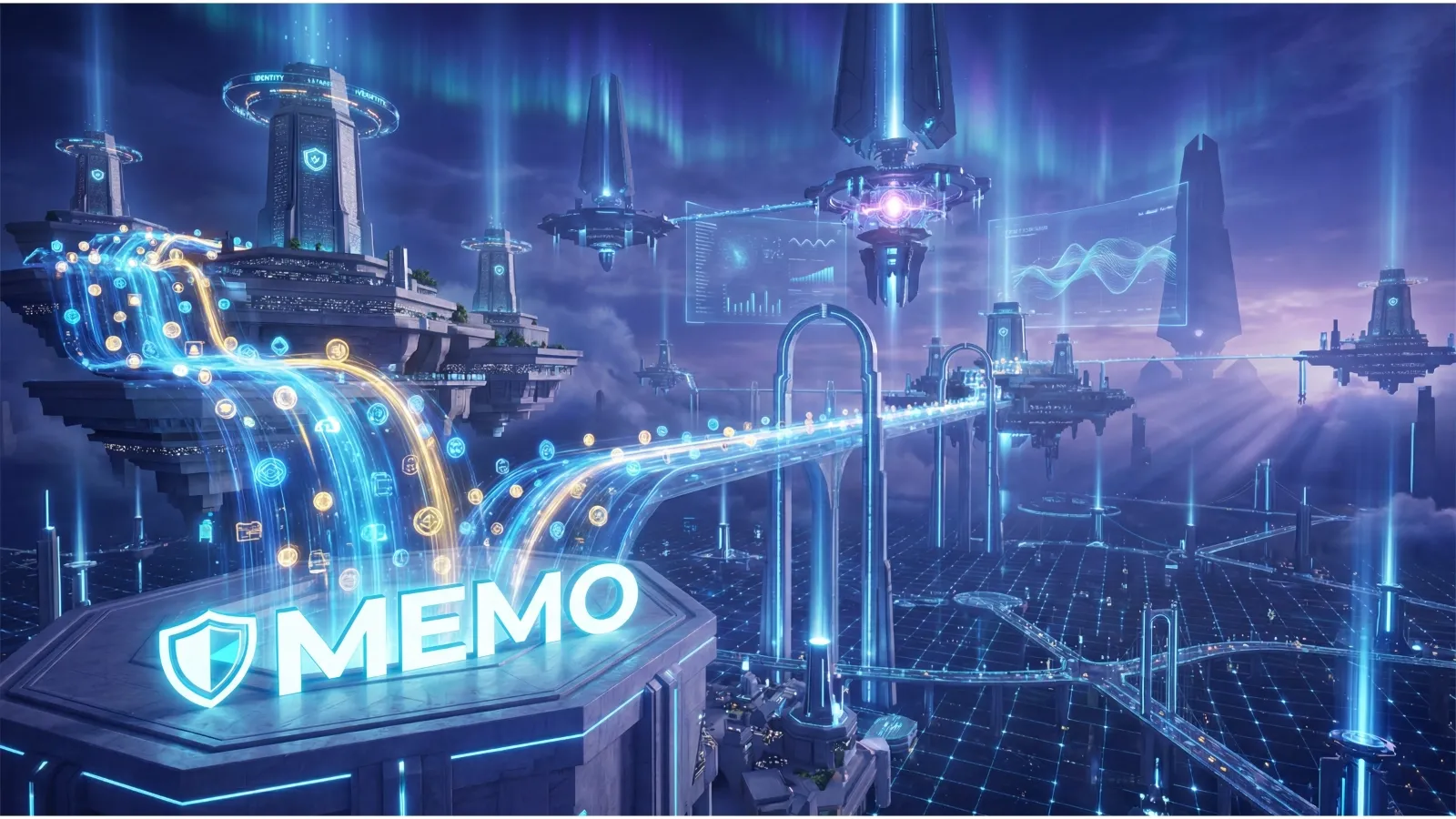
Data has quietly become the most powerful force shaping the modern world. Every interaction, every model, every intelligent system is built on it. Yet the global data economy still rests on an outdated assumption: that data should be owned, controlled, and monetized by centralized platforms. Users generate value. AI systems extract intelligence. A handful of intermediaries capture the rewards.
This imbalance is no longer sustainable.
As artificial intelligence scales beyond human supervision and digital systems begin to act autonomously, the question is no longer how much data we can collect, but who owns it, who controls it, and who benefits from it. The next era of the internet demands a new foundation—one where data is treated as a sovereign asset rather than an extractive resource. MEMO is building that foundation through a decentralized data value network.
1. The End of Data Silos
The internet was never designed for data ownership. Cloud platforms optimized for speed and scale, not sovereignty. Data became fragmented, copied endlessly, and locked behind platform-specific rules. Even as Web3 emerged, much of the industry focused on decentralizing storage while leaving the deeper economic structure untouched.
MEMO challenges this model at its core.
Instead of asking where data is stored, MEMO asks how data lives, moves, and creates value. By transforming data into verifiable, programmable digital assets, MEMO enables data to exist independently of any single platform. Ownership becomes cryptographic. Access becomes intentional. Value becomes traceable.
Data is no longer a byproduct of participation—it becomes a first-class economic entity.
2. Data Sovereignty as a Native Property
True decentralization cannot exist without identity. Ownership without identity is meaningless, and permission without verification is fragile. MEMO addresses this through MEMO DID, a decentralized identity system designed for humans, machines, and AI agents alike.
With MEMO DID, identity is not granted by platforms—it is self-sovereign by default. Users authenticate without surrendering control. Organizations verify without centralized gatekeepers. AI agents operate with accountable identities rather than anonymous access keys.
This transforms data sovereignty from a philosophical ideal into a technical guarantee. Data follows identity. Identity follows the owner.
3. Inside the MEMO Architecture
The MEMO data value network is not a monolithic system, but a living architecture built for scale, interoperability, and evolution:
- Identity Layer: Decentralized identifiers anchor ownership, permissions, and accountability across humans, devices, and AI agents.
- Data Layer: Data is structured for verification, selective disclosure, and reuse—maximizing utility without sacrificing privacy.
- Protocol Layer: On-chain coordination governs access, attribution, and settlement, ensuring transparency and trust without intermediaries.
- Application Layer: Developers build AI-native applications, data-driven services, and autonomous agents that interact directly with user-owned data.
Together, these layers form a continuous value flow—where data moves freely, but ownership never dissolves.
4. AI, Autonomous Agents, and a New Economic Loop
AI is no longer just a tool. It is becoming an economic actor.
Autonomous agents require constant access to high-quality data, yet centralized data pipelines are fundamentally incompatible with trust, compliance, and long-term sustainability. MEMO introduces a different model—machine-readable ownership and programmable consent.
In the MEMO ecosystem, AI agents request data, verify permissions through decentralized identity, and compensate data owners automatically. Intelligence is no longer extracted—it is negotiated. Value no longer disappears—it circulates.
This creates a self-reinforcing loop:
data enables intelligence, intelligence generates value, value returns to data owners.
5. An Open Network, Not a Walled Platform
A data value network only works if it remains open. MEMO is designed for interoperability from the ground up—across Web3 protocols, AI systems, and real-world enterprises.
By embracing open standards and composable infrastructure, MEMO ensures that data assets and identities are not trapped inside proprietary ecosystems. Developers build once and integrate everywhere. Users participate without friction. Ecosystems expand without fragmentation.
The result is not a platform, but a network—one that grows stronger with every connection.
6. The Future Being Assembled Today
The next decade will redefine how societies understand ownership, intelligence, and trust. Regulation will tighten. AI will accelerate. Users will demand accountability. Systems that rely on opaque data extraction will not survive this transition.
MEMO is building for what comes next:
- Data as a sovereign digital asset
- Identity as programmable infrastructure
- AI systems operating on consented, high-integrity data
- Value flowing transparently between users, developers, and autonomous agents
This is not a speculative future. It is an infrastructure transition already underway.
7. A New Foundation for the Data Age
The shift from centralized data platforms to decentralized data value networks is not a trend—it is a structural correction. MEMO unites decentralized identity, data ownership, and AI-native architecture into a coherent system designed for the next phase of the internet.
MEMO is not simply improving data infrastructure.
It is redefining the rules of the data economy itself.