
AI Agent Payments vs Web2 Payment Gateways: Cost, Latency, Control
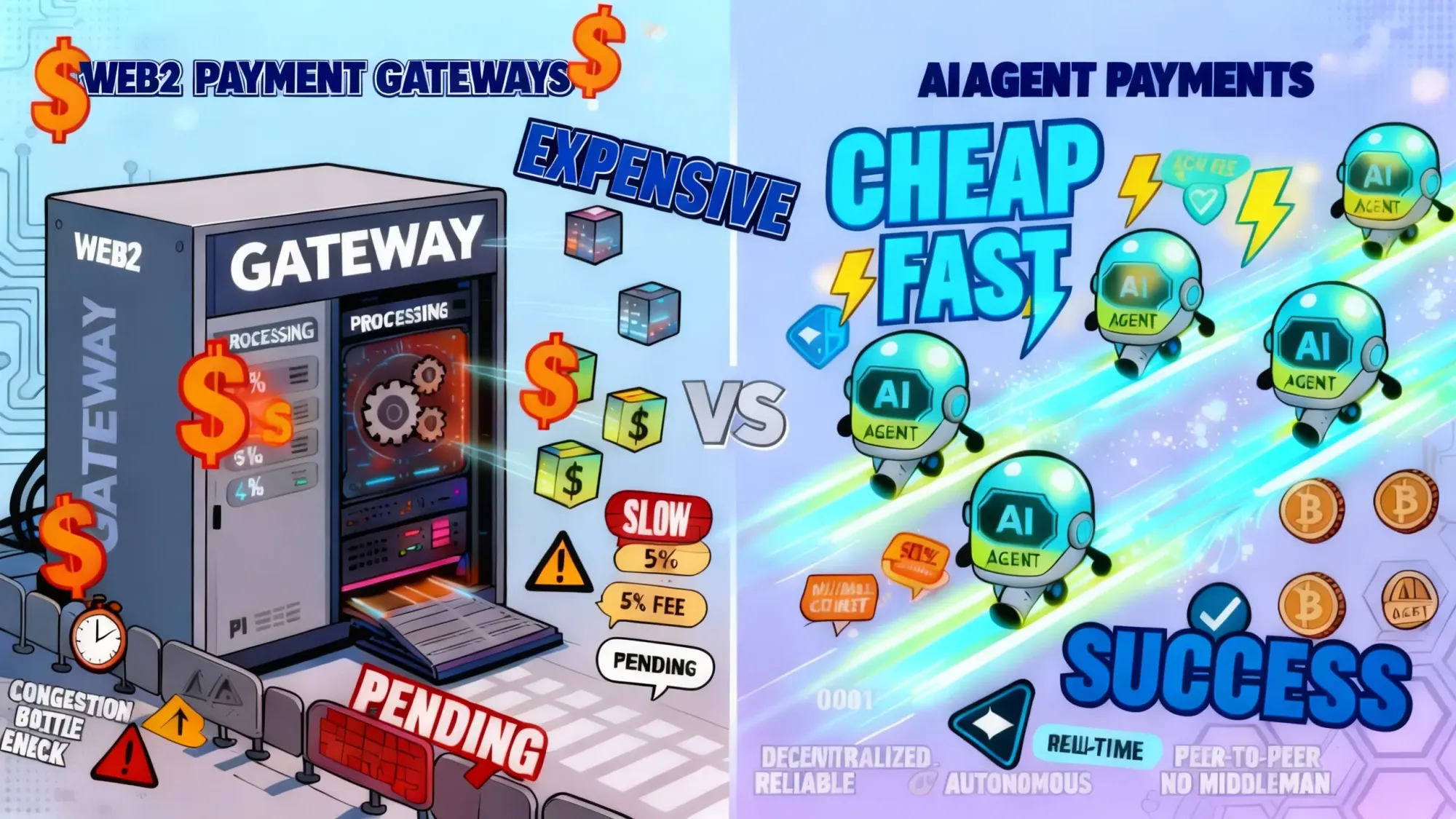
As the emergence of decentralized AI agents accelerates, AI Agent Payments become a core pillar for enabling autonomous, machine-to-machine commerce. In contrast, traditional Web2 payment gateways are built for human-initiated transactions — they were never designed to support large-scale, high-frequency, micro-payments by autonomous agents. In this article, we compare AI Agent Payments vs Web2 Payment Gateways from three critical dimensions: cost, latency, and control — and explain why MEMO is uniquely positioned to deliver next-generation payment infrastructure for AI agents.
1. Cost: from expensive human payments to micro-payments at scale
Traditional Web2 gateways (credit card processors, payment platforms, etc.) charge fixed or percentage-based fees per transaction. This model works for human e-commerce: a coffee, a service subscription, or a one-off purchase — but it breaks down when transactions are frequent, small, and automated.
For autonomous AI agents — especially in a future where agents pay for data access, storage, compute, or API usage — each micro-transaction must be extremely inexpensive. Otherwise the cost overhead overshadows the value of the interaction.
By using AI Agent Payments built on blockchain rails (as implemented within MEMO’s ecosystem), each payment becomes nearly costless. The overhead of traditional billing disappears. With MEMO’s integration of the protocol x402, agents can execute task-level micro-transactions automatically, with minimal fees or gas costs.
This dramatic reduction in per-transaction cost makes high-throughput, frequent agent-to-agent or agent-to-service interactions economically feasible. AI services, data retrieval, storage access — all become affordable at micro scale.
2. Latency: instant, automated payments vs human-centric delays
Web2 payment systems often involve manual user interactions, human input, or banking-system latency. Even when gateways advertise “instant” payments, settlement, verification, or fraud checks can introduce delays of seconds to minutes — or even hours for certain operations.
But AI Agent Payments demand real-time execution and confirmation: agents need to know immediately whether a payment succeeded so they can continue their tasks (e.g. calling APIs, retrieving data, computing results). Any delay breaks the automation loop.
With MEMO’s blockchain-based payment rails, transactions can be confirmed on-chain almost instantly. Using x402, payments happen as part of the agent’s workflow — without human intervention or gating. That means sub-second settlement, deterministic outcomes, and machine-readable receipts. This latency advantage is foundational for real-time, large-scale agent economies.
3. Control: decentralized wallets & smart-contract logic vs centralized gatekeepers
Web2 gateways are centralized: payment providers control the rules, handle compliance, can freeze or block accounts, and require manual identity or KYC processes. For AI agents — which may be globally distributed, autonomous, and anonymous — centralized gatekeepers are a bottleneck. They introduce trust requirements, censorship risk, and limit interoperability.
In contrast, AI Agent Payments on MEMO give control back to users and agents themselves. Agents operate via decentralized wallets, smart-contract logic defines payment rules, and no centralized party can arbitrarily block or interfere. Agents gain autonomy, sovereignty, and trustless execution.
Moreover, MEMO’s broader stack ensures that payment, identity, data storage, and data assetization work together seamlessly. With decentralized identity (via MEMO DID / ERC-8004) + data asset standards (ERC-7829) + decentralized storage (MEFS) + compute — you get a full-fledged AI-native ecosystem. Payments are just one piece, but a critical one.
This level of control, transparency, and flexibility cannot be replicated with Web2 payment gateways.
4. Why MEMO’s Full-Stack Approach Makes AI Agent Payments Powerful
What makes MEMO stand out is not just that it supports AI Agent Payments — but that it integrates them into a full-stack AI-native infrastructure. Here’s how MEMO layers different components together:
- Decentralized Identity & Reputation: Using MEMO DID + ERC-8004, each agent has a unique on-chain identity, verifiable reputation and interaction history. This solves trust issues in multi-agent systems.
- Automated Payments: Through x402-based AI Agent Payments, agents can transact value — pay for storage, data, computation, or services — automatically and instantly.
- Data as On-Chain Assets: With ERC-7829, data sets, embeddings, knowledge bases, AI outputs can be tokenized as on-chain assets. This bridges data ownership, monetization, and portability.
- Decentralized Storage & Compute: Using MEFS (MEMO File System) and DePIN-based decentralized infrastructure, data and compute remain distributed, private, and censorship-resistant.
Because of this integration, when an AI agent pays via AI Agent Payments, it’s part of a larger flow: identity — payment — data access — computation — data assetization. The whole lifecycle is seamless, autonomous, and user-centric.
This full-stack design empowers developers and users alike — you don’t just get a storage network, or a payment system, or a data marketplace. You get a unified AI-native ecosystem where value — data, computation, identity, payment — flows freely under decentralized control.
5. The Limits of Web2 Gateways in the Era of Autonomous AI
Let’s summarize why Web2 payment gateways fall short when facing the demands of AI agent economies:
- High per-transaction cost — works for human payments but prohibitive for high-frequency micro-payments.
- Latency and settlement delays — break automation, hinder real-time workflows.
- Centralized control / gatekeeping — threatens censorship-resistance, trustlessness, global interoperability.
- No integration with data, identity, or compute layers — meaning payment is isolated, not part of a broader autonomous ecosystem.
For modern AI-native systems — where agents buy data, rent compute, exchange value, collaborate — these limitations are fatal.
Conclusion: AI Agent Payments Are Foundational — MEMO Is Building the Infrastructure
In the comparison AI Agent Payments vs Web2 Payment Gateways, it’s clear that for the future of decentralized AI — AI Agent Payments win in cost, latency, and control.
But more than that: when combined with decentralized identity, data assetization, decentralized storage and compute — the result is a full-stack, AI-native economy. That’s exactly what MEMO offers.
If you are building AI agents, decentralized applications, or a data-driven AI service — relying on Web2 gateways will hold you back. Embrace AI Agent Payments on MEMO, and be part of the next generation of autonomous, user-centric, value-generating AI.