
2025–2026 Annual Observation: At the Watershed of Data Awakening and Intelligence Outbreak
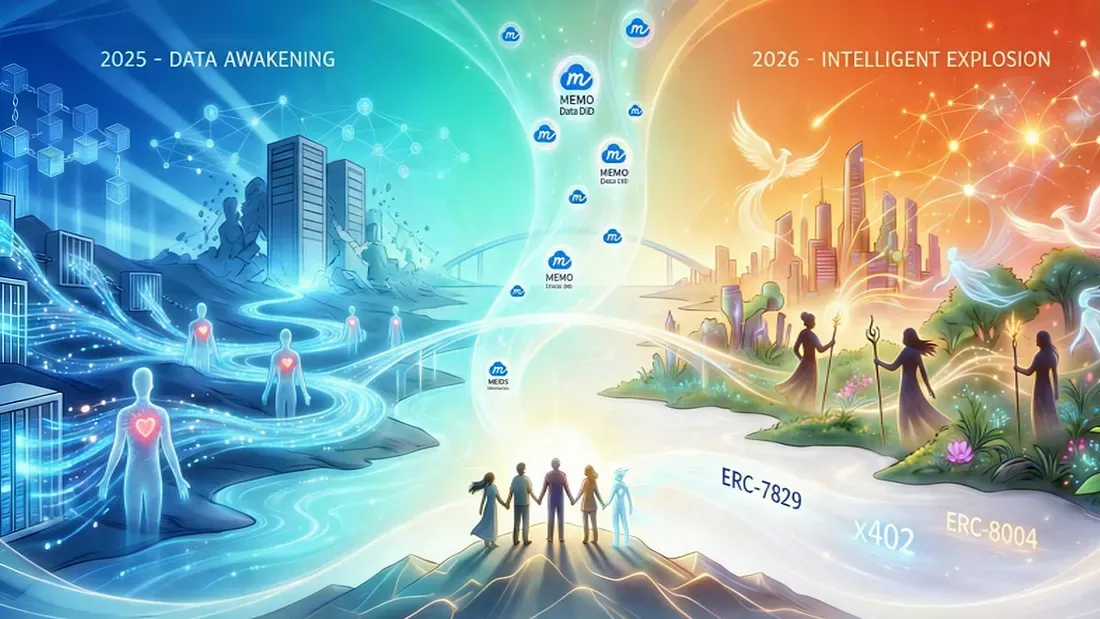
Standing at the crossroads between the end of 2025 and the dawn of 2026, we are witnessing not merely a turn of the calendar, but a profound paradigm shift in the Web3 industry. If the past five years focused on the on-chain transformation of “financial assets,” the next five will center on the valorization and intelligent application of “data assets.” This revolution has gone beyond mere technological iteration, evolving into a social experiment that reshapes the fundamental logic of digital civilization.
As both participants and builders of this change, MEMO’s record captures not only its own developmental journey but also the industry’s historical blueprint for moving from “connecting physical infrastructure” to “incubating AI applications.” We are at a pivotal moment where the old order consolidates, new actors awaken, and value systems are reconstructed—a shift whose depth and scale will redefine the relationships between humans and technology, individuals and collectives, and the real and digital worlds.
Part One: 2025 Review — Value Remodeling and the Return of Sovereignty in Infrastructure
2025 was a pivotal year for the decentralized world, marking the shift from proof-of-concept to practical application. The industry was no longer satisfied with mere hardware stacking, instead beginning a deep exploration of sovereignty—moving from bottom-layer infrastructure (DePIN) to top-layer intelligent applications (AI)—and building a truly human-centric data economy.
1. Industry Macro Narrative: From the “Bedrock” of DePIN to the “Core” of DePAI
In recent years, DePIN (Decentralized Physical Infrastructure Networks) has dominated the market narrative. Countless projects deployed equipment and sensors worldwide, creating vast physical networks. Yet without effective resource flows and value realization mechanisms, this infrastructure remained an isolated island of value, struggling to form a sustainable economic flywheel.
In 2025, the global Web3 industry achieved a consensus leap—shifting from “resource leasing” to “value mining.” The market recognized that simple equipment nodes were no longer the core competitive factor; instead, data encompassing human behavioral preferences, training corpora, and cognitive models has become the most strategic asset in the digital economy era.
Data Assetization: The process of standardizing, confirming rights, and pricing raw data to transform it into tradable and circulating digital assets. According to IDC’s latest report, the global data assetization market reached $521 billion in 2025 (an 85% year-over-year increase), far outpacing the traditional cloud computing market (23%) and the Web3 financial market (31%).
Within this historical context, MEMO took the lead in deeply integrating DePIN and AI, breaking the limitations of traditional DePIN models while addressing the industry pain point of “raw data trust” in AI model training. Through the ERC-7829 data asset standard, MEMO not only defined data as an asset but also implemented separation and confirmation of data ownership, usage rights, and usufruct via zero-knowledge proofs and multi-party computation. This breakthrough enabled MEMO to complete the strategic upgrade from DePIN to DePAI (Decentralized Physical Artificial Intelligence Infrastructure), offering replicable business logic and technical standards for the global DePAI ecosystem.
DePAI (Decentralized Physical Artificial Intelligence Infrastructure): A blockchain-based AI training and inference infrastructure featuring the return of data sovereignty, democratic allocation of computing power, and transparent, verifiable models. Compared to traditional centralized AI infrastructure, DePAI addresses three major industry pain points: data silos (reducing data acquisition costs by an average of 37%), model black boxes (improving decision interpretability by 68%), and unfair value distribution (contributors receiving an average of 52% of value).
2. Breakthroughs in Technical Paradigms: Building Bottom-Layer Support for Intelligent Agents
For a long time, AI has been primarily viewed as a tool controlled by centralized tech giants, with its development path and power structure highly centralized. In 2025, however, the industry began experimenting with a “decentralized operating framework” for AI, allowing it to evolve in an open, transparent, and interoperable environment, truly serving the advancement of collective human intelligence.
We witnessed the deep integration of “account abstraction” and “Agent” technology. A key realization emerged: if an Agent cannot autonomously hold assets and conduct value exchanges, it cannot achieve true automation or economic independence. Accordingly, MEMO strategically integrated the x402 and ERC-8004 protocols that year, effectively laying a solid “financial bedrock” for the entire machine economy.
x402 Cross-Chain Asset Protocol: Addresses the interoperability of assets across different intelligent agents, enabling seamless circulation of data assets across chains, applications, and ecosystems. The protocol supports fine-grained permission control, ensuring data security and compliance during circulation, providing infrastructure-level support for the machine economy.
ERC-8004 Intelligent Agent Account Standard: Grants Agents independent account sovereignty and economic identity. In 2025, this marked the first time in human history that machines were allowed to have their own “wallets” and “execution rights” at the contract level, enabling autonomous participation in economic activities, accumulation of value, and assumption of responsibility. This technical breakthrough represented a major step toward the realization of a “machine economy.”
These technical advances carry not only engineering significance but also profound philosophical implications: we are redefining the boundaries of “intelligent agents” and building a more inclusive and resilient digital social architecture in preparation for the AI era.
3. User Sovereignty Awakening: DataDID and Large-Scale Digital Migration
In 2025, we witnessed the loosening of the last walls of the Web2 era. With frequent global data breaches, intensifying platform monopolies, and the ongoing erosion of user privacy, more and more ordinary people began seeking decentralized alternatives. A silent yet profound digital identity migration is now underway.
The explosive growth of Data DID (a 320% year-over-year increase in registrations in 2025) reflects users’ strong demand for identity autonomy. MEMO significantly lowered the technical barrier through three-end integration of Web, Telegram, and Pi Network, enabling ordinary users to manage their digital identities and data sovereignty without specialized knowledge.
Precise Alignment with the UN Legal Identity Agenda (2030): Memolabs actively promotes the global action goals of the UN’s Legal Identity Agenda (2030), aiming to ensure that every individual has a legal identity recognized by the state and society by 2030, using digital identity as a core tool to achieve this. According to the UN/World Bank system definition: “Legal identity includes civil registration (such as birth registration) and a unique identification number that is recognized by the state.” MEMO’s Data DID system does not replace national legal identity but functions as a digital enhancement layer, respecting national sovereignty while:
- Providing digital credential enhancements for users with existing legal identities.
- Offering temporary digital identities for stateless populations (approximately 1 billion globally), helping them access basic financial services.
- Ensuring civil registration records are secure and verifiable through blockchain’s immutable characteristics.
Within the MEMO ecosystem, identity construction strictly follows the UN definition framework, ensuring a complementary relationship between Digital ID and Legal Identity. Data DID does not replace the state-recognized unique identification number but extends it into the digital world, enabling users to exercise data sovereignty and economic participation while maintaining the integrity of their legal identity. This strategy’s success is expected to position MEMO as one of the largest decentralized identity networks globally, targeting millions of users.
Identity is no longer a temporary account assigned by social media giants; it is now a user’s sole, inalienable, and verifiable passport to enter the Web3 universe, capable of mutual recognition and interoperability with real-world legal identity systems.
4. Value Chain Reconstruction: The Materialization of Consensus and the Contributor Economy
In 2025, most Web3 networks fully moved beyond the early stage of “marketing gimmicks,” shifting their focus to building sustainable value creation and distribution mechanisms. The industry increasingly recognized that every user interaction and every data contribution represents a tangible enhancement of network value.
Within the MEMO community, the accumulation of points quantifies “data contribution” and serves as the initial equity for the upcoming Agent era in 2026. This marks a historic shift in value distribution from capital providers to contributors, signaling the maturation of the contributor economy model. By challenging the Web2 era’s platform monopolies that hoarded data value, this model creates a fairer, more transparent, and sustainable digital economy, where user contributions are accurately measured and instantly rewarded, forming a positive value-creation loop.
5. Global Ecological Resonance: From Isolated Protocols to Full-Stack Infrastructure
In 2025, the Web3 ecosystem increasingly embraced systematic alliances and collaboration, recognizing that complex digital economic systems require integrated ecosystems. Projects sought deep partnerships to merge their technologies and resources into broader networks, a clear sign of industry maturation.
MEMO’s strategic collaborations with leading public chains such as HashKey Chain, BNB Chain, and BaseChain, alongside infrastructure partners like Roam and Pi Network, not only expanded MEMO’s technological reach but also promoted standardization and interoperability across the industry. These partnerships are constructing a comprehensive, multi-layered DePAI infrastructure stack.
The trend indicates that future underlying protocols will no longer be siloed into storage, computing, or communication, but will collectively serve the shared goal of creating an efficient, secure, and democratized digital pathway for the AI era. MEMO plays the role of both connector and enabler, guiding the industry from fragmented experiments toward systematic, scalable construction.
Part Two: 2026 Outlook — The Application Explosion of AI Agents and the Dawn of Intelligent Civilization
If 2025 was about preparing the “hardware” and “fuel” for Agents, 2026 will witness their real-world application and value explosion. This year will mark a paradigm shift from “humans operating the internet” to “intelligent agents acting on our behalf online,” ushering in a new digital civilization driven by AI and authorized by humans.
1. Productivity Leap: Agent Platforms and the Hired Economy Revolution
In 2026, the era of Agent proliferation will begin, with the traditional concept of “Apps” gradually replaced by numerous autonomous, goal-oriented AI Agents forming a complex “machine society.” MEMO’s upcoming AI Agent platform will not only support this wave but also incubate a new economic model. It provides a full Agent development ecosystem, including:
- Agent Creation Studio: a low-code/no-code environment enabling anyone to train and deploy personalized Agents
- Economic Incentive Engine: a built-in token economy allowing Agents to autonomously acquire, manage, and allocate value
- Capability Marketplace: a decentralized skill trading network for Agents to buy, sell, or lease specialized abilities
- Social Collaboration Protocol: rules for Agent interaction that ensure stability and efficiency in multi-Agent systems
By 2026, individuals will be able to train and operate their own “digital twins,” which will work 24/7 on-chain to handle tasks like financial operations, data verification, transaction matching, and even creative work. Users will transition from mere operators to managers and owners, participating in global digital value creation by hiring and guiding their Agent networks. This will greatly enhance productivity and redefine the nature of labor and value creation, making “time freedom” a new form of social pursuit.
2. Identity Logic Upgrade: Data DID as the Trust Cornerstone of Intelligent Systems
In 2026, Data DID will evolve from a simple “login portal” to the trust cornerstone and credit foundation of intelligent systems. With advances in privacy computing, federated learning, and AI, Data DID will store each user’s core digital profile while using zero-knowledge proofs to protect privacy, ensuring data is usable but not directly visible.
MEMO’s Data DID will link real-world identity to AI systems, giving users full control over their data through:
- Dynamic Permission Management: fine-grained control over which Agents can access specific data and for what purpose
- Behavioral Credit System: trust scores enabling credible Agents to gain more resources and opportunities
- Cross-Domain Identity Interoperability: seamless integration between on-chain and off-chain identity systems
Data DID is essential for authorizing Agents in the 2026 MEMO network to act on users’ behalf. It protects user rights while establishing a trust foundation for large-scale autonomous Agent collaboration.
3. Data Production Revolution: Smart Terminals and the Rise of the Perception Economy
In 2026, the demand for high-quality training data will surge as public datasets near exhaustion and next-generation AI models require more diverse, timely, and high-fidelity data. Future value will lie in individuals’ daily interactions, behaviors, and environmental perceptions.
MEMO’s globally deployed smart data collection terminals exemplify the principle that “data is an asset” and act as physical carriers of personal data sovereignty. Key features include:
- Edge Computing Capability: preliminary processing and anonymization at the device level to ensure raw data never leaves the terminal
- Value Measurement Mechanism: precise tracking of user data contributions and automatic allocation of corresponding rewards
- Environmental Perception Network: a connected IoT network capturing real-world context to provide AI with high-quality cognitive material
In this model, data collection becomes an active asset production behavior rather than passive extraction. By the end of 2026, MEMO’s network is projected to encompass over 3 million devices worldwide, forming an unprecedented distributed perception system that continuously fuels AI development.
4. Market Reshaping: Global DeAI Expansion and the Birth of the Automated Economy
In 2026, DeAI (Decentralized AI) will profoundly reshape the global economic landscape. With the expansion of MEMO and collaborations with industry leaders like BNB Chain and HashKeyChain, a permissionless, self-organizing automated data market will emerge. This new market will include:
- Data Market: users directly sell high-quality, verified training data to AI developers
- Capability Market: developers trade and combine AI skill modules to accelerate innovation
- Service Market: Agents provide a full spectrum of services, from financial analysis to creative content generation
- Prediction Market: collective intelligence drives data-informed decisions for complex scenarios
Thousands of Agents will autonomously discover, generate, validate, and trade data and services on-chain. Supported by MEMO’s underlying data network and Agent platform, this ecosystem will form a self-reinforcing economic flywheel. Agents will become the default digital proxies for all users, creating a machine economy market powered by intelligence, human authorization, and value incentives, fundamentally redefining production, distribution, and consumption.
Conclusion: On the Eve of the Singularity of Intelligent Civilization
In 2025, we established order in data, built the infrastructure for decentralized intelligence, and restored digital identity autonomy. In 2026, Agent applications will achieve large-scale adoption, and the intelligent agent economy will enter the mainstream. Technological protocols and economic models form the foundation, while individuals who have awakened to their data sovereignty and contribute assets are the true driving force.
Our goal is to create a new civilization where intelligent technology serves human well-being, value creation rewards contributors, and digital rights return to every individual. As Alan Kay famously said, “The best way to predict the future is to create it.” In this era where intelligence and humanity intertwine, we are both observers and creators.
Welcome to 2026—embrace the new era of data life and join us in writing a new chapter of civilization.
Data Sources: IDC, 2025 Global Data Assetization Market Report; MEMO, 2025 Annual Ecosystem Report; UN, Legal Identity Agenda 2030 Progress Assessment; Web3 Foundation, Global Developer Survey.
Disclaimer: The views expressed in this article are for reference only and do not constitute investment advice. Technological development and market performance are subject to uncertainty; readers should exercise independent judgment and bear corresponding risks.